
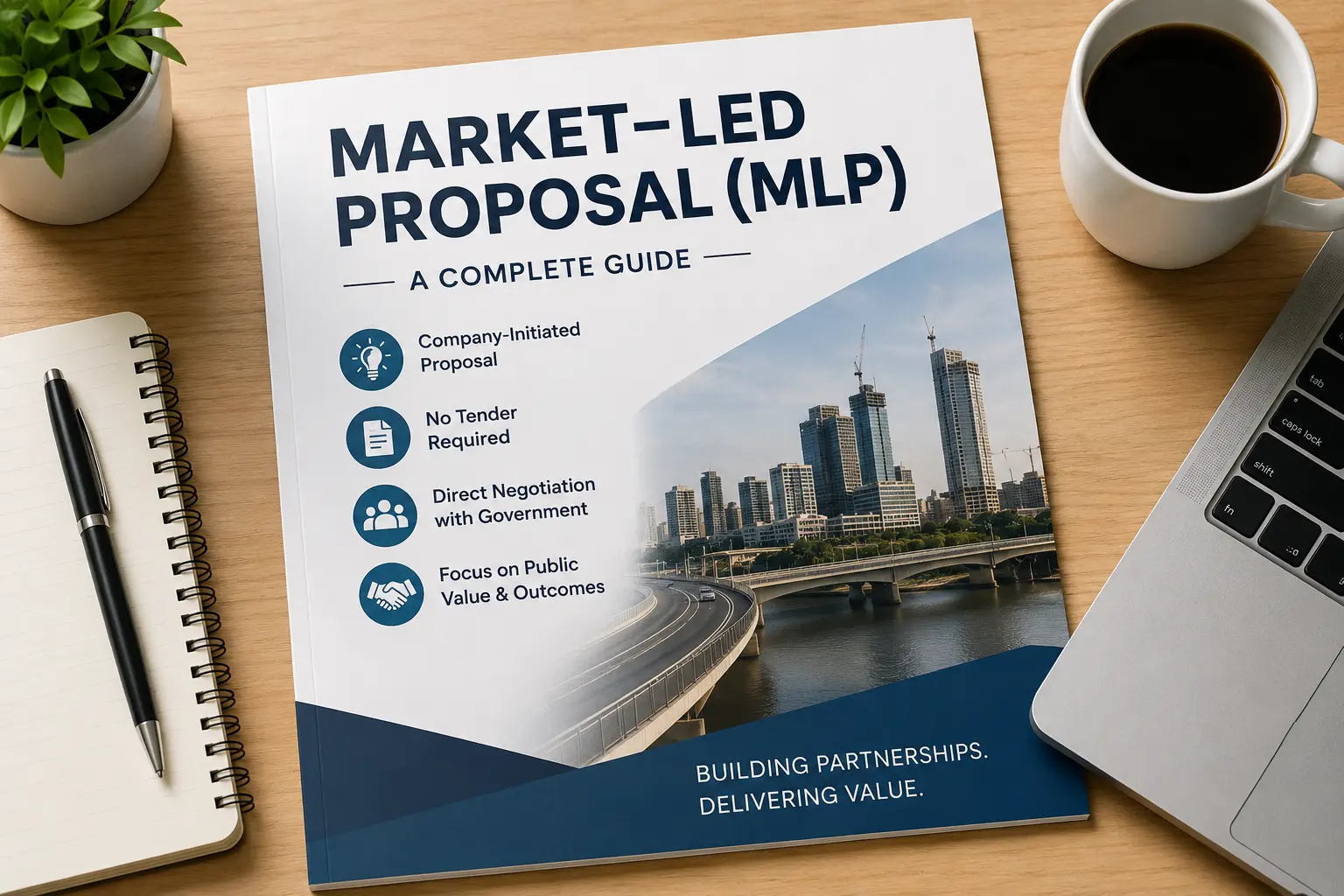
A market led proposals (MLP) are a project or service idea that a private company brings directly to a government, without being asked. No tender was issued. No request for proposal went out. A company spotted a gap, an advantage, or a piece of land it controls, and decided to put a specific deal on the table.
That one detail — the private sector starts the process, not the government — explains almost everything else about how MLPs work: why governments bother accepting them, why most submissions go nowhere, and why the rare successful one can turn into a billion-dollar infrastructure project.
This guide walks through what an MLP actually is, how the assessment process works, where it differs from a tender or a PPP, and what tends to separate a proposal that gets a real hearing from one that gets a form-letter rejection.
A note on scope before you read further
MLP policy is set and revised by individual governments. The criteria, templates, and timelines referenced here reflect published guidance from New Zealand’s Treasury, Victoria’s Department of Treasury and Finance, Western Australia’s government, and the UK’s Department for Transport at the time of writing — but these documents get updated (New Zealand revised its guidelines in 2024). Treat this as a framework for understanding how MLPs work, and confirm current requirements directly with the relevant government body before investing time in a submission.
What an MLP Is — and What It Isn’t
An MLP is a formal approach from a company (the “proponent”) asking a government to negotiate directly, instead of opening the idea up to competitive bidding. The proposal might involve:
- New infrastructure the company would build and often finance
- A service delivery model not currently offered
- Access to or use of an existing government-owned asset
- A major commercial transaction involving public land or systems
What separates this from simply pitching an idea is that most governments now run MLPs through a defined policy: a formal pathway with submission templates, assessment criteria, and approval stages. New Zealand’s Treasury, Victoria’s Department of Treasury and Finance, and Western Australia’s government each publish their own guidelines for this. The UK’s Department for Transport runs a five-stage version of the same idea for transport projects.
A quick disambiguation, since the term gets confused: “market-led proposal” also shows up in marketing, where it describes a strategy built around customer research rather than internal assumptions. That’s an unrelated concept with no connection to government procurement. If that’s what brought you here, this article won’t be useful — you want content on customer-driven product strategy instead. Everything below refers to the public-sector meaning.
How the MLP Process Actually Works
Every jurisdiction structures this a little differently, but the shape holds across Australia, New Zealand, and the UK: four broad stages.
1. Pre-submission engagement
Most governments now require, or strongly encourage, an initial meeting before anything gets submitted formally. This is where a proponent tests whether the idea is worth developing further, and where governments quietly filter out proposals that clearly won’t meet policy criteria. Western Australia and New Zealand both treat this as a distinct early step rather than leaving it informal.
2. Formal submission
The proponent completes a structured document — often a “concept proposal” template — laying out the problem, the proposed solution, why this specific proponent should get exclusive negotiation rights, and the expected public benefit. It isn’t a pitch deck. It reads closer to a business case, built to survive scrutiny from people whose job is to find reasons to say no.
3. Assessment
Evaluators score the proposal against a short list of criteria that appears in almost every jurisdiction’s policy: does it serve a real public interest, is there a defensible reason this proponent gets direct negotiation instead of a competitive process, and does it offer better value for money than a tender likely would. New Zealand’s guidelines target three to six months for this initial assessment, though complex projects run longer.
4. Negotiation and approval
Proposals that clear assessment move into detailed negotiation on terms, risk allocation, and financing. Cabinet-level sign-off is required in most jurisdictions before anything finalizes. For large infrastructure, this stage alone can stretch to three years, which is one reason MLPs suit patient, well-capitalized proponents far more than smaller businesses hoping for a quick win.
MLP vs Competitive Tender vs PPP
These three terms get used loosely, but they’re structurally different.
| Market-Led Proposal | Competitive Tender | Public-Private Partnership (PPP) | |
|---|---|---|---|
| Who initiates it | Private company | Government | Either, but formalized by government |
| Competition involved | None — exclusive negotiation | Multiple bidders compete | Usually a competitive partner selection |
| Best suited for | Ideas needing unique assets, IP, or land access | Clearly defined, replicable needs | Long-term infrastructure with shared risk and financing |
| Transparency level | Lower, and scrutinized more heavily as a result | High — open bidding process | Moderate to high |
| Typical use case | Novel concepts government hadn’t planned for | Standard goods, services, construction | Large infrastructure (roads, hospitals, rail) |
The practical takeaway: if your idea could reasonably be delivered by more than one company, it’s a weak MLP candidate. Governments will — and should — push it toward a competitive tender instead. MLPs exist for situations where exclusivity is genuinely defensible, not as a shortcut around competition.
Who Should Use This Pathway — and Who Shouldn’t
Before spending weeks on a submission, it’s worth being honest about whether an MLP is even the right route.
MLPs tend to fit:
- Companies that control something a competitor can’t easily replicate — specific land, an existing concession, proprietary technology, or a financing structure not generally available
- Organizations that can fund preparation costs (technical studies, legal review, financial modeling) without a guaranteed return
- Proponents solving a problem the government hasn’t formally scoped yet
- Teams prepared for a process that can run from several months to multiple years, especially for large infrastructure
MLPs tend to be a poor fit for:
- Businesses whose core pitch is “we can do this cheaper or better” without a structural advantage behind it — that’s an argument for winning a tender, not for skipping one
- Smaller companies without the reserves to absorb a rejected submission’s sunk costs
- Ideas that are really a request for a standard contract or grant, which belong in existing procurement or funding programs
- Anyone who needs a fast decision; a competitive process, running on a published timeline, is often quicker in practice
A Realistic Scenario
Here’s a simplified, illustrative example of the reasoning at work — not a real case, but representative of the kind of decision proponents face.
A mid-sized engineering firm owns the only viable rail corridor easement connecting two industrial zones. The regional government hasn’t proposed a freight link there, but the firm believes one would relieve road congestion, and has modeled a financing structure using its own balance sheet plus private debt.
That’s a reasonable MLP candidate. The land access is genuinely exclusive, the government hasn’t already scoped the project, and there’s a defensible reason a competitive tender wouldn’t work: no other company owns that easement. The firm’s actual job is proving the value-for-money case holds up to independent scrutiny — not proving the idea itself is good. Assessors assume good ideas exist; what they’re checking is whether this deal, with this proponent, is the best way to deliver one.
Compare that with a firm that simply believes it could build a proposed road faster than a government tender process would allow. Without land, IP, or financing a competitor doesn’t have, that firm doesn’t have an MLP case. It has an argument for bidding well once the tender is actually issued.
What Makes a Proposal Actually Viable
Three things, across nearly every jurisdiction’s published criteria, tend to decide whether a proposal survives assessment.
Real uniqueness, not claimed uniqueness
Owning adjacent land, holding specific intellectual property, or controlling an asset the project needs — an existing toll road concession, say — is defensible. “We think we’d do it better” is not. Victoria’s Department of Treasury and Finance has been explicit that proposals need to show value a competitive process genuinely couldn’t replicate, and its own auditor-general has pushed back on cases where that uniqueness argument looked thin.
Value for money that holds up to scrutiny
With no competing bid to benchmark against, the burden sits with the proponent to prove the deal is good for the public, not just convenient for the government. In practice, that means independent financial modeling — not just the proponent’s own projections.
Fair risk allocation
Governments explicitly check whether financial, reputational, and delivery risk is distributed sensibly. A proposal that hands most of the upside to the private partner while leaving the public sector exposed on the downside rarely survives review, however strong the underlying idea is.
How This Plays Out in Practice
The numbers vary by jurisdiction, and they’re worth knowing before committing to a submission.
Western Australia received around 90 unsolicited proposals between April 2019 and early 2025, with property development and infrastructure each accounting for roughly a quarter of that volume. Queensland’s experience shows the funnel effect starkly: about 330 initial ideas were discussed with government between 2015 and 2018, only around half became formal submissions, and just two reached final agreement.
That’s the pattern to plan around — most proposals never make it past initial discussion, and a formal submission still doesn’t guarantee acceptance after significant investment in preparation.
Victoria’s West Gate Tunnel project, put forward by Transurban, is the clearest example of an MLP with a defensible case: the company’s existing toll road concession gave it access no competitor could match. It’s also the clearest example of the model’s weak spot. The state’s auditor-general later raised concerns about how the deal’s financial benefits were disclosed, and the project has become a reference point in ongoing debates about MLP transparency.
The Real Risks
Preparation costs sit entirely with you
Technical studies, financial modeling, legal review — all of it happens at the proponent’s expense, with no guarantee of acceptance. Some jurisdictions offset this with incentives like bid premiums or first-mover advantages, but the baseline risk stays with the private party.
Confidentiality doesn’t come built in
A formal tender has confidentiality protocols baked into the process; an MLP doesn’t. Proponents have to manage this themselves — signed agreements before detailed discussions, controlled document access, and clear terms for what happens to shared information if the deal falls through.
Scrutiny cuts both ways
Skipping competitive bidding invites more public and political attention, not less. Proposals approved without a clear justification for exclusivity tend to become liabilities later — one more reason the uniqueness test matters as much to the government as it does to you.
Common Mistakes That Sink Proposals
Treating “innovative” as a substitute for “unique.”
Assessors distinguish between an idea nobody thought of and a deal only one proponent can deliver. The first is interesting. Only the second justifies skipping competition.
Under-investing in independent value-for-money analysis
Proposals built entirely on the proponent’s own numbers tend to get discounted heavily. Third-party modeling costs more upfront but carries far more weight with evaluators.
Skipping the pre-submission meeting
Where it’s offered, this step exists to stop proponents from spending months on something with no realistic path to approval. Treating it as a formality wastes the one cheap opportunity for honest early feedback.
Assuming tender-style confidentiality applies automatically
It doesn’t. Confidentiality on an MLP has to be actively negotiated and documented, not assumed.
Expecting approval odds closer to a grant application
Based on the figures jurisdictions do publish, the ratio of initial ideas discussed to final agreements is low. Proponents who go in expecting something closer to grant-approval rates tend to underprepare for how deep the review actually goes.
Troubleshooting Common Sticking Points
No response after your initial approach
Most policies specify a timeframe for acknowledging a pre-submission meeting request. If you’re well past it, check whether you used the correct formal channel — an informal approach to an individual official is usually routed differently than a submission through the designated inbound-proposal process.
Feedback after rejection feels vague
You can ask what specifically failed the assessment. Public interest fit, uniqueness, and value for money are the three most common failure points, and knowing which one applies changes whether resubmission is even worth pursuing.
Assessment is taking longer than the published timeframe suggests
This is common for complex or high-value proposals — published estimates like New Zealand’s three-to-six-month target tend to describe more straightforward cases. Confirm you’re still active in the process rather than assuming a long silence means decline.
You’re not sure the uniqueness argument is strong enough
If you can’t state, in one sentence, what makes you the only realistic candidate for this specific deal, that’s worth resolving before submission — not something to figure out mid-review.
FAQs
Does submitting a market-led proposal guarantee a contract?
No. It guarantees consideration and, if the concept clears initial review, an invitation to negotiate — not an award. Most proposals are filtered out well before that stage.
Are market led proposals legally binding once submitted?
The submission itself isn’t binding. A binding agreement only exists once negotiation concludes and both parties sign formal contract documents, which usually requires Cabinet-level approval first.
Can smaller businesses submit market led proposals, or is this only for large firms?
Technically yes, but the practical bar is high. The uniqueness and value-for-money tests tend to favor companies with specific assets, IP, or financing capacity that smaller firms often lack. A novel service-delivery idea has better odds here than a small-scale infrastructure one.
How is a market-led proposal different from lobbying government?
Lobbying seeks influence or policy change. An MLP is a structured, documented proposal for a specific project or service, assessed against published criteria through a formal process — not an informal ask.
What happens if my proposal is rejected?
Most policies allow feedback on why a proposal didn’t proceed, though the level of detail varies by jurisdiction. A rejected proposal generally can’t be resubmitted unchanged; the uniqueness or value case needs to actually improve.
How much does it cost to prepare a market-led proposal?
There’s no standard figure — it scales with project complexity, since costs cover technical feasibility studies, legal review, and independent financial modeling. What’s consistent across jurisdictions is that these costs sit entirely with the proponent, with no reimbursement if the proposal doesn’t proceed. That’s a large part of why smaller, less capitalized organizations tend to struggle with this pathway.
Can a market-led proposal be submitted anonymously or through an intermediary?
Policies generally require a named, accountable proponent, since assessors need to evaluate whether that specific party actually holds the exclusive advantage claimed. Using an advisor to help prepare the submission is normal; hiding who the real proponent is isn’t.
Decision Framework: Should You Submit an MLP?
Work through these in order. A “no” at any point is a strong signal to stop and reconsider the pathway rather than push forward.
- Can you name the specific asset, right, or capability that makes you the only realistic candidate?
If you can’t state it in one sentence, you don’t have an MLP case yet. - Would the project still make sense if it took two to three years to reach a signed agreement?
If not, a competitive tender’s published timeline is likely the better fit. - Can you fund independent technical and financial due diligence without a guaranteed return?
If preparation costs would strain the business either way, the risk profile doesn’t match your position. - Does the proposal serve a public interest the government hasn’t already prioritized?
If they’re already planning something similar, you’re competing with an internal process, not filling a genuine gap. - Have you tested the idea informally with the relevant government body first?
Skip this, and you find out the hard way — after real money is spent — whether the first four answers were ever going to add up to yes.
Answer yes to all five, and a formal submission is worth building. Answer no to even one, and it’s worth asking whether a competitive tender, a grant program, or a direct partnership conversation — rather than the MLP channel specifically — is the better route for the idea underneath it.