
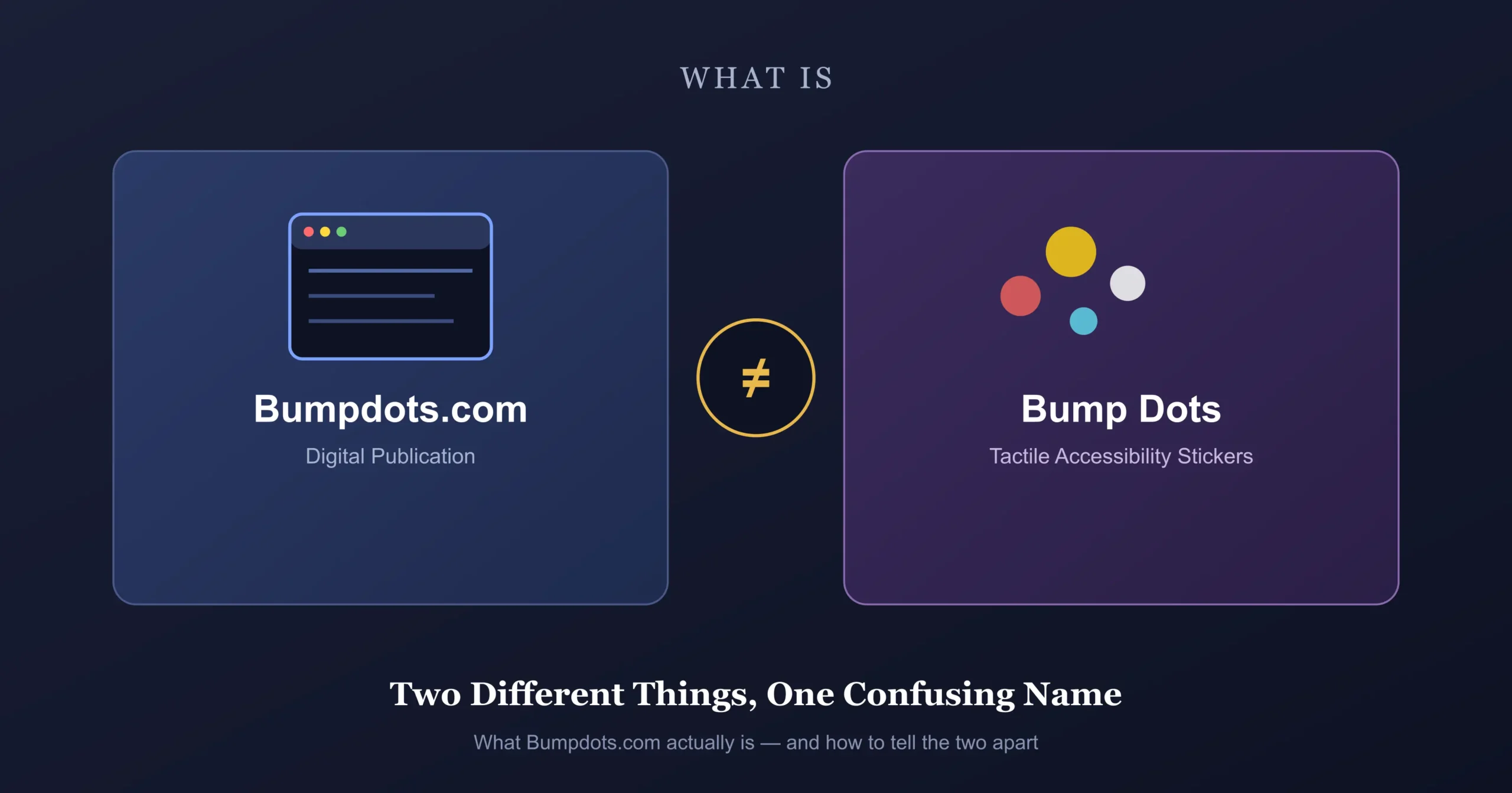
Type “bumpdots.com” into Google and you’re probably chasing one of three things: you read something on the site and want to know who wrote it, you’re deciding whether to link to it or write for it, or you actually meant “bump dots” — the little adhesive stickers blind and low-vision people use to mark buttons and keys by touch. Here’s what I found for each.
What Bumpdots.com Actually Is
Bumpdots.com is a multi-topic publication covering technology, AI, finance, gaming, business, health, and lifestyle. Public business-directory records tie it to an operation in Noida, Uttar Pradesh, and it appears to be a fairly young site.
That’s about as far as public information goes. There’s no publication history to lean on, no independent reviews of its accuracy, nothing that confirms or contradicts the quality of what it runs. So treat what follows as a way to judge the site yourself — not a verdict on it.
Why “Who Runs This?” Is the Real Question
A publication you can trust usually answers three things within a click of the homepage: who wrote this, who owns the company, and what the editorial process looks like. Bumpdots.com doesn’t make any of the three easy to find. No consistent byline structure, no named editorial team, no posted editorial policy.
That’s not proof the content is bad. It just means the only verification available right now comes from business directories like Crunchbase and F6S — and those listings are typically self-submitted. A Crunchbase profile confirms a company registered itself and described itself a certain way. It says nothing about whether the articles are accurate.
Say you’re researching cross-border e-commerce and find a growth figure cited on the site. Before you repeat it anywhere, trace it back to wherever the article claims it came from. No link, no traceable source? Don’t treat the number as fact — verify it independently first, the same way you’d handle a claim from any outlet you’ve never used before.
The Name Collision Nobody Mentions
“Bumpdots.com” and “bump dots” have nothing to do with each other, and almost nothing online says so directly.
Bump dots — two words, no domain — are physical tactile stickers: small raised silicone or rubber dots people use to mark a microwave button, a keyboard key, or a thermostat setting by feel instead of sight. The Carroll Center for the Blind and the Association for the Blind and Visually Impaired both sell them, and they’ve been a standard low-vision accessibility tool for years.
Bumpdots.com is a content site with no apparent connection to any of that. Same-sounding name, unrelated business.
If you’re a caregiver who typed the domain into your browser expecting a store, this is why you landed on an AI article instead of a shopping cart. Search “bump dots” as two separate words, or go straight to an accessibility retailer or organization serving low-vision users. The mix-up is the domain’s fault, not yours.
Who Should Use This Site — and Who Shouldn’t
It’s fine for casual reading on general topics, as a rough map of what a multi-niche publication in this space looks like, or as a starting point for story ideas you’ll verify elsewhere yourself.
It’s a poor fit for academic, medical, legal, or financial work that needs a verifiable, credentialed source; for repeating any statistic without checking where it came from; or for assuming it has any connection to accessibility products because of the name. If a decision about your health or money rests on something you read there, confirm it with an established, named-author source before you act on it.
Mistakes People Make With Sites Like This
Confusing clean design for editorial authority is the most common one — a polished layout says nothing about who’s behind the byline. A close second is treating a Crunchbase or F6S listing as an endorsement, when it’s really just a self-reported profile. Third: citing a number from an article without checking whether it links to an original source. And fourth, the one specific to this site: assuming the name means what it sounds like, when “bumpdots.com” and “bump dots” are two unrelated things wearing the same name.
A Framework for Judging Any Unfamiliar Site
Run this same four-question check on Bumpdots.com, or anywhere else you’re unsure about:
- Can you find a named author or editor for the specific piece you’re reading? No name, no accountability — treat it as unverified opinion.
- Is there a real, working contact method — a named email, not just a form? Use it before you commit to a partnership or backlink.
- Do specific claims link back to their original source? If a number has no traceable origin, check it elsewhere before repeating it.
- Does the site’s breadth match its apparent depth? One publication covering AI, finance, gaming, and health with equal confidence is unusual — real expertise rarely spreads that evenly. Read a few pieces in the one category you actually care about, and judge that category on its own.
Fail two or more of these, and the site is fine for general awareness — just not something you cite or partner with without more digging.
If You’re Stuck
Can’t find contact or ownership info? Check the footer — a privacy policy or terms page sometimes names a registered entity even when the About page doesn’t. Trying to confirm a statistic? Search the number alongside the research firm or agency it’s likely drawn from, rather than trusting the citation as written. Ended up here shopping for accessibility products? You want “bump dots,” two words — try an accessibility-focused retailer directly. Weighing a guest post or paid placement? Ask for an editorial contact by name first, and don’t read a slow reply as a red flag on its own — small publications are often just understaffed.
Q: What is Bumpdots.com?
A: Bumpdots.com is a multi-topic digital publication covering technology, AI, finance, gaming, business, health, and lifestyle, linked to a business operation in Noida, Uttar Pradesh, India.
Q: Is Bumpdots.com legitimate?
A: It’s a real, active publication rather than a scam, but it doesn’t currently publish clear author bylines, an editorial policy, or ownership details, so its credibility should be verified independently before you cite or partner with it.
Q: Is Bumpdots.com the same as “bump dots”?
A: No. “Bump dots” (two words) are physical tactile stickers used by blind and low-vision people to mark objects by touch. Bumpdots.com is an unrelated content website; the similarity is a naming coincidence.
Q: Does Bumpdots.com accept guest posts?
A: There’s no publicly posted contribution policy. Anyone considering a guest post or backlink should request a named editorial contact directly rather than relying on a contact form alone.
Q: How do I verify a statistic or claim from Bumpdots.com?
A: Check whether the article links to its original source. If it doesn’t, search for the figure alongside the likely originating research firm or agency before repeating it elsewhere.
Q: Where do I find real “bump dots” for accessibility use?
A: Search “bump dots” as two words and look at accessibility-focused retailers or organizations serving blind and low-vision communities, such as the Carroll Center for the Blind.
Bottom Line
Bumpdots.com is real and active, not a scam — but it hasn’t yet made itself easy to verify from the outside. Judge individual articles by their sourcing, not the domain name or the design. If you’re considering a link or a guest post, ask for a named editorial contact instead of relying on a directory listing. And if you came here looking for tactile bump dots, search those two words instead — you’re in the wrong place.