
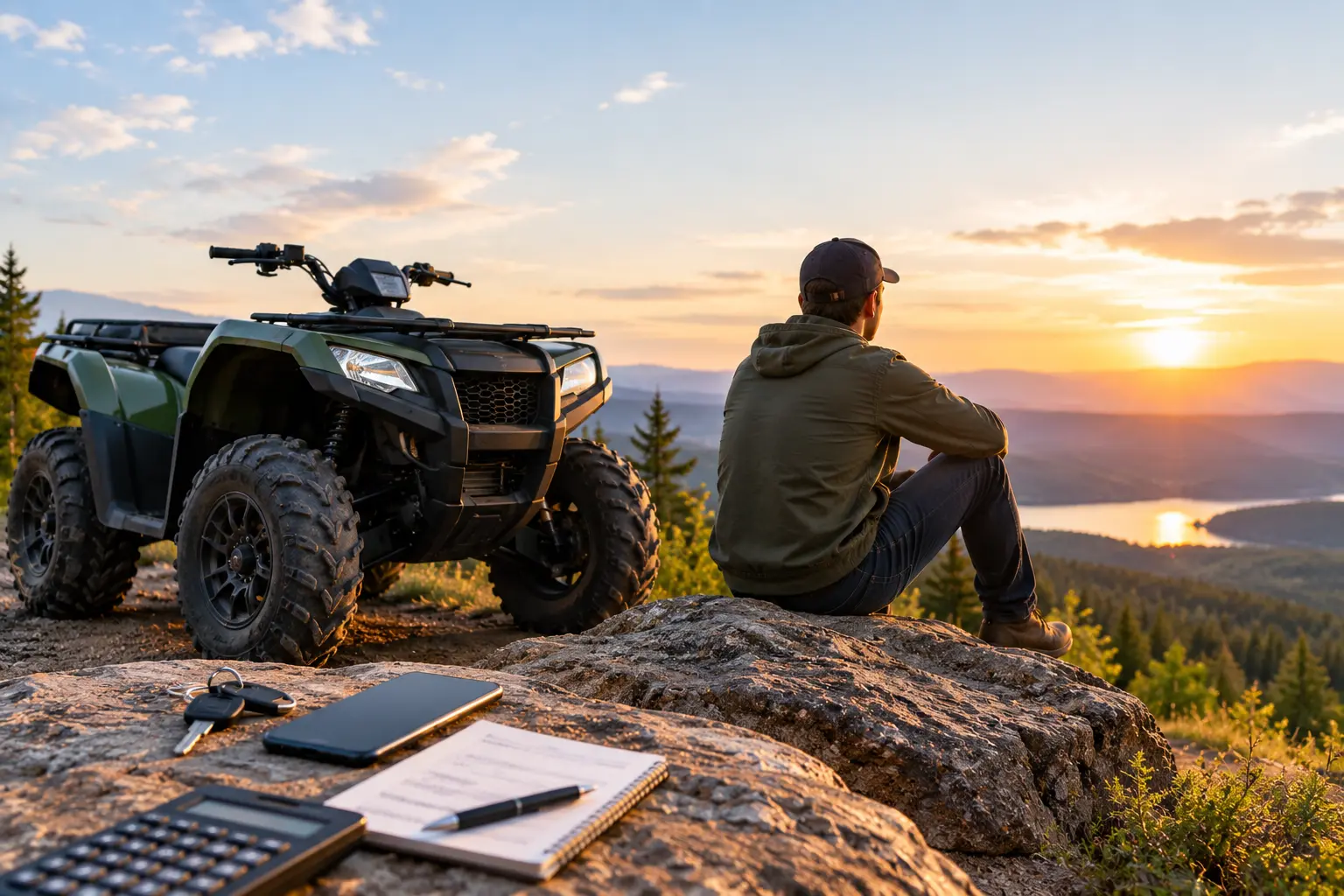
Getting an ATV loan with bad credit is possible, but the approval is only half the decision. The harder question is whether the financing offer is affordable enough to make buying the ATV worthwhile.
A lower credit score can reduce your lender choices or lead to a higher APR, larger down payment, shorter term or additional requirements. Current powersports financing guides show that borrowers with less-than-perfect credit may still have options through personal lenders, dealers, manufacturers, banks and credit unions, but the terms can vary substantially.
That is why the smartest approach is not to search for the lender that says “approved.”
Search for the lowest-risk financing you can realistically qualify for.
Can You Get ATV Financing With Bad Credit?
Yes, potentially.
There is no universal credit score that guarantees approval or denial for every ATV loan. Lenders can consider your credit history alongside factors such as income, existing debt, loan amount, down payment, employment and the ATV being financed.
Your financing options may include:
- ATV dealer financing
- Manufacturer-sponsored financing
- Banks and credit unions
- Online personal loans
- Secured loans
- A co-signed loan
- Financing for used ATVs
- Private-party financing through a personal loan, where permitted
LendingTree’s current 2026 guide identifies personal loans, dealer financing, manufacturer financing and bank or credit-union loans as potential routes for borrowers seeking powersports financing with less-than-perfect credit.
The important distinction is that bad credit does not mean no financing; it means you may have to prove your ability to repay in other ways or accept less favorable terms.
What Lenders Look at When Your Credit Is Bad
Your credit score is important, but it is not the entire application.
A lender is trying to estimate the probability that you will make every payment on time.
That makes these factors important.
Income
Stable, verifiable income can strengthen an application because it gives the lender evidence that you have money available for the payment.
Be prepared to provide information such as:
- Employer details
- Pay stubs
- Bank statements
- Tax documents for self-employment
- Other verifiable income
Do not inflate your income on an application. A financing decision based on inaccurate information can create much bigger problems than a rejection.
Existing debt
A lender may look at your current obligations alongside the proposed ATV payment.
For example, an ATV payment that looks manageable by itself may become unaffordable when combined with:
- Credit-card payments
- Auto loans
- Student loans
- Personal loans
- Rent or mortgage
- Child-support obligations
- Other recurring debts
This is why the maximum loan amount you qualify for is not necessarily the amount you should borrow.
Credit history
Lenders may look beyond the score itself.
A recent missed payment can tell a different story from an older credit problem followed by several years of consistent payments.
Review your credit reports before applying so you know what the lender is likely to see.
Down payment
A down payment reduces the amount you need to finance.
For example, if the ATV costs $10,000 and you put $2,000 down, you are asking the lender to finance $8,000 rather than $10,000, before taxes, fees and other financed costs.
A lower balance can reduce the lender’s exposure and may improve the overall economics of the loan.
However, do not drain your emergency savings just to increase your down payment.
The ATV itself
With secured financing, the ATV can serve as collateral.
That reduces some of the lender’s risk because the lender may have rights to the vehicle if you default.
The trade-off is serious: if you stop making payments on a secured loan, the ATV can be repossessed.
The CFPB explains that secured vehicle loans can give lenders a lien on the vehicle and the ability to repossess it after default.
Your Main ATV Financing Options With Bad Credit
There is no single financing route that is best for every borrower.
Compare these options based on total cost, approval requirements and risk.
| Financing option | Best for | Main advantage | Main drawback |
|---|---|---|---|
| Dealer financing | Buyers purchasing from a dealership | Convenient and may connect you with multiple lenders | Dealer-arranged rates may not be the lowest |
| Manufacturer financing | Buyers of eligible new models | Promotional rates may be available | Promotions often require strong credit and eligible models |
| Credit union | Members with an established financial relationship | Can offer competitive financing | Approval requirements may be stricter |
| Bank | Stronger credit profiles | Potentially competitive pricing | Bad-credit approval can be difficult |
| Online personal loan | Buyers who want flexibility | May be used for ATV purchases and private-party transactions depending on lender | Rates and fees can be high |
| Secured loan | Borrowers willing to pledge collateral | Collateral may improve approval prospects | Default can result in loss of the collateral |
| Co-signed loan | Borrowers with a qualified co-signer | A stronger co-signer may improve the application | The co-signer becomes responsible for the debt |
| Used ATV financing | Buyers willing to purchase used | Lower purchase price can reduce borrowing | Older or high-mileage ATVs may have fewer financing options |
1. Dealer Financing
Dealer financing is often the most convenient option because the dealership can submit your application to lenders in its network.
That convenience has a downside.
You may not know whether the dealer’s offer is competitive unless you compare it with another financing quote.
The CFPB recommends comparing dealer-arranged financing with direct financing from banks or credit unions rather than assuming the dealership has the best offer.
Best approach: Get an outside quote before visiting the dealer when possible.
Then you have a benchmark.
If the dealer offers a better APR or lower total cost, you can consider it.
If not, you already have another option.
2. Manufacturer Financing
ATV manufacturers sometimes offer promotional financing through participating dealers.
These offers can be attractive when you qualify.
For example, Polaris currently advertises promotional financing on selected off-road models and states that approval, rates and terms depend on creditworthiness and other qualifications.
That last part matters.
A headline such as “1.99% APR” does not mean every applicant receives 1.99%.
Promotional rates may be restricted to specific models, purchase dates, terms and credit profiles.
Pro Tip: Ask the dealer to show you the financing offer you personally qualify for—not just the promotion displayed in the advertisement.
3. Bank or Credit Union Financing
A bank or credit union may be worth checking before you accept dealership financing.
Credit unions can be particularly useful if you already have an established relationship with one.
The CFPB notes that borrowers can seek financing directly from banks or credit unions and compare the resulting quote with dealer-arranged financing.
Bad credit can make approval harder, but there is little downside to checking if you can prequalify without a hard inquiry.
Ask specifically whether the institution offers:
- ATV loans
- Powersports loans
- Recreational vehicle loans
- Secured personal loans
Some institutions categorize powersports financing differently.
4. Online Personal Loans
A personal loan can be useful when an ATV-specific lender is unavailable or when you are buying from a private seller.
LendingTree’s current powersports guide notes that personal loans can be used for ATV purchases and that many of the options it discusses are unsecured personal loans.
An unsecured personal loan does not use the ATV as collateral.
That can protect the vehicle from repossession under the loan agreement, but it does not make default harmless.
Late or missed payments can damage your credit, and the lender can pursue the remedies available under the loan contract and applicable law.
Do not choose an unsecured loan simply because you are afraid of collateral.
Compare the total cost.
5. Secured ATV Financing
A secured ATV loan uses the ATV as collateral.
Because the lender has an interest in the vehicle, secured financing may be easier to obtain than some unsecured alternatives.
But the risk is straightforward:
If you default, you can lose the ATV.
The CFPB identifies vehicle repossession as a potential consequence of default on secured vehicle financing.
Before signing, determine exactly what happens after missed payments and whether there are additional fees associated with default.
6. A Co-Signer
A co-signer can strengthen an application when that person has a stronger credit profile and is willing to take responsibility for the debt.
But co-signing is not a favor without financial consequences.
The CFPB explains that a co-signer can become responsible for repayment if the primary borrower fails to pay.
A co-signer should understand that missed payments can affect their finances and credit as well.
Never pressure someone into co-signing because you want the ATV.
7. Used ATV Financing
A used ATV can reduce the amount you need to borrow.
That can be one of the most effective ways to make bad-credit financing more manageable.
For example, compare:
New ATV: $12,000
Down payment: $1,500
Amount financed: $10,500
with:
Used ATV: $7,500
Down payment: $1,500
Amount financed: $6,000
The second loan creates substantially less debt before interest and fees.
But inspect the used ATV carefully.
A lower purchase price does not compensate for an ATV that needs expensive repairs immediately after purchase.
How to Improve Your Chances of Getting Approved
You cannot change your credit history overnight.
You can, however, improve the overall application.
1. Check your credit reports first
Look for:
- Incorrect late payments
- Accounts that do not belong to you
- Incorrect balances
- Duplicate accounts
- Outdated information
Dispute legitimate errors before applying.
You can obtain your federally authorized free credit reports through AnnualCreditReport.com.
2. Reduce the amount you need to borrow
A smaller loan can reduce both the payment and the lender’s exposure.
If you are deciding between a $12,000 ATV and a $7,000 used model, do not compare only the sticker prices.
Compare the complete financing cost.
3. Save a reasonable down payment
A down payment can reduce the principal you finance.
It can also reduce the loan-to-value ratio on secured financing.
But do not empty your savings account simply to qualify.
An ATV payment is not your only financial obligation.
4. Choose the right loan term
A longer term can reduce the monthly payment.
It can also increase the total interest paid.
For example, imagine a hypothetical $8,000 loan at 15% APR:
- 36 months: about $278 per month
- 60 months: about $190 per month
The 60-month payment looks easier.
But you would pay substantially more interest over the longer term.
Use the term that keeps the payment affordable without stretching the loan unnecessarily.
5. Consider a less expensive ATV
This is often overlooked.
If the lender offers financing only at an expensive rate, changing the vehicle may be more effective than searching indefinitely for another lender.
A $6,000 ATV financed responsibly can be a better financial decision than a $12,000 ATV financed at a rate you can barely afford.
6. Add a qualified co-signer only when appropriate
A co-signer can strengthen an application, but both parties need to understand the obligation.
Never use a co-signer to make an otherwise unaffordable purchase appear affordable.
7. Apply strategically
Do not submit applications randomly to dozens of lenders.
Start with lenders where you have a realistic chance of qualifying and use prequalification where available.
A soft credit inquiry used for prequalification generally differs from the hard inquiry that can occur when you formally apply. The CFPB recommends understanding how each financing inquiry affects your credit before shopping for a loan.
How Much Should You Put Down on an ATV?
There is no universal down-payment percentage that works for every borrower.
The right amount depends on:
- Your savings
- Credit profile
- ATV price
- Loan-to-value requirements
- Income
- Existing debt
- Financing terms
A larger down payment can reduce the amount financed.
But the goal is not to put down as much as possible.
The goal is to leave yourself with enough cash to handle unexpected expenses after buying the ATV.
Warning: If making the down payment leaves you with no emergency savings, reconsider the purchase.
How to Compare Bad Credit ATV Loans
Do not compare loans by monthly payment alone.
Use this checklist.
Compare the APR
APR is more useful than the interest rate alone because it incorporates certain costs associated with the credit transaction.
The CFPB recommends using APR to compare vehicle financing offers and distinguishing it from the stated interest rate.
Compare the total payments
A loan with a lower monthly payment can cost more overall if the repayment term is much longer.
Ask the lender:
“How much will I pay in total if I make every scheduled payment?”
Compare fees
Check for:
- Origination fees
- Documentation fees
- Application fees
- Late fees
- Prepayment penalties
- Dealer-related financing charges
- Optional products added to the loan
Compare the amount financed
Make sure you know whether the loan includes:
- ATV price
- Taxes
- Registration
- Dealer fees
- Accessories
- Warranty products
- Insurance products
Optional add-ons can increase the amount you finance.
The CFPB warns that optional dealer products can increase the amount borrowed and recommends evaluating whether they are actually necessary.
The Monthly Payment Trap
Consider two hypothetical offers:
| Offer A | Offer B | |
|---|---|---|
| Amount financed | $8,000 | $8,000 |
| APR | 15% | 15% |
| Term | 36 months | 60 months |
| Approx. monthly payment | $278 | $190 |
| Monthly-payment winner | ✓ | |
| Lower total-interest structure | ✓ |
Offer B looks easier because the monthly payment is lower.
But the longer repayment period means you pay interest for longer.
This is why a salesperson asking, “What monthly payment do you want?” should not be the starting point.
Start with:
“What APR, total cost and repayment term are available?”
Then determine whether the resulting payment fits your budget.
What Credit Score Do You Need to Finance an ATV?
There is no single minimum credit score for all ATV financing.
Different lenders use different underwriting models and may consider income, debt, collateral, loan amount and other information alongside your credit history.
Some lenders advertise minimum scores, while others do not publish one.
LendingTree’s current 2026 comparison, for example, includes personal-loan options with different stated minimum credit requirements, demonstrating why a single “ATV loan credit-score requirement” would be misleading.
The better question is:
“Which lenders are willing to evaluate my complete financial profile?”
Can You Get ATV Financing With No Credit?
Possibly.
No credit history and bad credit are different situations.
With no credit, the lender has less information about how you handle borrowed money.
With bad credit, the lender has evidence of past credit problems.
Either situation can make financing more difficult, but they are not identical.
You may have additional options if you can provide:
- Stable income
- A larger down payment
- A co-signer
- Collateral
- A smaller loan request
Do not assume that “no credit check” means “no underwriting.”
Legitimate lenders still need to evaluate the transaction and repayment risk.
Be Careful With “Guaranteed Approval” ATV Financing
A legitimate lender cannot promise you a specific financing outcome without evaluating your application.
Acorn Finance explicitly warns that true guaranteed ATV financing does not exist and says legitimate lenders evaluate creditworthiness and other financial factors.
Be skeptical of advertisements promising:
- Guaranteed approval
- No matter your credit
- Everyone gets approved
- No income verification
- No questions asked
- Instant approval with no financial review
These claims can hide expensive terms or misleading sales practices.
A lender that says “we work with bad credit” is making a very different claim from one that says “everyone is approved.”
The first can be legitimate.
The second deserves scrutiny.
Should You Use Buy-Here, Pay-Here Financing?
Buy-here, pay-here financing means the dealer typically provides the financing directly rather than arranging a loan with an outside lender.
The CFPB notes that buy-here, pay-here dealers generally serve borrowers with no or poor credit and that interest rates tend to be higher than those available from banks, credit unions or other lenders.
That does not mean every dealer using this model is inappropriate.
It means you should compare the complete cost carefully.
Ask for:
- APR
- Finance charge
- Amount financed
- Total of payments
- Late fees
- Repossession terms
- Payment schedule
- Whether payments are reported to credit bureaus
If the dealer refuses to explain the numbers clearly, walk away.
What Documents Should You Have Ready?
Requirements vary by lender, but having basic documentation available can make the process easier.
Prepare:
- Government-issued identification
- Proof of income
- Employment information
- Address history
- Bank information
- Current debt information
- Insurance information if required
- ATV purchase details
- Down-payment amount
- Co-signer information, if applicable
Self-employed borrowers may need additional income documentation.
If you are buying a used ATV from a private seller, the lender may also need information about the vehicle, seller and title.
Ask before submitting the application.
A Better Step-by-Step Strategy for Bad Credit ATV Financing
Step 1: Set your maximum purchase price
Do this before shopping for an ATV.
Otherwise, the vehicle you fall in love with can determine your budget.
Step 2: Calculate the complete purchase cost
Include:
- ATV
- Sales tax
- Registration
- Dealer fees
- Equipment
- Helmet and protective gear
- Insurance
- Transportation
- Immediate maintenance
The loan should not be based only on the advertised ATV price.
Step 3: Check your credit
Know what is on your reports before a lender sees them.
Step 4: Get a financing quote outside the dealership
A bank, credit union or online lender may provide a useful benchmark.
Step 5: Ask the dealer for its best financing offer
Do not reveal your target monthly payment first.
Ask for the complete financing terms.
Step 6: Compare APR and total cost
Put the offers side by side.
Step 7: Inspect the ATV
Especially when buying used, mechanical condition matters as much as financing cost.
Step 8: Read the contract
Confirm:
- APR
- Amount financed
- Payment
- Number of payments
- Total payments
- Fees
- Collateral
- Default provisions
- Optional products
Step 9: Decide whether the loan is actually affordable
If the payment requires you to cut essentials or rely on overtime that is not guaranteed, the ATV is too expensive.
When Bad Credit ATV Financing Is a Bad Idea
An ATV is usually a discretionary purchase.
That makes the affordability test more important than it would be for some essential forms of transportation.
Consider waiting if:
- You are behind on essential bills.
- You have no emergency savings.
- The loan would require a very high payment.
- The financing offer has an APR you cannot comfortably afford.
- You would need another loan to make the payments.
- You are using credit cards to cover normal living expenses.
- The dealer is pressuring you to sign immediately.
- You do not understand the financing contract.
- You are buying primarily because the monthly payment looks small.
A lender saying yes does not mean the purchase is financially sensible.
When Financing an ATV Can Make Sense
Bad-credit financing can still be reasonable when:
- Your income comfortably supports the payment.
- You have an emergency reserve.
- The ATV serves a genuine recreational or work-related purpose.
- You have compared multiple financing offers.
- The APR and fees are acceptable.
- You understand the total cost.
- You can afford maintenance, insurance and riding expenses in addition to the loan.
- You are not sacrificing essential financial goals to make the purchase.
For work-related use, also separate the question of whether the ATV is useful from whether the financing is affordable.
A vehicle can be economically useful and still be a bad purchase at an excessive financing cost.
Common Mistakes to Avoid
Focusing only on approval
Getting approved is not the objective.
Getting financing you can repay without creating a financial problem is the objective.
Choosing the lowest monthly payment
A lower payment can simply mean a longer loan.
Always compare total payments.
Assuming dealer financing is automatically best
Convenience is not the same as competitive pricing.
Compare outside financing first when possible.
Borrowing for accessories you do not need
Helmets and required safety equipment are different from cosmetic upgrades.
Do not increase your loan simply because the dealer offers to roll accessories into the financing.
Draining your savings for the down payment
An ATV should not leave you unable to handle an unexpected $500 or $1,000 expense.
Accepting “guaranteed approval”
Legitimate lenders still assess risk.
Treat guaranteed-approval claims as a warning sign.
Ignoring the used ATV’s condition
A cheap ATV that immediately needs major repairs can become much more expensive than a properly inspected vehicle.
FAQ
Can I get an ATV loan with a 500 credit score?
Possibly, but there is no universal approval rule based on a single score. Some lenders specialize in borrowers with weaker credit profiles, while others require stronger credit. Income, debt, down payment, collateral and the lender’s underwriting model can all affect the decision.
What is the easiest way to finance an ATV with bad credit?
Dealer financing can be convenient because the dealership may have relationships with multiple lenders. However, convenience does not guarantee the lowest cost. Compare dealer financing with a bank, credit union or personal-loan option when available.
Can I finance a used ATV with bad credit?
Yes, potentially. Used ATV financing is available through some dealers and lenders, although eligibility can depend on the ATV’s age, value, condition and the lender’s rules.
Can I finance an ATV with no credit?
Potentially. No credit is different from bad credit, but lenders may still require proof of income, a down payment, collateral or a co-signer.
Do ATV loans require a down payment?
Not always. Some personal loans do not require a down payment, while secured dealer or manufacturer financing may. Even when a down payment is optional, putting some money down can reduce the amount financed.
Can I get ATV financing without a hard credit check?
Some lenders allow prequalification using a soft inquiry, but a hard credit inquiry may occur when you formally apply. Read the lender’s application terms before proceeding.
Can bad credit ATV financing help rebuild my credit?
It can potentially help if the lender reports your payment history and you make payments on time. But reporting practices vary. Never take an expensive loan solely as a credit-rebuilding strategy.
Should I use a co-signer for an ATV loan?
A co-signer may improve your chances or financing terms if the lender permits it, but the co-signer becomes responsible for the debt if you do not pay. Make sure both people understand the obligation before signing.
Is an unsecured personal loan better than secured ATV financing?
Not automatically. An unsecured loan may avoid using the ATV as collateral, but it can carry a higher cost. A secured loan may offer better pricing or approval prospects but puts the ATV at risk if you default.
Compare the total cost and risk of both options.
How long can an ATV loan be?
Loan terms vary by lender and product. Current powersports financing options can range from relatively short repayment periods to several years. A longer term lowers the monthly payment but generally increases the amount of interest paid if the rate is unchanged.
Can I get 0% ATV financing with bad credit?
A promotional 0% APR offer may exist for certain models or purchase periods, but eligibility is not universal. Manufacturer promotions commonly state that financing is subject to credit approval and other restrictions.
Do not assume a 0% advertisement applies to your credit profile.
Final Decision Checklist
Before signing an ATV financing contract, make sure you can answer all of these questions:
- What is the exact APR?
- How much am I financing?
- What is the total finance charge?
- How much will I pay over the life of the loan?
- How many payments are required?
- Is the ATV collateral?
- What happens if I miss a payment?
- Are there late fees?
- Is there a prepayment penalty?
- Are optional products included?
- Did I compare another financing offer?
- Can I comfortably make the payment after insurance and maintenance?
- Will I still have emergency savings after the purchase?
If you cannot answer these questions, you are not ready to sign.
The Bottom Line
Bad credit does not automatically prevent you from financing an ATV.
Your options may include dealer financing, manufacturer programs, credit unions, banks, online personal loans, secured loans or a co-signer.
But approval should not be the finish line.
Compare the APR, total payments, fees, loan term, collateral requirements and default consequences before choosing an offer. The CFPB specifically recommends comparing financing sources and understanding the full cost of vehicle credit rather than focusing only on the monthly payment.