
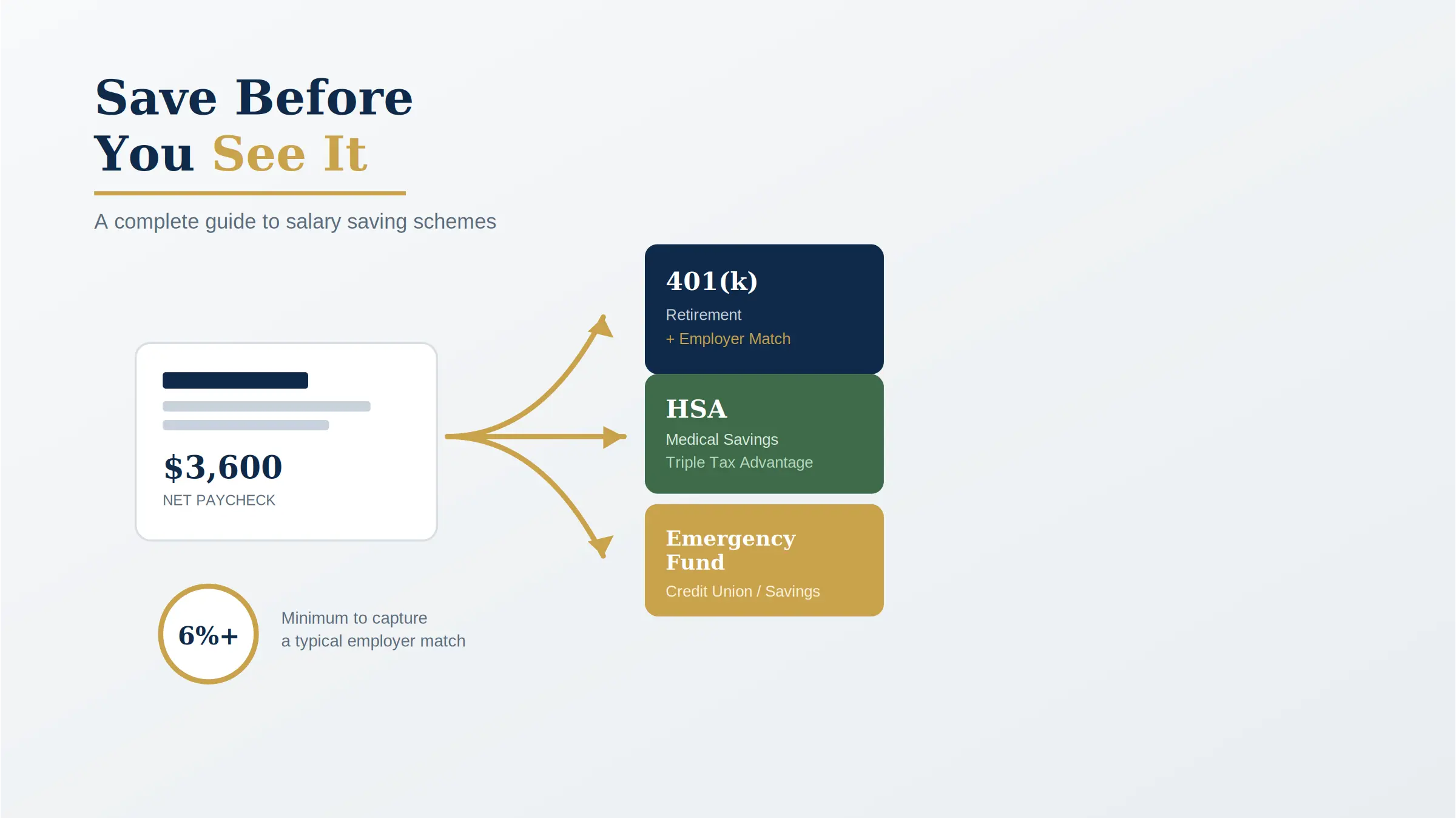
The single biggest predictor of whether someone saves consistently isn’t income, discipline, or financial knowledge — it’s whether the money moves before they see it. That’s the entire mechanism behind a salary saving scheme, and it’s why participation rates in automatic payroll-deduction programs run dramatically higher than in accounts people have to fund manually. Removing the decision point removes the main reason saving plans fail.
What a Salary Saving Scheme Actually Is
A salary saving scheme — also called a payroll savings plan, employee savings plan, or salary deduction scheme — is any arrangement where a fixed amount is automatically withheld from an employee’s pay and directed into savings or investments, before the money ever reaches a checking account. The employer handles the mechanics; the employee simply sets an amount or percentage once and, in most cases, never has to think about it again.
This isn’t a single product — it’s a category covering several distinct types of accounts, each with different tax treatment, purposes, and rules.
The Main Types of Salary Saving Schemes
1. Employer-Sponsored Retirement Plans (401(k), 403(b))
The most widely used salary saving scheme in the US. Contributions come out of pay before income tax is calculated (in a traditional 401(k)) or after tax with tax-free withdrawals later (Roth 401(k)). For 2026, the employee contribution limit is $24,500, with an additional $8,000 catch-up allowed for those aged 50-59 or 64 and older, and up to $11,250 in catch-up contributions for those aged 60-63.
The most important number in this entire category is the employer match. A typical formula matches 50% of contributions up to 6% of salary — meaning an employee contributing 6% receives an extra 3% of salary from their employer, essentially a guaranteed 50% return before any investment growth even happens. Not contributing enough to capture the full match is, in effect, turning down free money every single pay period.
2. Health Savings Accounts (HSAs)
Available to employees enrolled in a qualifying high-deductible health plan, HSAs offer a rarer triple tax advantage: contributions reduce taxable income, growth is tax-free, and withdrawals for qualified medical expenses are also tax-free. Unlike a Flexible Spending Account, HSA balances roll over indefinitely rather than expiring at year-end, which makes them useful as a long-term savings vehicle within a broader salary saving scheme, not just a same-year medical expense account.
HSA contributions also reduce FICA taxes (Social Security and Medicare), not just income tax — a distinction that separates them from standard 401(k) contributions and makes them one of the more tax-efficient payroll deductions available.
3. Flexible Spending Accounts (FSAs)
Similar to HSAs in that contributions are pre-tax payroll deductions, but FSA funds are generally use-it-or-lose-it within the plan year (some employers allow a small carryover or grace period). FSAs can cover medical expenses, and separate dependent-care FSAs cover childcare costs — both funded entirely through payroll before tax.
4. Employee Stock Purchase Plans (ESPPs)
ESPPs let employees buy company stock through payroll deductions, often at a discount to market price (commonly 10-15%). This creates a built-in return on the discount alone, though it comes with a real trade-off: concentrating savings in a single company’s stock carries more risk than a diversified investment, especially if that company is also the source of the employee’s paycheck.
5. Credit Union Payroll Savings
Many employers partner with a credit union to let employees direct part of each paycheck into a savings account, separate from retirement accounts. These accounts often pay more competitive dividend rates than standard bank savings accounts and work well as an accessible emergency fund within a broader salary saving scheme, since — unlike a 401(k) — the money isn’t locked away with early-withdrawal penalties.
6. U.S. Savings Bonds Through Payroll
One of the oldest salary saving schemes in America, dating to World War II payroll bond campaigns. Employees can still direct a portion of pay into savings bonds through some employers, though this option has become less common as other payroll savings products have expanded.
7. General Payroll-Linked Savings Accounts
Outside the US, and increasingly within it too, some employers offer simple payroll-linked savings — a set amount is deducted each pay period and deposited into a regular savings account, with no tax advantage attached but the same automatic, “set and forget” benefit. In the UK, this model is common through workplace credit union partnerships and financial wellness providers, often positioned as a way to build a modest emergency fund rather than a long-term investment vehicle.
How Much Difference Automation Actually Makes
The data on this is consistent and striking: auto-enrollment retirement plans see roughly 94% participation, compared to about 64% for voluntary plans requiring an active sign-up. The product doesn’t change — only the default does. Similarly, one UK workplace trial found that switching from an opt-in to an opt-out savings model raised active participation from a low baseline to 70% of employees.
A Worked Example
Consider a worker earning $60,000 a year who contributes 6% to a 401(k) salary saving scheme, with an employer matching 50% of contributions up to that 6% threshold:
- Employee contribution: $3,600/year
- Employer match: $1,800/year
- Combined annual contribution: $5,400 — for an actual out-of-pocket cost to the employee of just $3,600
Over 30 years at a 7% average annual return, consistent contributions at this level compound into a substantially larger balance than the raw contribution total alone would suggest — this is the combined effect of the employer match and long-term compounding working together, which is precisely why starting early and hitting the match threshold matters more than optimizing every other variable.
What People Who Max Out Their Salary Saving Scheme Have in Common
The math behind a salary saving scheme is straightforward — automated contributions, employer match, compounding. What’s less obvious is what separates someone who contributes the bare minimum from someone who treats their salary saving scheme as the center of a broader savings strategy. According to interviews Business Insider conducted with several “super savers” — people setting aside 50% or more of their income — a few consistent patterns emerge that apply directly to how someone should approach their own payroll deductions:
- They increase their salary saving scheme contribution rate gradually, not all at once. Rather than jumping straight to a large percentage, many raise their 401(k) or payroll deduction by a small amount — often 1% — each year, timed to salary increases so the change is barely noticeable in take-home pay.
- They redirect windfalls straight into their salary saving scheme rather than spending them. Bonuses, tax refunds, and other unplanned cash are treated as an opportunity to boost a retirement or savings contribution rather than income to spend, since the money was never factored into the regular budget anyway.
- They track spending before deciding how much to contribute. Reviewing actual spending — rather than assumed spending — routinely reveals available room in the budget for a higher salary saving scheme contribution than people initially believe they can afford.
- They treat automation as the entire strategy, not a helpful add-on. The common thread across every high-savings-rate example is removing the manual decision entirely — money moves before it can be spent, whether that’s a payroll-deducted 401(k) contribution or an automatic transfer to a brokerage account layered on top of it.
The practical takeaway: a salary saving scheme works best not as a fixed, “set it once and forget it forever” decision, but as a contribution rate that gets revisited and increased over time — particularly at each raise, bonus, or windfall — using the same automation principle that made the initial scheme effective in the first place.
Building the Right Mix for Yourself
There’s no single “best” salary saving scheme — the right combination depends on what’s available through your employer and what you’re saving for:
- Contribute enough to your 401(k) salary saving scheme to get the full employer match first. This is close to a universal rule — it’s an immediate, guaranteed return that nothing else on this list can match.
- Use an HSA if you’re on a qualifying health plan. The triple tax advantage makes it one of the most efficient accounts available, and unused funds simply continue growing rather than expiring.
- Build a separate emergency fund through a credit union or standard payroll savings account. Retirement accounts come with withdrawal restrictions and penalties; a true emergency fund needs to stay liquid and accessible.
- Consider an ESPP only as a supplement, not a replacement, for diversified retirement savings, given the concentration risk of holding a large position in a single employer’s stock.
Frequently Asked Questions
Is a salary saving scheme the same as salary sacrifice?
They’re related but not identical. Salary sacrifice (more common in UK terminology) specifically means an employee agrees to a formal reduction in gross salary in exchange for a non-cash benefit, such as increased pension contributions. A salary saving scheme is the broader category, which includes salary sacrifice arrangements as one type among several.
Can I access money in a salary saving scheme if I need it urgently?
It depends on the account type. Retirement accounts like 401(k)s typically restrict early withdrawals and impose penalties before a certain age. Credit union payroll savings and standard payroll-linked savings accounts are generally accessible without penalty, which is exactly why they work well as emergency funds separate from retirement savings.
What happens to my salary saving scheme if I change employers?
Retirement accounts like 401(k)s can typically be rolled over into a new employer’s plan or an individual IRA without tax penalty. HSAs are fully portable and remain yours regardless of employer changes. Credit union accounts and FSAs vary — FSA balances should forfeited if unused by the time employment ends, subject to the specific plan’s rules.
How much should I contribute to my salary saving scheme if I want to save aggressively?
There’s no fixed number, but research on high-savings-rate individuals suggests starting with at least enough to capture any employer match, then increasing the contribution rate gradually — often by 1% a year — rather than attempting a large jump all at once.
The Bottom Line
A salary saving scheme works because it removes the single biggest obstacle to saving: having to actively decide, every single pay period, to set money aside instead of spending it. The people who get the most out of theirs don’t rely on a single clever trick — they capture the employer match, increase their contribution rate gradually over time, and redirect windfalls straight back into the scheme rather than spending them. The specific account types matter less than simply starting and letting automation and time do the rest.