
Many investors want something that sounds almost impossible: steady returns without taking stock-market-level risk.
That demand led to the rise of targeted return funds. Rather than trying to beat a stock market index, these funds aim to deliver a specific return target over time while controlling volatility and limiting losses.
The Global Targeted Returns Fund is one of the best-known examples of this approach. Instead of focusing on a single asset class, it uses a flexible mix of investments and strategies designed to generate positive returns in different market conditions. The idea sounds appealing. The reality is more complex.
If you’re considering a Global Targeted Returns Fund, here’s what you need to know before investing.
What Is a Global Targeted Returns Fund?
A Global Targeted Returns Fund is a type of multi-asset investment fund that aims to achieve a predetermined return objective rather than outperforming a benchmark such as the S&P 500 or FTSE 100.
For example, the M&G Global Target Return Fund targets returns above the Sterling Overnight Index Average (SONIA) over rolling three-year periods while seeking to reduce volatility and limit losses.
Unlike traditional equity funds, these funds can invest across:
- Stocks
- Bonds
- Currencies
- Commodities
- Cash
- Derivatives
- Alternative investments
Fund managers have broad flexibility to shift allocations as market conditions change.
How Does the Strategy Work?
The key idea is simple.
Rather than asking:
“Will stocks outperform this year?”
The manager asks:
“Where can we find attractive risk-adjusted opportunities right now?”
A targeted return fund often combines dozens of investment positions simultaneously.
Some positions may profit if stock markets rise.
Others may profit if interest rates fall.
Others may benefit from currency movements or commodity trends.
This approach is sometimes described as an “absolute return” strategy because the goal is positive returns regardless of market direction. However, positive returns are never guaranteed.
A Simple Example
Imagine a portfolio manager believes:
- U.S. technology stocks will outperform European stocks.
- Long-term government bonds will outperform short-term bonds.
- The U.S. dollar may strengthen against another currency.
Instead of buying a broad market index, the manager can create targeted positions around those specific views.
The result is a portfolio built from many independent investment ideas rather than one large market bet.
Why Investors Became Interested in Targeted Return Funds
The popularity of targeted return funds increased after major market crashes.
Many investors experienced significant losses during periods of market stress and started looking for alternatives that might provide:
- Lower volatility
- Better diversification
- More predictable outcomes
- Reduced dependence on stock markets
For retirees and cautious investors, the promise of smoother returns can be attractive.
A portfolio that loses 10% during a difficult year may be psychologically easier to hold than one that loses 30%.
That emotional benefit is often overlooked when people compare investment products.
The Potential Advantages
Diversification Beyond Traditional Portfolios
Most investors already own stocks and bonds.
A targeted return fund may add exposure to strategies that are difficult to replicate individually.
This can reduce reliance on a single market or sector.
Professional Risk Management
Many targeted return funds actively monitor portfolio risk rather than simply focusing on returns.
The objective is often to keep volatility within a defined range.
For investors who dislike large swings in portfolio value, this can be appealing.
Flexibility During Changing Markets
Traditional funds often operate within strict limits.
A targeted return strategy can adapt more quickly.
Managers may increase cash positions, adjust currency exposure, or reduce equity risk when market conditions deteriorate.
That flexibility can be valuable during uncertain economic periods.
The Risks Most Investors Miss
This is where many marketing brochures become less enthusiastic.
Targeted return funds can be useful tools, but they are not magic.
The Target Is Not a Promise
One of the biggest misunderstandings involves the word “target.”
Many investors unconsciously interpret it as a guarantee.
It isn’t.
A target is simply an objective.
Even well-managed funds can miss their return goals due to unexpected market conditions.
Complexity Can Hide Problems
A simple index fund is easy to understand.
A targeted return fund may contain dozens or even hundreds of positions.
That complexity can make it difficult for investors to understand:
- What drives performance
- Where risks exist
- Why returns differ from expectations
When something underperforms, the explanation is often less straightforward.
Higher Fees
Many targeted return strategies require:
- Research teams
- Active trading
- Risk management systems
- Derivative expertise
Those costs can lead to higher fees compared with passive index funds.
Over long periods, fees matter.
Even small differences can significantly impact total returns.
Manager Dependence
An index fund follows a rules-based approach.
A targeted return fund depends heavily on the decisions of the management team.
If investment views prove wrong repeatedly, performance can suffer.
How Have Targeted Return Funds Performed in Practice?
This is probably the question most investors care about.
The answer is mixed.
Some targeted return funds have delivered periods of attractive risk-adjusted returns.
Others have struggled to meet their stated objectives.
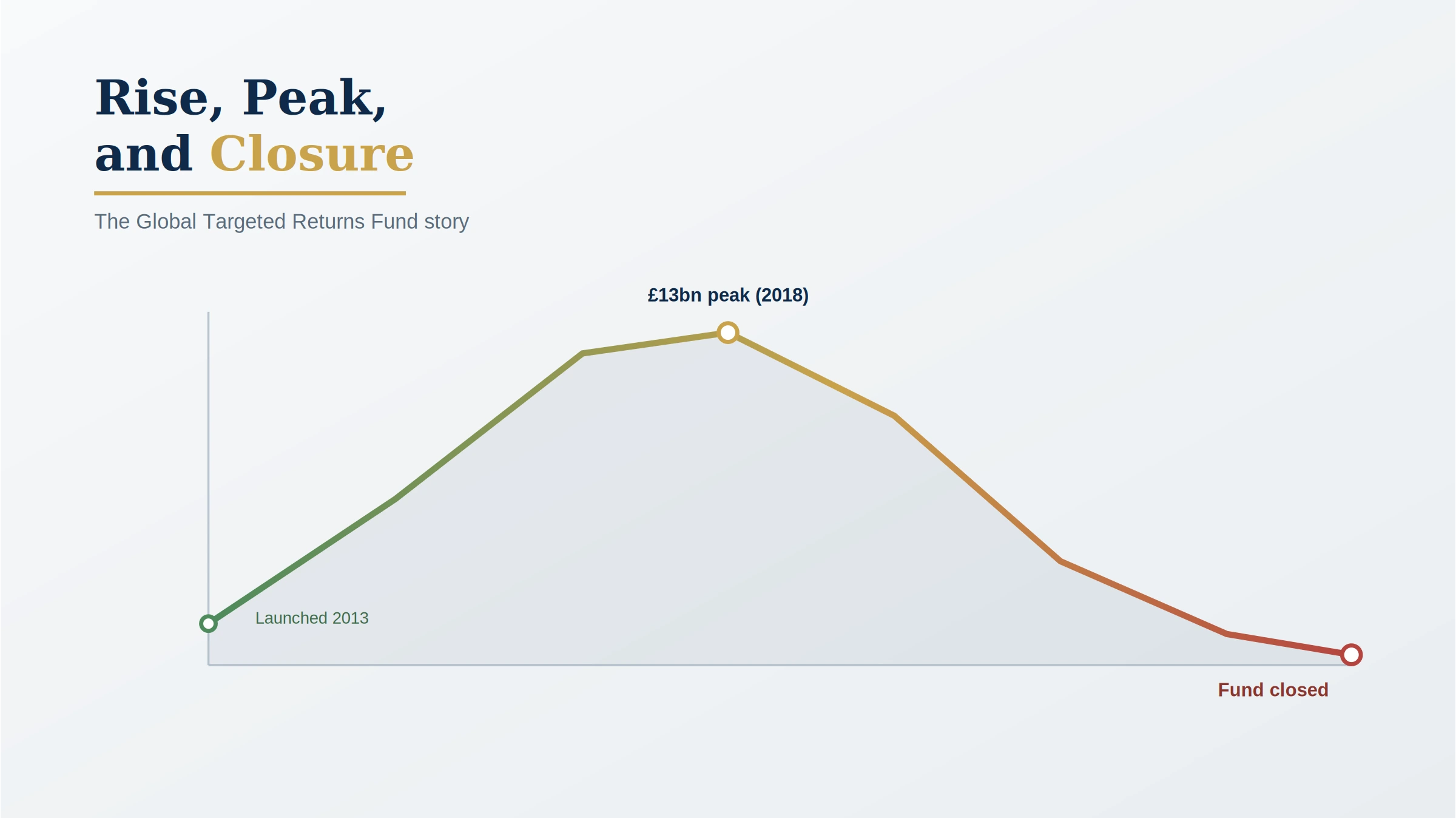
The experience of the sector shows that generating consistent positive returns in all market environments is far harder than it sounds. In fact, declining investor demand and disappointing performance contributed to the merger of the Invesco Global Targeted Returns Fund into another strategy.
That doesn’t mean the concept is flawed.
It does mean investors should evaluate each fund individually rather than assuming the strategy itself guarantees success.
Who Should Consider a Global Targeted Returns Fund?
A Global Targeted Returns Fund may make sense for investors who:
- Already own traditional stock and bond funds
- Want additional diversification
- Prefer smoother portfolio performance
- Understand active management risks
- Have a medium- to long-term investment horizon
It may be less suitable for investors who:
- Want maximum long-term growth
- Prefer low-cost index investing
- Need complete transparency
- Expect guaranteed returns
One mistake I frequently see is investors using these funds as replacements for their entire portfolio.
They generally work better as a complement rather than a substitute.
Alternatives Worth Comparing
Before investing, compare targeted return funds with other options.
| Investment Type | Main Goal | Risk Level | Complexity |
|---|---|---|---|
| Global Index Fund | Long-term growth | Moderate to High | Low |
| Bond Fund | Income and stability | Low to Moderate | Low |
| Targeted Return Fund | Positive returns with controlled risk | Moderate | High |
| Balanced Fund | Growth and income | Moderate | Moderate |
| Multi-Asset Fund | Diversification | Moderate | Moderate |
For many investors, a diversified portfolio of index funds may still be the simplest solution.
Targeted return funds become more interesting when investors need additional diversification beyond traditional asset allocation.
Key Questions to Ask Before Investing
Before buying any Global Targeted Returns Fund, ask:
- What is the exact return target?
- How is risk measured?
- What asset classes are used?
- How has the fund performed during market downturns?
- What fees am I paying?
- How much flexibility does the manager have?
- What could cause the strategy to fail?
These questions often reveal more than marketing materials.
Final Thoughts
The strongest reason to consider a Global Targeted Returns Fund isn’t the possibility of higher returns. It’s the possibility of building a portfolio that relies less on a single market outcome.
That’s an important distinction.
A good targeted return fund should be viewed as a diversification tool first and a return generator second. Investors who understand that difference tend to have more realistic expectations and are less likely to abandon the strategy during difficult periods.
Frequently Asked Questions
What is a Global Targeted Returns Fund?
A Global Targeted Returns Fund is a multi-asset investment fund that aims to achieve a specific return objective over time while managing risk and limiting volatility.
Are targeted return funds safe?
No investment fund is completely safe. Targeted return funds generally seek lower volatility than stock-focused funds, but they can still lose money and may miss their return targets.
Do targeted return funds guarantee returns?
No. The return target is an objective, not a guarantee. Actual results can differ significantly from expectations.
How are targeted return funds different from index funds?
Index funds track a market index. Targeted return funds use active management and flexible asset allocation to pursue a specific return objective.
Who should invest in a Global Targeted Returns Fund?
They may suit investors seeking diversification, active risk management, and potentially smoother returns than traditional equity investments.