? See how the Land Rover system works, what warning lights mean, real repair cost ranges, and whether to repair or delete it.)
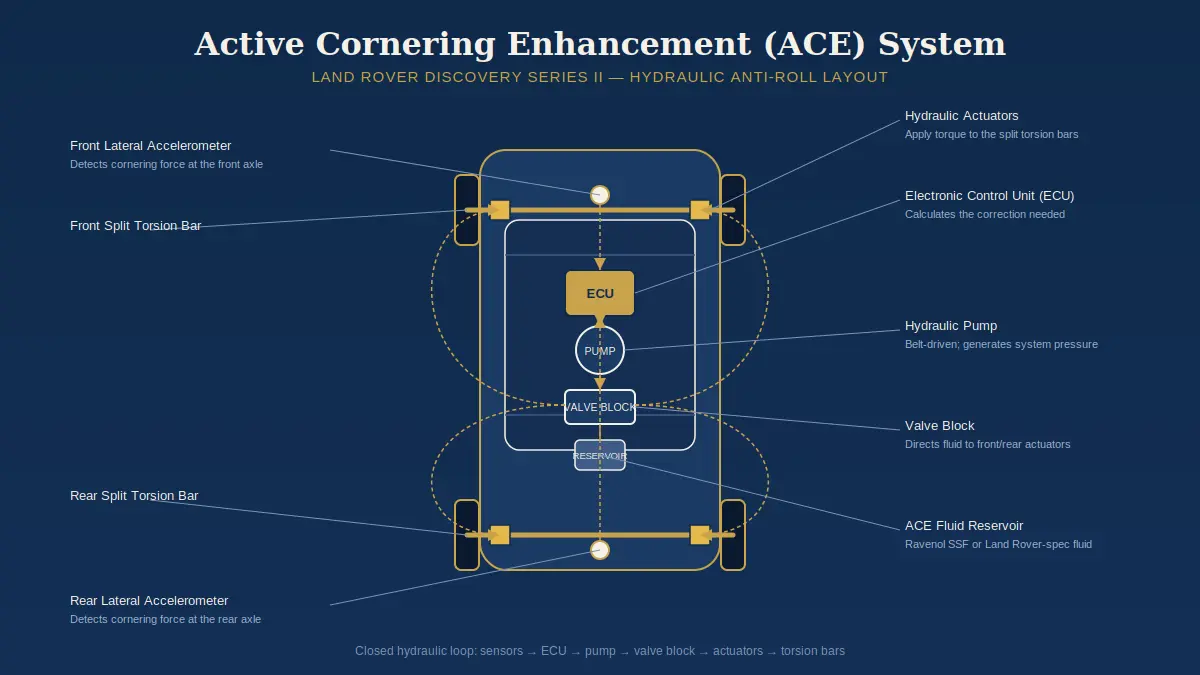
Active Cornering Enhancement (ACE) is a hydraulic anti-roll system, developed by Land Rover for the Discovery Series II, that actively reduces body lean during cornering using sensors, an ECU, and hydraulic actuators.
Three letters cause more confusion on the Discovery Series II than almost anything else on the truck: ACE. Some owners shrug it off as a black box that either works or doesn’t. Others see the warning light for the first time and assume the worst. Once you understand what’s actually happening under the vehicle, neither reaction makes much sense. The system is simpler than its reputation suggests, and the failures are predictable if you know where to look.
This guide covers how ACE works, what it costs to keep running, when repairing beats deleting it, and what to check before buying a vehicle that has it.
The technical details, thresholds, and repair patterns below come from Land Rover’s published ACE architecture and from repair experience documented widely across the Discovery II ownership community. Costs and failure rates shift with region, mileage, and history — treat the numbers here as planning benchmarks, and confirm anything specific against your own VIN and a qualified inspection.
What Is Active Cornering Enhancement?
Every other vehicle on the road manages body roll with fixed-stiffness anti-roll bars — a piece of metal that resists twisting by a fixed amount no matter what the corner demands. ACE throws that approach out. It uses front and rear sensors, an electronic control unit, and hydraulic actuators to apply real-time counter-torque to split torsion bars, adjusting the resistance corner by corner instead of relying on one static setting.
Take two Discovery IIs onto the same on-ramp at 45 mph. The one without ACE leans hard enough toward the outside of the turn that a passenger feels their body shift toward the door. The ACE-equipped truck stays close to level — the outer torsion bar has already stiffened within roughly 130 milliseconds of the lateral force building.
One thing to confirm early: check for the ACE reservoir under the hood, near the brake fluid tank. It’s a separate, clearly labeled hydraulic fluid reservoir. Badges get swapped between trims all the time; the hardware doesn’t lie.
A frequent mix-up is treating ACE like an air suspension or comfort feature, since both affect how a vehicle rides. ACE does neither. It has no effect on ride height and does nothing until the vehicle is actually turning. If a truck is sitting unusually low or high, that’s a spring or air suspension issue — not ACE.
Don’t judge whether the system is working based on how the truck feels in a straight line, either. It’s corner-specific by design. Test it on a cloverleaf on-ramp or a series of S-turns, not a highway merge, and you’ll know within a few corners whether it’s doing its job.
Why Was ACE Developed?
Large SUVs bring real advantages — visibility, cabin space, off-road capability — but their higher center of gravity makes them far more prone to body roll than a passenger car sitting closer to the ground. Land Rover’s engineers were stuck with a classic trade-off: a stiffer anti-roll bar sharpens on-road handling but restricts wheel travel off-road, cutting into the articulation needed over rocks, ruts, and uneven ground. Soften the bar for off-road flexibility, and the truck leans more in every corner on the way there.
ACE existed to remove that trade-off rather than split the difference. By adjusting roll stiffness only when a corner actually demands it, the system delivers stability on the road without giving up suspension flexibility off it — instead of forcing an owner to pick one or the other, which is exactly what every conventional anti-roll bar setup on the market still asks you to do.
A Brief History of ACE
Land Rover developed ACE with Lucas as an optional Performance Package feature on the 1999–2004 Discovery Series II, making it one of the first active roll-control systems offered on a mainstream production off-roader. The target was the SUV industry’s oldest complaint: tall, heavy vehicles lean badly in corners.
It worked well enough to surprise people. Road testers in the early 2000s routinely compared the ACE-equipped Discovery II to sedans in slalom and lane-change testing — an odd comparison to make about a body-on-frame 4×4, but the results backed it up.
ACE was optional, not standard, across the whole production run, so don’t assume a given Series II has it just because of the model year. Confirm it with the build sheet or a physical look at the reservoir and torsion bar linkages.
It’s tempting to write ACE off as a one-generation experiment Land Rover abandoned, but that’s not quite right. The underlying idea — active torque applied to split anti-roll bars — carried forward into Dynamic Response on the Range Rover Sport and later models, and the same logic now shows up across the industry in more advanced form.
If you’re buying into this system specifically for the driving feel, go in with clear eyes: this is more than two-decade-old hydraulic engineering. Excellent for its era, but you’re maintaining vintage hydraulics, not a modern electronically actuated system.
How Does Active Cornering Enhancement Work?
ACE runs as a closed loop. Front and rear accelerometers detect lateral force the instant a corner begins. The ECU takes that reading along with steering angle and vehicle speed and calculates how much counter-torque is needed. Hydraulic actuators then apply that torque directly to the split torsion bars — stiffening the outside of the turn, relaxing the inside. When the corner ends, the system releases pressure and returns to a neutral, fully articulated state for off-road use.
On a decreasing-radius corner, where lateral force keeps building as you turn in, the ECU isn’t applying one fixed correction and calling it done — it’s recalculating continuously through the entire turn. That’s why the system feels like one smooth response rather than a single on/off correction.
The engineering target is specific: body roll is nearly eliminated up to about 0.4g of lateral acceleration, and above that the system allows a progressively increasing amount of lean. That’s deliberate. Masking the cornering limit entirely would be dangerous at the edge of grip — the driver needs to feel the vehicle approaching its limit, not get surprised by it.
A stiffer ride everywhere isn’t a sign the system is doing its job — it’s usually the opposite. A properly functioning ACE system feels neutral in a straight line and only engages under cornering load. Permanent stiffness points to a stuck actuator or a fault that’s defaulted the system into a fixed state.
If you’re trying to confirm ACE is functioning on a used vehicle, don’t rely on the dashboard alone. Have someone watch the body from outside during a tight, moderate-speed turn. A working system produces a visibly flatter stance than a non-ACE Discovery II taking the same corner at the same speed — you’ll see the difference before you’ll read it on a scan tool.
Key Components of the ACE System
The system is a closed high-pressure hydraulic loop built from a specific set of parts: front and rear lateral accelerometers, the ACE ECU, an engine-driven high-pressure hydraulic pump, a valve block with directional and pressure-control valves, hydraulic actuators mounted to the split torsion bars, a pressure transducer and filter, and a dedicated fluid reservoir using a specific hydraulic fluid — commonly Ravenol SSF or the Land Rover-specified equivalent.
The pump is belt-driven off the engine accessory drive, the same way a power steering pump is mounted. That’s worth knowing because a failing ACE pump often whines or groans in a way that sounds almost identical to a power steering problem, and plenty of owners chase the wrong system first.
Keep a rough map in your head: reservoir and hoses point to leaks, the pump points to noise and pressure loss, the valve block points to erratic or one-sided response, sensors point to a warning light with no obvious mechanical symptom. That mapping alone cuts out most of the guesswork.
Fluid substitution is a common and avoidable mistake. ACE needs a specific hydraulic fluid spec — swapping in standard power steering fluid or the wrong ATF equivalent degrades seals over time and accelerates the exact leaks owners are trying to prevent.
If you’re sourcing parts, buy from a supplier who explicitly lists Discovery II ACE compatibility rather than a generic “Land Rover suspension parts” listing. The actuators and valve blocks are specific enough that fitment mistakes are common with generic sourcing.
Benefits of Active Cornering Enhancement
The direct payoff is reduced body roll, better tire contact through corners, and a noticeably calmer ride for passengers — without giving up wheel articulation off-road, since the system relaxes automatically at low speed or when the terrain demands full travel. It’s genuinely a dual-purpose system, not just an on-road upgrade with an off-road excuse.
On a mountain switchback route, an ACE-equipped Discovery II carries more speed through a tight bend with less driver correction than a non-ACE model — and an hour later can drop into a rutted trail and use full suspension travel with zero driver input to switch modes.
If comfort matters more to you than cornering speed, know that the biggest real-world payoff for most owners isn’t handling — it’s reduced side-to-side motion for passengers, which matters a lot on long, winding drives and cuts down on motion sickness complaints.
Don’t expect ACE to turn a Discovery II into something that corners like a sports sedan. It reduces lean meaningfully, but the vehicle is still tall, heavy, and built on a high center of gravity. ACE manages the symptom — it doesn’t rewrite the vehicle’s physics.
And don’t judge the system in isolation from tire condition and alignment. Worn tires or a poor alignment will still make a vehicle feel vague in corners even with ACE working perfectly. Get the basics right first, or you’ll misjudge how well the system is actually performing.
ACE vs. Traditional Anti-Roll Bars
At a glance, ACE and a standard anti-roll bar look like they’re solving the same problem. The difference is entirely in how they respond. A traditional bar is a single piece of fixed-rate steel — it applies the same resistance in a parking-lot U-turn as it does at highway speed, which means any setting stiff enough to control body roll on the road also limits wheel travel off it. ACE isn’t fixed at all; it reads the corner and decides how much resistance to apply, then lets go entirely when articulation matters more than roll control.
| Factor | ACE | Traditional Anti-Roll Bar |
|---|---|---|
| Roll control | Active, adjusts per corner | Passive, fixed resistance |
| Off-road wheel articulation | Preserved — relaxes automatically | Limited by a stiff bar’s fixed rate |
| Moving parts | Sensors, ECU, pump, actuators | None — a single mechanical bar |
| Maintenance | Ongoing (fluid, seals, hoses) | Minimal — rarely needs attention |
| Typical repair cost when something fails | Higher — hydraulic components | Lower — usually just bushings or end links |
| Cornering feel | Flatter, more composed | Noticeable lean at speed |
The takeaway isn’t that one is universally better — a fixed bar is simpler and close to maintenance-free for the life of the vehicle, which is exactly why most cars still use one. ACE only earns its added complexity on a vehicle that genuinely needs to be good at both sides of the trade-off: composed on pavement, fully articulated off it.
ACE vs. Other Suspension & Stability Systems
An ACE gets lumped in with two systems it isn’t. Electronic Stability Control manages skids and loss of traction through individual wheel braking and throttle intervention — a safety net that only intervenes once grip is already compromised. ACE works before that point, managing body roll through the suspension continuously, regardless of grip level. Air suspension is a separate system again, controlling ride height and spring rate rather than roll resistance.
Modern active roll-control systems — Porsche PDCC, Mercedes Active Body Control, BMW Dynamic Drive — use the same core concept as ACE, active torque applied to anti-roll bars, but with electric or more advanced hydraulic actuation, faster response, and less maintenance overhead.
A vehicle can run ESC, air suspension, and ACE all at once, and each one activates under completely different conditions: ESC kicks in if you brake hard mid-corner and a wheel starts to lock, air suspension shifts if you raise the vehicle for clearance, and ACE is working continuously through every cornering maneuver, grip level aside.
If a diagnostic scan throws a fault and you’re not sure which system it belongs to, check the fault code prefix. ACE-specific codes are distinct from ESC or traction control codes, even though both can trigger a similar-looking dashboard light. Don’t assume which system is at fault without confirming with a scan tool.
It’s also worth not assuming that “active suspension” or “adaptive dampers” on a modern vehicle means the same job ACE does. Adaptive dampers mostly adjust damping stiffness for comfort — they don’t apply active counter-torque to resist roll the way ACE and its successors do.
Cross-shopping a Discovery II against a modern SUV with active roll control? Know the trade-off going in. Modern systems are more capable and more reliable, but far pricier to fix once they fail, since electric actuators and their control software tend to be proprietary and dealer-serviced. ACE’s hydraulic simplicity cuts both ways — easier for an independent shop to work on, less capable overall.
Understanding the ACE Warning Light
The ACE light — part of the broader family of suspension and dashboard warning lights worth knowing before you’re staring at one — communicates fault severity through color and behavior. A constant amber light means reduced performance but a drivable vehicle: slow down, avoid aggressive cornering, and get it diagnosed soon. A flashing or constant red light means something more serious — often a fluid leak or critical pressure loss — and it’s a pull-over-now situation, since running the pump dry can destroy it.
A typical failure sequence looks like this: a worn hose fitting drips slowly over weeks, the amber light flickers on and off as pressure fluctuates, the owner assumes it’s minor and keeps driving, and eventually the pump runs dry and seizes — turning what would’ve been a $200 hose repair into a $1,000-plus pump replacement.
The moment the light comes on, check the fluid reservoir level before anything else. It’s the fastest, cheapest diagnostic step, and it rules out the single most common cause immediately.
An amber light left ignored for weeks is one of the more expensive mistakes owners make. Amber doesn’t mean “fine to ignore” — it means reduced performance now, with an underlying issue that tends to get worse, not better, over time.
Warning
ACE is a high-pressure hydraulic system. Even with the engine off, residual pressure can remain in the lines and actuators. Never open a fitting, hose, or the valve block without confirming the system has been properly depressurized — fluid under residual pressure can cause serious injury. This is a job for someone who knows the specific bleed and depressurization procedure, not a guess-and-check DIY attempt.
If the light comes on right after suspension or hydraulic work, suspect trapped air before assuming a new failure. Improperly bled ACE systems throw fault codes that often disappear once the system is bled correctly.
Common ACE Problems & Why They Happen
ACE is a 20-plus-year-old hydraulic system that’s spent its life in a vibration-heavy, often off-road environment, so its failure points are predictable rather than mysterious: fluid leaks from aging hoses, seals, and fittings; pump failure from dry-running or straight wear; noisy operation from trapped air or worn internals; and sensor or ECU connection faults from corrosion or vibration-loosened connectors. Deferred maintenance makes all of it worse — a system with a documented history of fluid checks ages noticeably better than one that’s been ignored.
A vehicle with well over 100,000 miles and no documented ACE service history is far more likely to show a leak at the pump fittings or valve block than one with the same mileage and a record of periodic checks. And mileage isn’t the whole story — hydraulic seals degrade with age regardless of how many miles are on the odometer, so a low-mileage but old truck isn’t automatically in the clear.
Use the symptom itself as the starting point for diagnosis. A whine or groan usually points to the pump or trapped air. A warning light with no noise or visible leak often points to a sensor or connector issue. Fluid visible on the ground under the front or rear axle points to a hose or seal leak.
Don’t dismiss a loose connector as too simple an explanation. A surprising share of ACE faults trace back to a corroded or poorly seated sensor connector rather than a genuine hydraulic failure — checking connections first is worth the five minutes before ordering parts.
If you’re chasing an intermittent fault a shop can’t reproduce, ask them to check the wiring harness near the sensors for chafing. On vehicles with real off-road history, harness damage from rocks or brush is a common, easy-to-miss cause of faults that come and go.
Troubleshooting Framework: A Step-by-Step Diagnostic Path
Work through ACE issues in order — cheapest and most common causes first, expensive and rare causes last. This order avoids the classic trap: replacing a pump or valve block when the actual cause was a $15 connector or a low fluid level.
- Check fluid level first, every time, regardless of symptom. Low fluid is the most common trigger and the fastest thing to rule out.
- If fluid is full and the light is still on, scan for fault codes with a Land Rover-specific tool — Nanocom, TestBook, or equivalent. Generic OBD-II readers frequently miss ACE codes entirely and give a false “all clear.”
- If the codes point to a sensor, check the accelerometer connectors for corrosion or a loose seat before ordering a replacement sensor. This resolves a meaningful share of “sensor fault” codes for free.
- If there’s an audible whine or groan, suspect trapped air first — especially after recent hydraulic work — or early pump wear. Bleed the system properly before condemning the pump.
- If fluid is visibly dropping with no other symptom, trace the actual leak source before assuming pump failure. Most leaks are a single-component fix.
- Only after ruling out 1 through 5, consider pump or valve block replacement. It’s the most expensive path and should be a conclusion, not a first guess.
What You Can Do
An owner who hears a new groan on cold starts and jumps straight to ordering a pump is skipping steps. Checking fluid, then bleeding the system, is often all it takes — the actual cause is frequently air introduced during a recent hose replacement, not the pump wearing out.
Keep a quick log of when a symptom shows up — cold start only, tight turns only, constant — since that detail narrows the likely cause faster than the symptom alone, and it’s worth relaying to whoever you take the vehicle to.
Watch for shops that recommend a full pump and valve block swap without first checking fluid, running a proper code scan, or checking for trapped air. Skipping the cheap steps and jumping straight to the expensive ones is a reasonable thing to question before you approve the work.
ACE Maintenance & Repair Costs
Routine maintenance is straightforward: check fluid level at every service interval, roughly every 12 months or per your owner’s manual, inspect hoses, actuators, and the valve block visually for leaks, and bleed the system properly any time hydraulic work is done, since trapped air causes both noise and false fault codes.
When something fails, costs vary by severity. A minor leak typically runs $200–800 to repair. A full pump or valve block replacement can run $1,000–3,000 or more, depending on parts sourcing and local labor rates.
An owner who catches a slow leak early — a single worn hose, roughly $250 to replace — avoids the cascading failure that follows once a dry-running pump seizes and takes the valve block’s calibration down with it.
Get quotes from independent Land Rover specialists rather than dealerships when you can. Dealership labor rates for ACE work often run well above what an independent specialist charges for the same procedure, and specialists familiar with Discovery II hydraulics tend to source compatible parts faster.
Waiting for a fault code before checking fluid, rather than checking it proactively at every oil change, is a common and costly habit. By the time the light comes on, you may have already put wear on the pump — a proactive check catches the problem before it becomes a bill.
If you’re budgeting for a used Discovery II, build a $500–1,000 ACE contingency fund into your first year of ownership even if the system currently shows no faults. Given the age of these vehicles, treating ACE maintenance as a “when, not if” line item is more realistic than hoping it stays fault-free indefinitely.
Should You Repair or Delete Your ACE System?
This decision comes down to how you actually use the vehicle. Repairing preserves the dual on-road/off-road benefit and the original engineering, at the cost of ongoing exposure to aging hydraulic parts. Deleting the system — swapping in standard, fixed anti-roll bars and a modified pulley setup — trades the active cornering benefit for long-term reliability and removes the hydraulic failure points entirely. Neither is objectively correct.
An owner who mostly drives highway miles and values reliability over handling nuance is usually better served by a delete kit; they’ll rarely notice the difference day to day and eliminate a recurring maintenance category. An owner who regularly drives mountain roads, or who values the vehicle’s original engineering and resale authenticity, is usually better served repairing and maintaining the system as designed.
Get firm quotes for both paths before committing. Delete kits typically cost less upfront than a full pump or valve rebuild, but factor in labor for the conversion — it’s not always a straightforward bolt-on job.
What’s MISSTEP
The most common misstep here is deleting ACE reactively, right after an expensive repair bill, without comparing that cost to a more targeted fix — replacing just the failed hose or sensor rather than the whole system. The nuclear option sometimes costs more than fixing what actually broke.
If resale value matters to you, know the market is split: some buyers specifically want a factory-original ACE system and will pay more for it, others specifically seek out deleted vehicles for the reliability. Research your local or target buyer pool before assuming either choice universally helps or hurts resale.
Repair tends to be the better fit if:
- You regularly drive winding roads, mountain routes, or genuine off-road terrain where the dual-purpose benefit matters
- The system has a clean history with no repeated failures
- You have access to a specialist, or you’re willing to learn proper maintenance yourself
- Factory-original condition matters to you for resale or personal preference
Delete tends to be the better fit if:
- Your driving is mostly highway or daily commuting, where the cornering benefit rarely comes into play
- The vehicle already has a documented history of repeated ACE failures or years of neglect
- You don’t have reliable access to a specialist and want to reduce dependence on hard-to-source hydraulic parts
- Minimizing ongoing maintenance cost outranks preserving original engineering
Whatever you choose, don’t decide it in the moment right after a repair bill. Sleep on it, get a second quote, and compare the delete cost against fixing just the failed component before committing either way.
Buying a Used Vehicle With ACE: What to Check
Before buying a used Discovery II advertised with ACE, verify the system is present and functional rather than taking the listing’s word for it — this pairs well with a full used Land Rover Discovery II buyer’s guide if you’re still deciding between trims and model years. Confirm the physical hardware — reservoir, actuators, torsion bar linkages — check for active fault codes with a proper diagnostic tool, inspect for leaks around the pump, hoses, and valve block, and test drive it through real corners, not just a straight-line loop around the block.
A private-sale listing once described a vehicle as having “fully functional ACE,” no further detail given. A pre-purchase scan turned up two stored codes for sensor communication errors — invisible on a casual test drive, but enough to negotiate $600 off the asking price to cover diagnosis and repair.
Bring or arrange a diagnostic tool that can actually read Land Rover-specific codes — Nanocom, TestBook, or equivalent. A generic OBD-II reader will often miss ACE-specific codes entirely and give you a false all-clear.
Don’t treat a clean dashboard as proof the system is healthy. A slow leak, a marginal sensor, or a system currently defaulted to a passive state can all exist without triggering an active warning light at the exact moment of inspection.
Pair the diagnostic scan with a physical test every time: have someone watch the vehicle from outside during a tight, moderate-speed turn and compare the lean angle to what you’d expect from a non-ACE model. A vehicle that leans just as much as a standard Discovery II, despite showing no fault codes, may have hardware present but non-functional in a way the electronics haven’t caught yet.
The Future of Active Cornering & Roll Control Technology
The concept ACE pioneered — active torque applied to anti-roll bars — has evolved into systems using electric actuators instead of belt-driven hydraulic pumps, responding faster and needing less maintenance. The broader trend points toward tighter integration with ADAS, predicting a corner before the driver turns the wheel using map and camera data, 48-volt mild-hybrid electrical systems capable of powering more capable actuators, and AI-assisted predictive control that anticipates roll rather than only reacting to it.
Porsche’s PDCC is a good example of where this leads: electrically actuated anti-roll bars that respond faster than ACE’s hydraulic pump-driven setup, with far less routine maintenance since there’s no fluid to leak and no pump to wear out. Same underlying idea, newer hardware.
Don’t assume newer automatically means cheaper to fix. Electric systems trade hydraulic maintenance for expensive, often dealer-exclusive electronic component and software repairs once they eventually fail.
It’s also a mistake to write ACE off as obsolete with nothing left to teach. The core logic it pioneered — sense lateral force, calculate the correction, apply torque to the bar — is still the foundation every modern active roll-control system runs on, just with different hardware doing the actuating.
If you’re trying to see where this technology is headed next, watch for roll-control systems that work in concert with predictive route data — navigation-aware suspension — rather than purely reactive sensor input. That’s the next real leap past what ACE and its direct successors do today.
FAQs
How much does it cost to fix Active Cornering Enhancement?
It depends on the failure. A minor hose or seal leak typically runs $200–800. A full pump or valve block replacement can run $1,000–3,000 or more depending on parts sourcing and local labor rates. Catching a leak early is almost always cheaper than waiting for it to take out the pump.
What does a flashing red ACE light mean?
A flashing or constant red ACE light signals a serious fault — usually a fluid leak or critical pressure loss. Pull over safely and get it inspected before continuing to drive; running the system in this state risks further damage, including to the pump.
Can I install ACE on a Discovery II that wasn’t originally equipped with it?
Yes, but it’s a complex and expensive retrofit requiring the correct torsion bars, hydraulic pump, ECU, wiring harness, and sensors, plus proper calibration. Sourcing a complete, verified donor system and having it installed by a specialist usually costs more than the value it adds — it’s typically a factory-correct restoration project, not a practical upgrade.
Does ACE affect resale value?
It’s mixed. Some buyers specifically seek out factory-functional ACE systems and pay a premium for them. Others prefer ACE-delete vehicles for the reduced long-term maintenance risk. Document the system’s condition and service history either way — that documentation matters more to most buyers than which state the system is in.
Is the ACE light the same as a general suspension warning?
No. ACE has its own dedicated warning light, distinct from general suspension, ESC, or check-engine indicators, though on some dash layouts it can look similar at a glance. Confirm with a proper diagnostic scan rather than assuming based on light color or position.
What diagnostic tools do I need to check ACE myself?
A generic OBD-II reader often won’t pull ACE-specific fault codes. Land Rover-specific tools like Nanocom or TestBook — or a shop running equivalent software — are needed to read and clear ACE fault codes accurately.
Does ACE hurt off-road capability?
No — it helps it. The system automatically relaxes hydraulic pressure at low speeds and when maximum wheel articulation is needed, effectively simulating a disconnected anti-roll bar off-road, with no driver input required to switch modes.
Conclusion: Is Active Cornering Enhancement Worth It?
A production SUV in 1999 that could hold its own against sedans in cornering tests, then crawl over rocks an hour later, is a real engineering achievement — not marketing copy. Whether it’s worth having in 2026 comes down to what you’re optimizing for.
Keep and maintain it if you drive winding or off-road routes regularly, have access to a specialist or are willing to learn proper hydraulic maintenance, and are comfortable budgeting for occasional repair costs as a normal part of ownership rather than a surprise.