
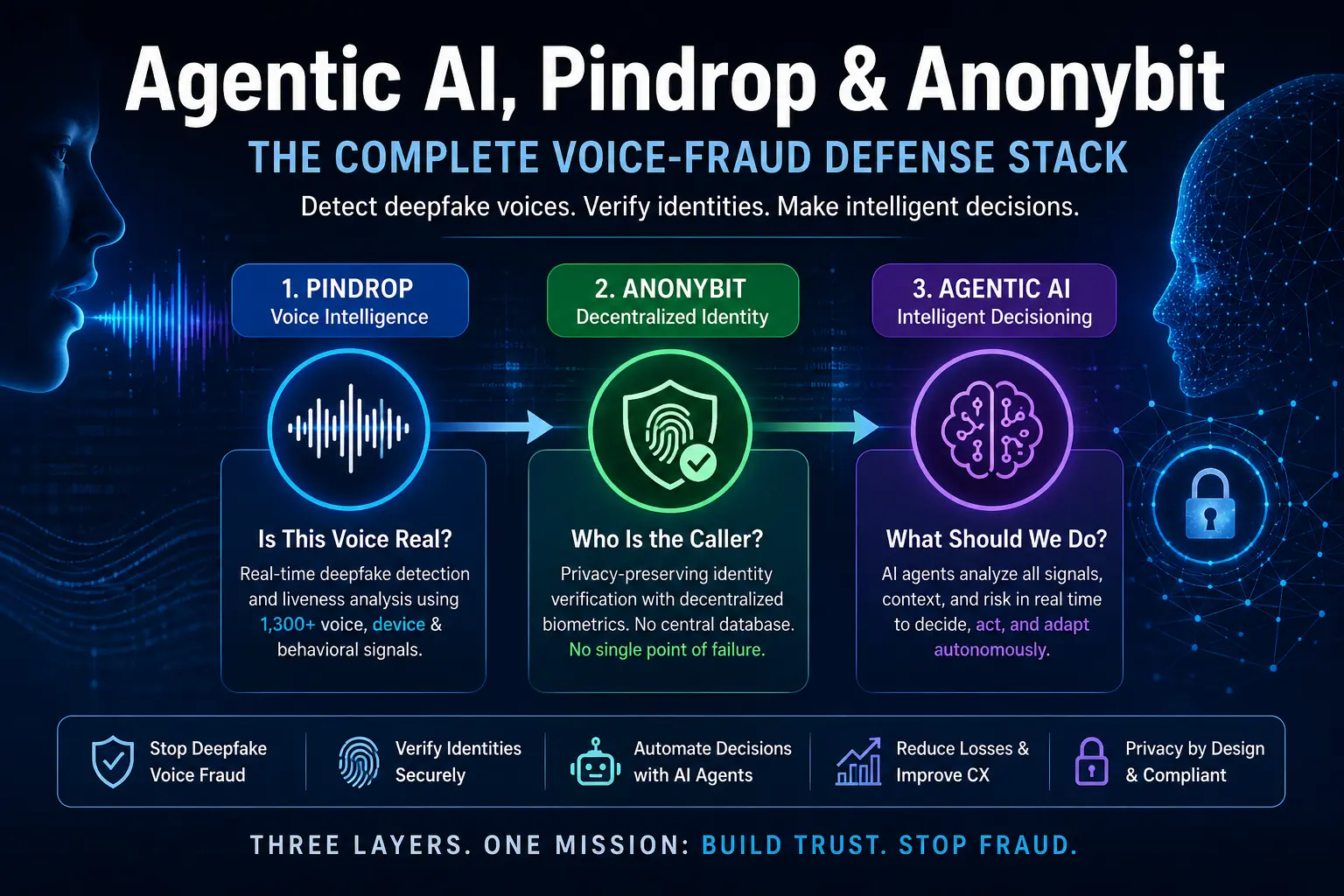
A three-second audio clip is enough to clone a voice convincingly today. That single fact is why “agentic AI,” “Pindrop,” and “Anonybit” keep showing up together in the same breath — as a proposed three-layer defense against deepfake voice fraud and biometric data theft.
This guide breaks down what each piece actually does, how they fit together in a real call, and — more usefully than most coverage of this topic — how to evaluate whether this kind of stack is worth pursuing for your organization, and what to ask before you buy.
Why This Combination Exists
Static authentication — passwords, security questions, one-time codes sent by SMS — was built for a world where attackers moved at human speed and had to compromise accounts one at a time. That world is gone. Generative voice tools can now produce a convincing clone from a few seconds of source audio pulled from a webinar, an earnings call, or a LinkedIn video, and automated bots can run that clone through a contact center’s IVR faster than any human fraud team can react.
The scale of the problem is well-documented. The FTC reported that U.S. consumers lost $12.5 billion to fraud in 2024 across roughly 2.6 million reports, with AI-enabled impersonation cited as a growing driver. Pindrop’s own 2025 Voice Intelligence & Security Report cited a surge in deepfake voice fraud exceeding 1,300% year over year. You’ll see that 1,300% figure and a “call every 46 seconds” statistic repeated across nearly every article covering this topic — worth knowing, since it means the number has been copied forward more than independently re-verified. Treat it as a directional signal of a fast-growing problem rather than a precise, current figure, and confirm anything you cite externally against Pindrop’s latest published report.
The response to that shift has settled into a fairly consistent three-layer pattern across the industry, sometimes called a “Triad Defense”: a voice-liveness layer, an identity/biometric-storage layer, and an orchestration layer that decides what to do with the signals. Pindrop, Anonybit, and agentic AI map cleanly onto those three roles.
Layer One: Pindrop — Is This Voice Real?
Pindrop is a voice-security and fraud-detection company founded in 2011 in Atlanta by Dr. Vijay Balasubramaniyan, Dr. Paul Judge, and Dr. Mustaque Ahamad. Rather than matching a caller’s voice against a single stored voiceprint, Pindrop’s Pulse engine analyzes a wide range of acoustic, device, and behavioral signals per call — commonly cited as 1,300-plus, covering things like:
- Spectral and frequency artifacts that text-to-speech pipelines leave behind
- Device and channel fingerprinting inconsistencies
- Missing or mismatched background/room acoustics
- Behavioral and session metadata that differs from a genuine live caller
From those signals, Pulse issues a liveness score — a real-time estimate of whether the audio is coming from a live human or a synthetic source — typically within a couple of seconds. Pindrop’s product family includes Protect (fraud risk scoring across the IVR and live-agent stages), Passport (passive authentication without security questions), Pulse (deepfake/liveness detection), and Pulse for Meetings (extending the same detection to video calls on platforms like Zoom, Teams, and Webex).
The important design detail: Pindrop is trying to catch synthetic audio before it reaches a human agent, ideally at the IVR stage, and route flagged calls to specialized fraud teams rather than general customer service.
Layer Two: Anonybit — Verifying Identity Without a Central Target
Anonybit, co-founded in 2018 by Frances Zelazny, addresses a different problem: where biometric data lives. A traditional biometric system stores fingerprints, face scans, or voiceprints in a central database. That database is a single point of catastrophic failure — a password can be reset after a breach, but a fingerprint or voiceprint cannot.
Anonybit’s approach fragments biometric templates into encrypted shards using techniques related to multi-party computation and zero-knowledge proofs, then distributes those shards across separate cloud nodes. No single node holds enough data to reconstruct a usable biometric record, and matching happens without ever reassembling the full template in one place. This has two practical effects: it shrinks the impact radius of any individual breach, and it aligns naturally with data-minimization requirements under regulations like GDPR Article 9 and HIPAA, since there’s no single “biometric data store” to declare.
Layer Three: Agentic AI — The Decision Layer
This is the piece that turns two risk signals into an action. A traditional fraud system flags an event and waits for a human to review it — a loop that can take minutes or hours, which is far too slow against an attack that unfolds in seconds.
An agentic layer instead observes the incoming signals continuously and acts on them without waiting for step-by-step instruction: it can allow a call to proceed, silently raise the authentication bar, route the session to a fraud specialist, or block it outright — reasoning across the Pindrop liveness score, the Anonybit identity confirmation, and contextual factors like transaction value, device history, and behavioral baselines, all before a human ever has to make a judgment call.
A simplified version of that logic looks something like this:
if liveness_score is high-risk:
    block and escalate to fraud team
elif liveness_score is ambiguous OR biometric_match is weak:
    require step-up verification
elif transaction_value is high:
    require step-up verification regardless of other signals
else:
    allow, log the decision
The specific thresholds get tuned per environment, but the shape matters more than the numbers: no single signal makes the call alone, and every decision gets logged so a human reviewer — or a regulator — can reconstruct why the system acted the way it did later.
How a Call Actually Moves Through the Stack
Walking through one scenario end to end makes the layering concrete:
- Call arrives. A fraud ring has cloned an executive’s voice from public interview audio and has a bot call the bank’s IVR to request a wire transfer.
- Pindrop scores the audio in real time. Within roughly two seconds, spectral artifacts consistent with synthetic speech push the liveness score into high-risk territory.
- Anonybit checks identity in parallel. The distributed biometric match either confirms or fails to confirm the caller against the account owner’s fragmented template — without ever reconstructing a full biometric record anywhere in the process.
- The agentic layer reasons across both signals plus context — device fingerprint, call metadata, transaction size — and decides in real time whether to allow, escalate, or block, and logs the reasoning.
- Legitimate callers see none of this. A normal customer’s call clears all three checks in the background and proceeds with no added friction; the entire point of the passive-authentication approach is that genuine users never notice a check happened.
Where This Gets Deployed
The clearest fits are environments where sensitive account access happens over voice and where a wrong decision is expensive:
- Banking and financial services — wire authorization, account recovery, and high-value transaction approval
- Healthcare — patient identity verification, prescription and insurance fraud prevention
- Insurance — claims processing over phone channels, a known target for synthetic-identity fraud
- Telecommunications — SIM-swap fraud, which frequently starts with a cloned-voice call to customer service
- Enterprise workforce security — tying consequential AI-agent actions back to a verified human, as organizations deploy more autonomous internal agents
What to Actually Ask Before Adopting This Kind of Stack
Most coverage of this topic stops at “here’s how it works.” The more useful question for a buyer is whether it’s worth deploying, and that depends on a handful of practical factors rarely addressed elsewhere:
Do you have the call volume to justify it?
Pindrop and comparable platforms are enterprise-priced, custom-quoted, and typically structured as annual or multi-year contracts scaled to call volume. There’s no public pricing and no self-serve tier. If you’re a smaller organization, ask whether your existing contact-center vendor (Amazon Connect, Genesys, Five9, Cisco) already has an integration partnership rather than building this from scratch, or whether an MSSP can run it for you.
Who owns false-positive tuning?
Any system scoring this many signals will misfire initially. Ask vendors directly what the onboarding/tuning period looks like, who’s responsible for calibrating thresholds to your specific call patterns, and what the false-positive rate looks like at 30, 90, and 180 days post-deployment — not just the headline accuracy number from a case study.
What’s the actual audit trail?
If the agentic layer is making autonomous decisions, you need to be able to reconstruct exactly why it blocked, escalated, or allowed any given call — both for internal review and for regulators. Ask to see a sample decision log before signing anything.
What’s the human-override path?
Full autonomy without an escape hatch is a liability, not a feature. Confirm there’s a clear process for human review on edge cases where the system’s confidence is low across multiple signals, and that staff are trained on when to override versus trust the system.
Does it cover your other channels?
Voice-liveness detection and biometric identity binding are one layer. You still need equivalent protection for email, chat, and digital onboarding flows — a voice-fraud stack doesn’t make those channels safer on its own.
Is the compliance claim specific to your jurisdiction?
Decentralized biometric storage is a genuinely strong architectural argument for GDPR and HIPAA alignment, but “aligned with data minimization principles” is not the same as “certified compliant.” Get your legal team to review the specifics for your industry and region rather than taking a vendor’s compliance framing at face value.
The Honest Limitations
No detection system is airtight. Independent reviews of voice-fraud platforms note that calls can occasionally slip through, particularly in poorly tuned deployments — this is a class of tool that rewards careful configuration, not a set-and-forget purchase. Pricing opacity makes early-stage budgeting difficult without engaging sales directly. And because this specific three-way combination (agentic AI plus Pindrop plus Anonybit specifically) isn’t a single packaged product from either vendor, integration work — connecting real-time APIs across voice analysis, biometric verification, and orchestration logic — falls largely on your team or a systems integrator.
Beyond This Stack
Whether or not you deploy this exact combination, a layered approach to identity fraud tends to include a few recurring elements worth knowing regardless of vendor:
- Adaptive, risk-based MFA that escalates based on behavior rather than relying on static one-time codes
- Multimodal deepfake detection covering video and face-swap attacks, not just audio
- Verification rituals for high-risk scenarios — simple pre-agreed code words defeat most “loved one in distress” voice-clone scams without any technology at all
- Ongoing staff and customer training — the FTC and CISA both publish free guidance on recognizing AI impersonation, and human awareness remains a meaningful frontline control even with strong technical defenses in place
FAQs
What does agentic AI actually do in this stack?
It’s the decision layer. It receives the liveness score from Pindrop and the identity confirmation from Anonybit, reasons across additional context like device history and transaction value, and decides in real time whether to allow, escalate, or block — without waiting for a human to review each case individually.
How does Pindrop detect a cloned voice?
It analyzes a broad set of acoustic, device, and behavioral signals per call — commonly cited around 1,300 — looking for artifacts that synthetic speech leaves behind but human ears can’t detect, producing a liveness score typically within a couple of seconds.
Why does Anonybit avoid storing a complete biometric record anywhere?
Because a centralized biometric database is a single high-value breach target, and unlike a password, a stolen fingerprint or voiceprint can’t be reissued. Fragmenting the data across nodes means no single breach exposes a usable record.
Is this only relevant for large enterprises?
In practice, the core platforms are enterprise-priced and quote-based. Smaller organizations typically access equivalent protection through a managed security service provider or through a contact-center platform’s built-in integration rather than procuring and integrating each layer independently.
Does this replace the need for other security layers?
No. It addresses the voice channel and biometric identity specifically. Email, chat, and other digital onboarding flows still need their own protections, and human review processes still matter for edge cases.