
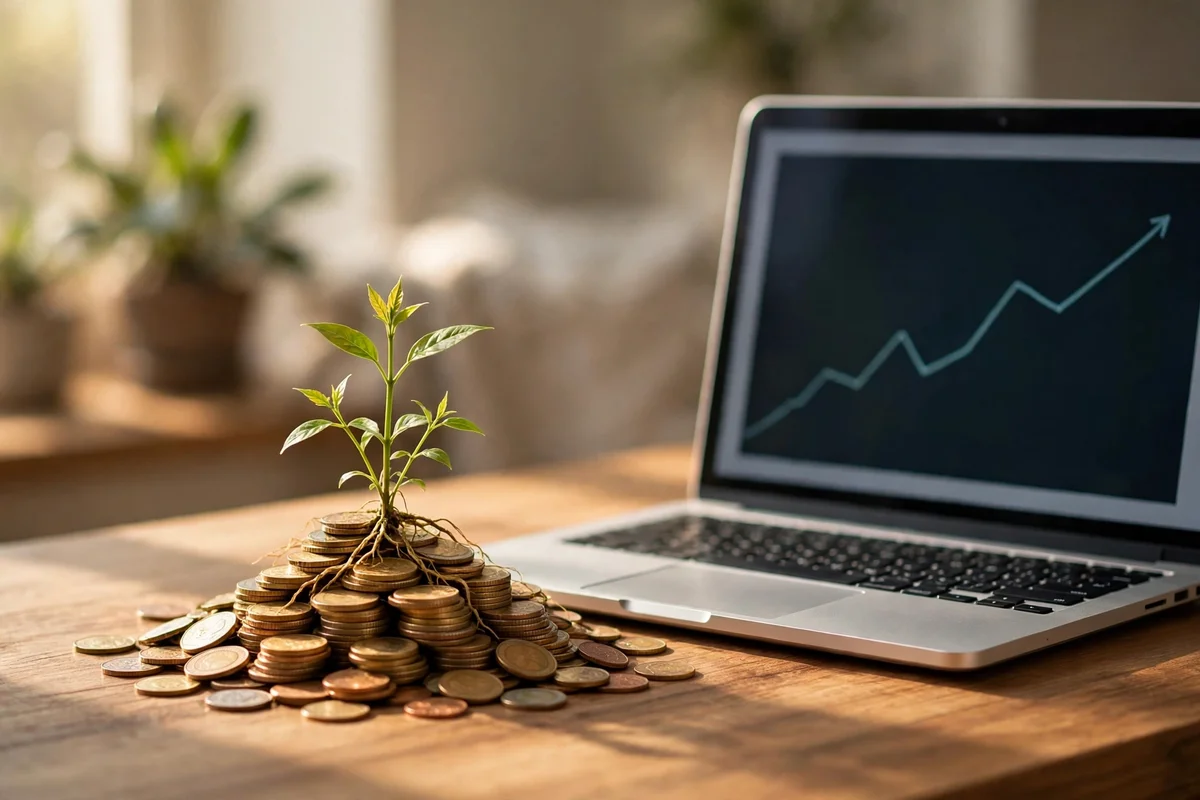
What $100 Actually Gets You
A hundred dollars will not make you rich, and pretending otherwise helps nobody. It will not replace a paycheck. What it can do is smaller and more useful: it can get you started.
Starting matters because investing rewards time more than size: money invested for decades has far more chances to grow than money waiting for the “right” moment.
What $100 Can and Cannot Do
Be clear-eyed about the limits — realistic expectations keep beginners from quitting in the first year.
What $100 can do: open an account, since many brokerages now have no minimum. It can buy into a diversified fund through fractional shares, start the habit of regular investing, and teach you how markets feel.
What $100 cannot do: make you rich quickly. Even in a good year, the gain on $100 is a few dollars, not a few hundred. It cannot replace saving — money you will need in the next year or two belongs in a savings account, not the market. It cannot beat high-interest debt, and it cannot guarantee anything. Investments can lose value, including your original $100.
Pay Off High-Interest Debt First
Before your first $100 goes into the market, look at what you owe.
Credit card debt is the usual problem. Card interest rates are typically far higher than any return you could reasonably expect from investing, so every dollar you pay toward that balance is a certain saving. Investor.gov makes the same point: pay high-interest card debt down aggressively before investing.
That does not mean you must be completely debt-free first. A mortgage at a low fixed rate is different from a card balance that grows when you only pay the minimum.
One exception: if your employer offers a 401(k) match, contribute at least enough to get the full match, even while you pay down debt.
Build an Emergency Fund Before Investing
Investing works best when you can leave the money alone — impossible if every unexpected bill forces you to sell.
Before you invest, set aside a small cash cushion — $500 to $1,000 is a realistic first target — in an accessible savings account. It covers the flat tire or the broken phone, so you never have to raid your investments at the worst moment.
The order matters: a starter cushion first, then high-interest debt, then investing. Our guide on how to save $1,000 fast lays out a three-month plan for that first $1,000; our guide on how to build an emergency fund on a low income covers the same ground for tight incomes.
Why first? Because markets fall. If your $100 drops to $80 the same week your car needs a repair, you will sell at a loss.
Where Beginners Can Start
With debt under control and a cushion in place, your $100 has three sensible homes.
Index Funds and ETFs
An index fund is a basket of investments that tracks a whole market — hundreds of large American companies, say — instead of betting on one company. An ETF is a similar basket you buy and sell like a single share. For a beginner with $100, it is the simplest way to own a little of a lot at once.
Fractional Shares
Not long ago, a single share could cost hundreds of dollars. Fractional shares changed that: most major brokerages now let you buy a slice for as little as $1 or $5.
Retirement Accounts
If your goal is the distant future, a retirement account deserves a look before a regular taxable account. A workplace 401(k) is the first stop if your employer offers one, especially with a match. If not, an IRA you open yourself can hold the same kinds of funds with tax advantages attached. For a first $100, a Roth IRA is often simplest.
How to Pick a Low-Cost Brokerage
A brokerage holds your investment account and lets you buy and sell. A few details matter.
No account minimum and no commission. Most major brokerages now charge $0 commission on stock and ETF trades and have no minimum. If a brokerage charges you just to buy, walk away.
Low expense ratios. Every fund charges a small yearly fee called an expense ratio. For a broad index fund, look for a fraction of a percent — the gap between 0.03% and 0.75% sounds tiny, but over decades it adds up to real money.
A company you trust. Stick to well-known brokerages registered with the SEC and members of FINRA. The SEC’s introduction to investing explains the basics — a good first stop before you open an account. Avoid anyone who contacts you out of nowhere promising high returns.
Open the account, link your bank, and move the $100 in — and set up an automatic monthly contribution, even if it is only $25.
A Simple First-$100 Split
Here is one plain way a beginner might split a first $100. This is an illustration, not a recommendation.
- $70 into a broad stock market index fund or ETF — the core: diversified and low-cost.
- $20 into a bond index fund or ETF. Bonds are generally steadier, so this slice smooths out the ups and downs.
- $10 kept as cash in the brokerage account, to learn how buying works or add to a fund later.
The exact percentages matter less than two things: that the money is invested rather than sitting idle, and that you keep adding to it.
On expectations: investor.gov notes some experts consider a 7–10% annual return a useful estimate for long-term diversified US stock investments, based on historic averages. That is an estimate, not a promise. Never plan around a specific return.
Fees to Watch
Fees are quiet — taken from your returns a little at a time, never billed.
Expense ratios are the yearly cost of owning a fund. A broad index fund with a very low ratio is usually the cheapest way to own the market; actively managed funds charge much more without reliably better results. Trading commissions are now $0 at most major brokerages for stock and ETF trades. Account fees cover maintenance, inactivity, or closing charges — read the fee schedule before you open the account. Advisory fees pay someone to manage your money as a percentage of your balance; at $100, that buys you very little.
Common Beginner Mistakes
Most beginner mistakes are about behavior, not picking the wrong fund.
Trying to time the market. Waiting for the “perfect” moment is the most common way to never invest at all. Nobody can predict short-term moves. Investing a fixed amount on a schedule beats waiting for a dip that may not come.
Checking your balance every day. Daily price moves are noise, and watching them tempts you to sell at the worst moment. Check monthly, or even quarterly.
Chasing hot tips. A stock your cousin swears by, a “guaranteed” opportunity from a stranger — these are the fastest ways to lose a beginner’s money. If an investment needs hype to sell itself, avoid it.
Selling when the market drops. Markets fall — it is normal. Selling during a fall locks in the loss. If your time horizon is years or decades, a drop is when your regular contribution buys more.
Investing money you need soon. Rent money, a bill due next month, savings for a car you need this year — none of that belongs in the market.
FAQs
Can I really start investing with just $100?
Yes. With no-minimum brokerages and fractional shares, $100 is enough to buy into a diversified index fund. Starting and adding regularly matters more than the amount.
What is the best first investment for a beginner with $100?
For most beginners, a low-cost broad market index fund or ETF, which spreads your money across many companies at once. A retirement account holding the same fund is worth considering for the long term.
Should I pay off debt or invest first?
High-interest debt first — the interest saved is a certain gain, while returns are never certain. The exception is an employer 401(k) match, worth capturing even while you pay down debt.
How much money do I need to open a brokerage account?
Many major brokerages now have no account minimum, and fractional shares mean you can start with as little as $1 or $5.
Will I lose my $100?
It is possible. All investments carry risk, and your balance can fall below what you put in. That is why investing is only for money you can leave alone for years.
The Bottom Line
Starting to invest with $100 in 2026 comes down to this: deal with expensive debt first, keep a small cash cushion, open a low-cost brokerage account, buy a diversified, low-fee fund, and keep adding small amounts regularly. A salary saving scheme can make those contributions automatic. Your first $100 will not change your life — the habit it starts might.
Disclaimer: This article is educational information only, not financial advice. Investing involves risk, including the possible loss of principal. Consider your own circumstances and, if needed, speak to a qualified financial adviser before making investment decisions.