
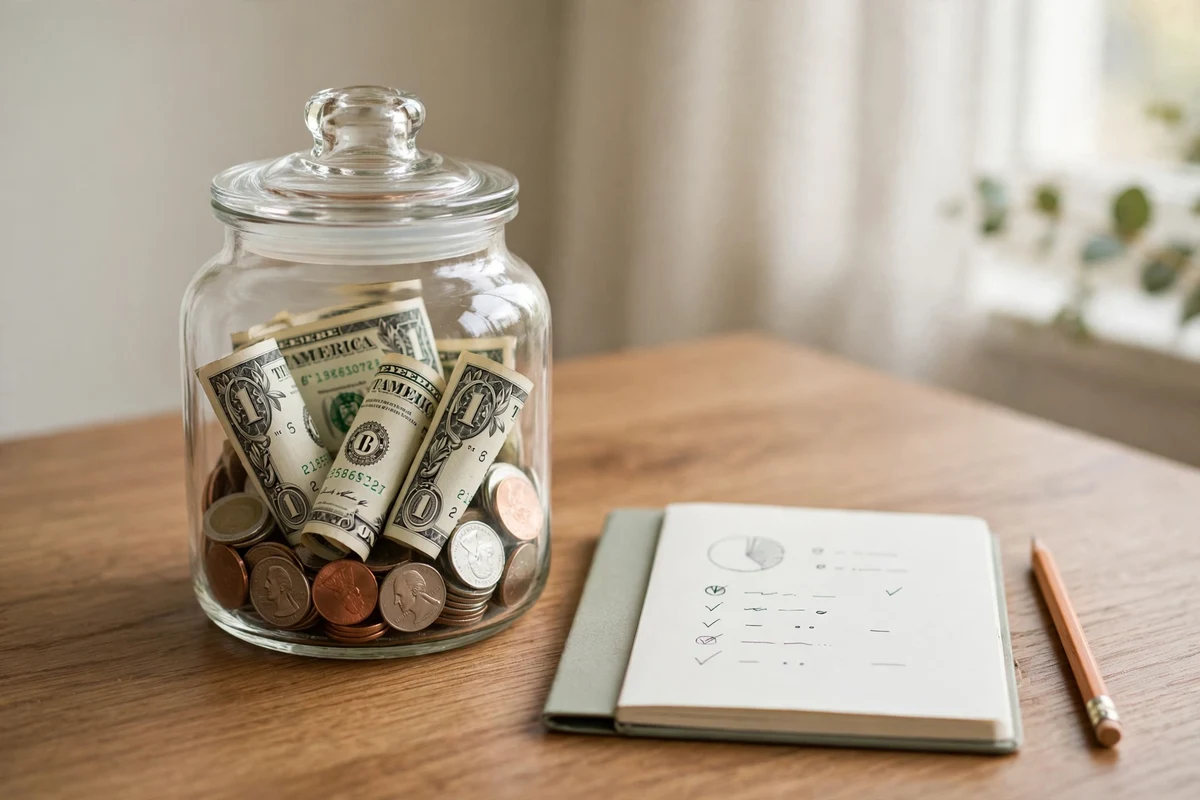
Why $1,000 Is the Right First Goal
A thousand dollars is not a fortune, and that is exactly why it works as a first savings goal. It is big enough to matter and small enough to reach. A car repair, a vet bill, a broken phone, or an insurance deductible usually lands in that range, and having the cash on hand turns a stressful week into an annoying one. Bankrate’s 2026 Annual Emergency Savings Report found that only 47% of Americans have enough savings to cover a $1,000 emergency without borrowing — so if you are starting from zero, you are normal.
Pick Your Timeline First
Saving $1,000 feels vague. Saving $77 a week feels like a plan. Before you cut anything, pick a deadline that fits your pay:
| Timeline | Per week | Per biweekly paycheck |
|---|---|---|
| 1 month | About $250 | About $500 |
| 3 months | About $77 | About $154 |
| 6 months | About $38 | About $77 |
Three months is the sweet spot for most people. One month is a sprint that usually needs selling something or a tax refund to work, and six months is slow enough that motivation fades. Write the date down — “Save $1,000 by February 7” beats “save $1,000 soon” every time.
Step 1: Open a Separate Account and Automate It
Do this before you save a single dollar. Open a savings account at a different bank from the one that holds your checking account, so moving money back takes a day or two. That small delay stops most impulse withdrawals. Then set up an automatic transfer for the day after each payday — for a three-month goal, about $154 per biweekly paycheck. The transfer happens before you have a chance to spend the money, which is the whole point: willpower is unreliable, but an automatic transfer is not.
Choose an account with no monthly fee that pays interest. Online high-yield savings accounts generally pay far more than the big brick-and-mortar banks. The interest is a small bonus, not the reason to save. The reason is separation: money sitting in checking gets spent, and money in a separate account gets left alone. If your employer offers payroll-based saving, that works too — a fixed amount from each paycheck can go straight into savings before it ever reaches checking. A salary saving scheme can make the habit automatic.
Step 2: Find the Money With a 10-Minute Audit
You cannot cut what you cannot see. Take your last two bank and card statements and add up what you spent on food, subscriptions, shopping, and anything you do not remember buying. Most people find at least one surprise — a subscription they forgot, or a food delivery habit that costs more than they thought. A notebook and ten honest minutes will do: where did money go last month that you barely noticed? That is where your first $100 will come from.
Step 3: Cut the Big Bills Before the Small Ones
The usual advice is to cut coffee and snacks first. That is backwards. Small treats are cheap, and cutting them makes saving feel miserable. Start with the biggest flexible bills, because one change there is worth weeks of skipping small things. Cut in this order:
Subscriptions first. Cancel the ones you have not used in the last month. Streaming services, apps, and memberships add up fast, and most people are paying for at least one they forgot about. Keep only the one or two you genuinely use every week.
Food delivery and takeout next. A takeout meal often costs two or three times what the same food costs to cook at home. Cook one or two extra meals at home each week and put the difference straight into savings — that alone can cover a large part of your weekly target.
Groceries after that. Plan meals before you shop, buy the store brand for basics, and shop with a list. The savings repeat every week, which is what matters over three months.
Phone, internet, and insurance last. Call your providers and ask what cheaper plans exist. A lower phone plan can free up money every month without changing your daily life at all.
Work down the list until your weekly target is covered, then stop. Cutting the top two or three items is how people finish in month three.
Step 4: Sell Things and Earn a Little Extra
If cutting alone does not reach your weekly number, the fastest way to close the gap is selling things you no longer use. One item a week — a jacket, an old phone, a game console, a piece of furniture — can add up to several hundred dollars over three months. List it, sell it, and move the money into savings the same day.
A small source of extra income helps too, but it does not need to be a second job. A few hours of weekend work, a freelance task, or overtime can cover the part of the weekly target that cuts cannot. Even $25 or $50 a week of extra income shortens the timeline by a month or more. Send half of every windfall straight to savings the moment it arrives — a tax refund, a birthday gift, a rebate, a bonus. Money you did not budget for is the easiest money to save.
Step 5: Where to Keep the Money
Keep the $1,000 in the separate savings account you opened in step one. Do not keep it in cash at home, where it is easy to dip into, and do not invest it — three months is far too short a horizon for investing, and the goal is safety, not growth.
Once you reach $1,000, that money becomes your starter emergency fund, for emergencies only: a car repair, a medical bill, a broken appliance. If you have to use it, that is what it is for — and then you rebuild it the same way, starting again with an automatic transfer. If you want to build beyond $1,000 into a fuller cushion, our guide on how to build an emergency fund on a low income picks up where this one leaves off.
If you are coming out of debt, the order matters: a small $1,000 cushion first, then attacking the debt, then building the fund further. Our guide on how to rebuild your finances after paying off debt walks through that sequence.
A Realistic 90-Day Plan
Month 1: Open the separate account and set up the automatic transfer. Cancel one or two subscriptions. Cook two extra meals at home each week. Sell one unused item. End of month: roughly $300 saved.
Month 2: Keep the automatic transfers going. Add one small source of extra income or sell one item a week. Send half of any unexpected money straight to savings. End of month: roughly $650 saved.
Month 3: Stay the course. In the final two weeks, sell one more item and cook at home for one more week to close the gap. End of month: $1,000 saved.
The numbers will not be exact. If you fall short in one week, catch up the next; if you overshoot, bank the extra.
FAQs
How fast can I realistically save $1,000 on a tight budget?
Three months — about $77 a week — using a mix of small cuts and a little extra income. Six months, at about $38 a week, is realistic on almost any income. One month usually needs a one-off boost, like selling things or a tax refund.
How much should I save per paycheck?
For a three-month goal, about $154 per biweekly paycheck. Set the automatic transfer for the day after payday.
What if I can only save $10 a week?
Start with $10 a week. That is $520 in a year, and you will get faster as the habit sticks. A small amount saved consistently beats a large amount planned and never started.
Where is the best place to keep the $1,000?
A separate high-yield savings account at a different bank from your checking account, with no monthly fee and no debit card attached.
What should I do once I hit $1,000?
Leave it alone as your starter emergency fund, for real emergencies only. Then decide your next goal: keep building toward one month of expenses, or turn to paying down high-interest debt while the $1,000 cushion protects you.
The Bottom Line
Saving $1,000 fast on a tight budget comes down to four things: a deadline you can picture, a separate account the money goes into automatically, a short list of cuts that starts with the biggest bills, and a little extra income or selling to close the gap. Together, over about three months, they add up to a thousand dollars — and to the confidence of knowing the next unexpected bill does not have to become a crisis.