
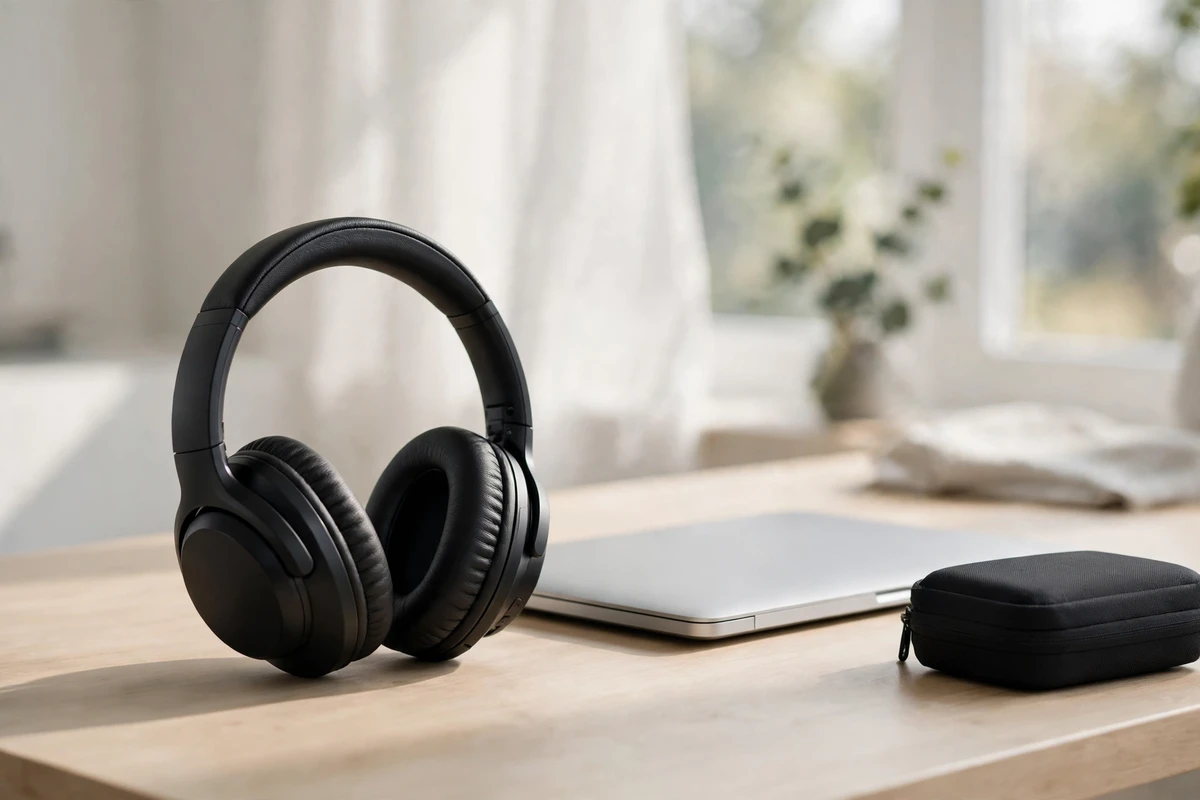
The best noise-cancelling headphones in 2026 are all good at the same basic job: they make a plane cabin, a train carriage or an open office quiet enough to think in. The differences between them are smaller than the marketing suggests, and they come down to the details — how long the battery lasts, how they sound on your phone, how heavy they feel after three hours, and whether their best features work on the phone you actually own.
Prices below are US list prices as of November 2026; flagships are discounted often, so check before you buy.
Comparison table
| Headphones | Best for | List price (US) | Battery (ANC on) | Weight |
|---|---|---|---|---|
| Sony WH-1000XM6 | Best overall | $449.99 at launch | Up to 30 hours | 254 g |
| Bose QuietComfort Ultra (2nd Gen) | Best noise cancellation and calls | $449 | Up to 30 hours (23 with Immersive Audio) | ~264 g |
| Sennheiser Momentum 5 Wireless | Best battery life and sound | $399.95 | Up to 57 hours | — |
| Apple AirPods Max 2 | Best for iPhone owners | $549 | Up to 20 hours | 386 g |
| Sonos Ace Ultra | Best for home cinema | ~$449 | Up to 35 hours | — |
| Soundcore Space One | Best budget pick | ~$100 | Up to 40 hours | — |
Battery figures are the manufacturers’ ratings with noise cancellation on. Real-world results vary with volume, codec and features — independent lab testing measured the Sony XM6 at over 37 hours, well past its 30-hour rating, while the Bose 2nd Gen measured around 27 hours against the same 30-hour rating.
Sony WH-1000XM6 — the best overall pick
Sony’s WH-1000XM6 is the default recommendation for most people, and it earns that spot by doing everything well rather than by winning one category outright. It launched at $449.99 in the US, with a current Sony store listing of $459.99, and it is regularly discounted during sales. It is rated for up to 30 hours with noise cancellation on, or 40 hours with it off — and that rating is conservative. SoundGuys’ lab testing measured 37 hours and 14 minutes of continuous playback with ANC on, though on LDAC Sony’s help guide puts the figure at 26 hours.
A 12-microphone array driven by Sony’s QN3 processor handles steady noise — engines, air conditioning, train rumble — without the audible gear-shift older headphones used to make. It also folds again, fixing one of the most complained-about design decisions of the XM5, and it supports LDAC high-resolution audio, multipoint connection to two devices at once, and a quick charge that gives roughly three hours of playback from three minutes plugged in. The catch is the phone in your pocket: LDAC does not work on iPhones, and there is no USB-C digital audio. If you already own the XM5, the upgrade is not automatic — it is often heavily discounted now, and for many people it remains the smarter purchase.
Best for: Most buyers, especially Android users and frequent travellers. Price: $449.99 at launch. Battery: up to 30 hours (ANC on), 40 hours off.
Bose QuietComfort Ultra Headphones (2nd Gen) — the quietest and the best for calls
If silence itself is the priority, the Bose QuietComfort Ultra (2nd Gen) is the pair to beat. Bose released the second generation in September 2025, and it lists at $449 in the US. It is rated for up to 30 hours with noise cancellation on, or 23 hours with Bose’s Immersive Audio spatial sound switched on, and up to 45 hours with ANC off. Independent testing measured around 27 hours with ANC on — a little under the rating, and a little under the Sony in the same test, but still a full working week of commuting.
What sets the Bose apart is the cancelling and the calls. Reviewers consistently put its adaptive noise cancellation at or near the top of the class, and its microphones handle voice calls more clearly than the Sony’s. The second generation also adds lossless audio over USB-C, so a wired connection to a laptop or phone now sounds as good as the hardware allows, and you can charge over USB-C while listening.
Best for: People who want the deepest quiet, take a lot of calls, or wear glasses. Price: $449. Battery: up to 30 hours (ANC on), 23 hours with Immersive Audio.
Sennheiser Momentum 5 Wireless — the battery and sound champion
The Sennheiser Momentum 5 Wireless, launched on 16 June 2026 at $399.95, is the sound-first alternative to Sony and Bose — and it wins the battery contest by a distance. Sennheiser rates it at up to 57 hours with noise cancellation on, nearly double the Sony and Bose, and a 10-minute charge is rated for about 7 hours of playback. The battery itself is a user-replaceable 700 mAh cell, so a worn-out battery does not have to mean new headphones — a genuinely unusual feature in 2026, and a real reason to consider the Momentum 5 if you plan to keep your headphones for years.
Its tuning is warmer and more detailed than the Sony’s out of the box, and the Momentum 5 supports aptX Lossless and Dolby Atmos. The compromise is noise cancellation, which still trails Sony and Bose on sharp, sudden sounds.
Best for: Long listening sessions, audiophiles, and anyone who hates charging. Price: $399.95. Battery: up to 57 hours (ANC on).
Apple AirPods Max 2 — the best for iPhone owners, and the heaviest
Apple’s 2026 revision of the AirPods Max keeps the sculptural aluminium design — and the 386-gram weight that comes with it — while moving to the newer H2 chip. It lists at $549 in the US, the most expensive pair in this guide by a clear margin, and it is rated for up to 20 hours with noise cancellation on — the weakest battery life here by a long way.
On an iPhone, nothing else integrates as smoothly. Spatial Audio with head tracking, automatic switching between Apple devices, and the tightest pairing experience in the class are all built in, and independent testing has put its noise cancellation at the very top of the group. The price is the honest objection: at $549 you pay about $100 more than the Sony or Bose for shorter battery life and a pair that does not fold — and on Android, most of what makes it special disappears. For more on Apple’s ecosystem, see our guide to the best wireless earbuds of 2026, where the AirPods Pro 3 make a stronger case for most iPhone owners.
Best for: iPhone owners who want the deepest Apple integration and do not mind the weight. Price: $549. Battery: up to 20 hours (ANC on).
Sonos Ace Ultra and Soundcore Space One — the specialists
The Sonos Ace Ultra, released in September 2026 at around $449, is the obvious buy if a Sonos soundbar runs your TV. Its headline feature is TV Audio Swap, which moves the sound from a Sonos soundbar to your headphones for private, spatial-audio movie watching — something no other pair here does. It is rated for up to 35 hours with noise cancellation on, and reviewers rate its noise cancellation and sound as strong all-rounders.
Good noise cancellation no longer starts at $400. The Soundcore Space One lists at around $100 and is rated for 40 hours with noise cancellation on — longer than the Sony, the Bose or the Apple pair. It folds, and at that price it is the pair to buy if you want quiet on a budget. If you are kitting out a home office on a budget, pair it with the picks in our guide to the best laptops for remote work in 2026 and you have a quiet workspace for far less than the flagship route.
Best for: Sonos owners (Ace Ultra) and budget buyers (Space One). Prices: ~$449 and ~$100. Battery: up to 35 and 40 hours (ANC on).
What to watch out for
Battery ratings are not comparable across brands. Every manufacturer tests differently — different volumes, different codecs, different features switched on. The Sony XM6 is rated at 30 hours but measured at over 37 in independent lab testing, while the Bose 2nd Gen is rated at 30 and measured at around 27. Treat the rating as a rough guide, and look for independent measurements before you decide.
Spatial audio costs battery. Bose’s Immersive Audio drops the 2nd Gen from 30 hours to 23. Sony’s spatial features and LDAC also trim runtime.
Your phone decides your codec. LDAC and aptX Lossless only work on Android. iPhones use AAC, which means the Sony and Sennheiser sound-quality advantages shrink on Apple devices.
Weight and returns matter. The AirPods Max 2 weigh 386 grams against the Sony’s 254 grams — easy to ignore in a shop, hard to ignore on a five-hour flight. Buy from a retailer with a proper returns window. If you are buying for travel, the case matters too — the Sony folds into a compact case, the AirPods Max does not. Our guides to the best travel insurance of 2026 and the best carry-on luggage of 2026 cover the rest of the kit.
FAQs
Which noise-cancelling headphones are the best overall in 2026?
The Sony WH-1000XM6, for most people. It has the most complete package: strong noise cancellation, the widest codec support, a folding design, multipoint, and battery life that beats its own rating in independent testing. The Bose QuietComfort Ultra (2nd Gen) is the better pick if silence and call quality are your top priorities.
Do I need to spend $450 to get good noise cancellation?
No. The Soundcore Space One, at around $100, cancels noise well enough for commuting and office use, and lasts 40 hours per charge. You pay the extra $350 for the last stretch of silence, better sound, better microphones and a more comfortable fit — worth it for frequent flyers, not essential for everyone.
The short version
Buy the Sony WH-1000XM6 if you want the best all-rounder and you use Android. Buy the Bose QuietComfort Ultra (2nd Gen) if silence and call quality matter most, or you wear glasses. Buy the Sennheiser Momentum 5 if you listen for hours and hate charging, or you want the warmest sound and a replaceable battery. Buy the AirPods Max 2 only if you live inside Apple’s world. Buy the Sonos Ace Ultra if you own a Sonos soundbar. And if your budget is tight, buy the Soundcore Space One — it gives you most of the quiet for about a quarter of the price.