
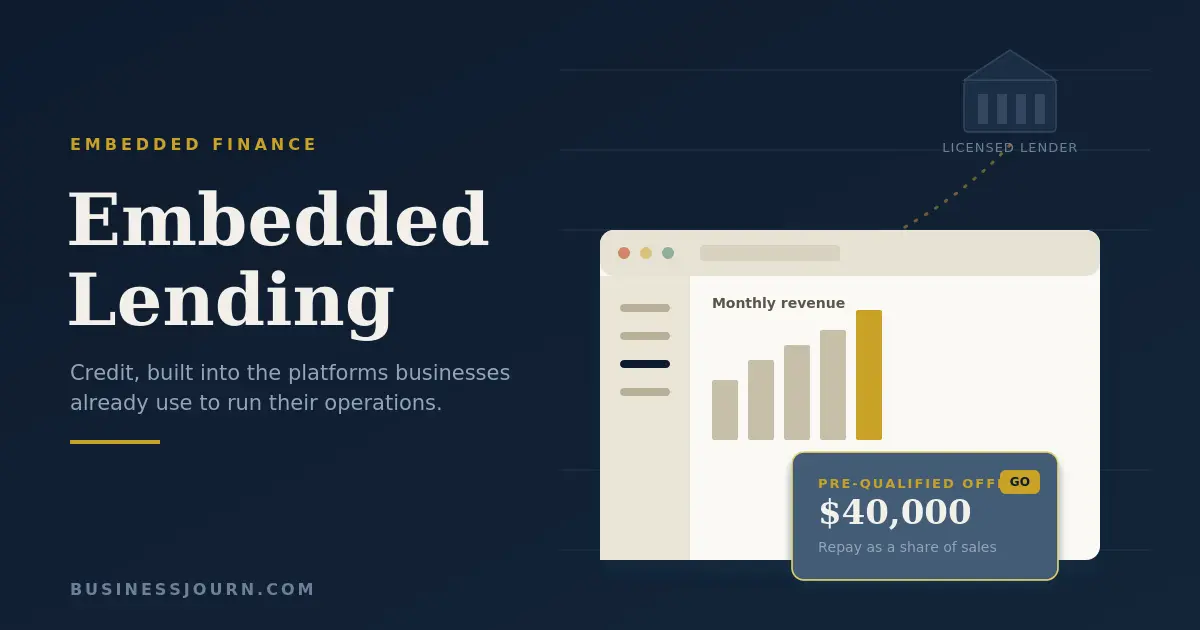
A small equipment rental company processes payments through the same software it uses to schedule jobs and invoice clients. One afternoon, a financing offer appears inside that software: a $40,000 line of credit, pre-qualified based on the rental company’s own transaction history. No bank visit, no loan officer. No separate application. The owner accepts the offer, and the funds land in the business account two days later.
That’s embedded lending, and it’s becoming the default way small businesses and consumers get access to credit.
What Is Embedded Lending?
Embedded lending is the practice of offering loans, credit lines, or financing products directly inside a platform that isn’t a bank — a SaaS tool, a marketplace, a point-of-sale system, or a booking app. A licensed lender still originates the loan and carries the regulatory responsibility, but the customer never has to leave the software they’re already using to get it.
The mechanics matter here because “embedded lending” gets used loosely. It sits inside a bigger category called embedded finance, which covers any financial product — payments, insurance, banking accounts, cards, or credit — built into a non-financial platform. This is the credit-specific slice of that category, and it comes with obligations the other slices don’t: underwriting, servicing, collections, and ongoing compliance for the life of the loan, not just at the point of sale.
Behind most embedded lending programs sits Banking-as-a-Service (BaaS) infrastructure. BaaS providers give platforms API access to regulated banking functions — account creation, money movement, lending rails — without the platform having to become a licensed bank itself. Embedded finance is the customer-facing layer; BaaS is the plumbing underneath it.
How Embedded Lending Actually Works
Programs vary by provider, but the flow is consistent across nearly every model on the market:
1. Data-driven pre-qualification. The platform already holds transaction history, sales volume, payment timing, or account activity for its users. That data feeds a risk model that flags who’s eligible before they ever ask for money.
2. In-app offer. Instead of a loan application form, the user sees a specific offer — a dollar amount, a rate or fee structure, and repayment terms — sitting inside their existing dashboard.
3. Fast verification. The user confirms identity and business details, and automated underwriting checks the offer against real-time data rather than a static credit file.
4. Disbursement. Approved funds move into the connected account, often within one to two business days, sometimes faster.
5. Automated repayment. Repayment is usually pulled automatically, either as a fixed installment or as a percentage of ongoing sales, so payments track with the business’s actual cash flow rather than a rigid monthly schedule.
The entire loop — offer, accept, fund, repay — runs on the same rails the platform already uses for payments, which is why the experience feels less like borrowing and more like a feature.
Four Ways Platforms Structure an Embedded Lending Program
Not every lending program is built the same way. Platforms generally choose from one of four structures:
| Model | How it works | Best for |
|---|---|---|
| Full-stack BaaS provider | A single provider holds the banking license, absorbs credit risk, and owns the infrastructure end to end | Platforms that want speed and want to avoid managing multiple vendors |
| Aggregator / lending-as-a-service | A software layer connects the platform to one or more third-party banks that actually fund the loans | Platforms that want flexibility across multiple lenders but can accept an extra integration layer |
| Revenue-based advance | Not a loan at all — a provider purchases a share of future revenue and collects repayment as a percentage of sales | Subscription and recurring-revenue businesses without much collateral |
| Point-of-sale installment / BNPL | Financing tied to a specific purchase, split into fixed installments at checkout | E-commerce and consumer retail |
Choosing between them comes down to how fast the platform needs to launch, how much regulatory exposure it’s willing to hold, and whether its customers have predictable revenue or one-off purchases.
Where Embedded Lending Shows Up Today
It has moved well past its early home in e-commerce checkout financing. Current use cases include:
- Vertical SaaS platforms offering working capital to the merchants, contractors, or salons that already run their operations through the software
- Marketplaces advancing pay to sellers, freelancers, or contractors based on pending or completed jobs
- Healthcare platforms, including fertility care and elective procedure providers, financing treatment in stages tied to milestones rather than a single lump sum
- Real estate portals surfacing mortgage pre-approval directly inside property listings
- Travel and booking sites splitting the cost of a trip into installments at the point of booking
- Agriculture technology platforms financing equipment or inputs against expected harvest revenue
- Education platforms embedding tuition financing into the enrollment flow
The common thread: financing shows up at the exact moment a financial decision is already being made, inside the tool the customer trusts for something else entirely.
Why Platforms Are Adding Lending Now
Three forces are pushing it from a nice-to-have into a core growth line for software platforms.
Retention
A platform that finances a customer’s growth is harder to leave than one that just processes their payments. Businesses that take capital tend to come back for a second round, and every additional financial product a customer uses increases switching costs.
Revenue diversification
Lending gives platforms a way to monetize the transaction data they already collect, without charging more for the core product. Fee income or revenue share from a lending partner adds a margin line that didn’t exist before. Bain & Company’s research on embedded finance found that platforms and enablers offering payments, lending, banking, and cards were on pace to more than double their combined revenue within a few years of the category taking off — lending and payments are the two segments driving most of that growth.
Underwriting accuracy
Traditional credit models rely on static, backward-looking data. A platform sitting on live sales and payment behavior can assess risk more accurately and extend credit to businesses that a traditional bank would pass on, particularly younger businesses without years of tax returns to show.
For the businesses on the receiving end, the advantage is speed and access. Financing decisions that used to take weeks now take minutes, and approval is based on how the business is actually performing rather than a credit score built on unrelated history.
The Regulatory Reality
This feels frictionless to the borrower, but the lending activity itself is still regulated the same way it always has been. Putting a loan inside a piece of software doesn’t change who’s accountable for underwriting standards, disclosures, or fair lending compliance — it just changes who the customer sees.
That accountability sits with the licensed financial institution behind the program, but responsibility is shared across the stack in practice. The platform is expected to support compliant workflows and controls. The lender owns underwriting, disclosures, and regulatory reporting. Any technology or infrastructure provider in between has to keep those pieces coordinated as the program scales.
Platforms evaluating an embedded lending partner should be looking past the initial launch and asking how the partner handles loan servicing, reporting, and compliance over the full life of the loan — not just how fast they can get a pilot live.
Risks Worth Planning For
This isn’t risk-free for any party in the chain.
- Overborrowing. Frictionless access to credit can make it easy for a business or consumer to take on more debt than they can service, particularly when offers are proactive rather than requested.
- Data exposure. Lending decisions run on sensitive transaction and behavioral data shared across multiple systems, which raises the stakes on data security and privacy compliance.
- Concentration risk for platforms. A platform that leans heavily on one lending partner inherits that partner’s risk appetite — if the partner tightens credit standards or exits a segment, the platform’s financing offer disappears with it.
- Fraud exposure. Automated, high-speed underwriting reduces friction, but it also gives fraud less time to get caught before funds move.
None of these risks are reasons to avoid it. They’re reasons to pick infrastructure and lending partners with strong controls rather than the fastest possible integration.
What’s Next for Embedded Lending
A few trends are shaping where it goes from here:
- Milestone-based and staged financing is expanding beyond healthcare into any industry where costs unfold over time rather than at a single purchase point.
- AI-driven underwriting is getting sharper at pricing risk using alternative data, which should keep expanding access for businesses that traditional models overlook.
- Consolidation among infrastructure providers is pushing platforms toward fewer, more capable partners rather than stitching together several point solutions.
- Regulators are catching up, and platforms that build compliance into the program from day one will have an easier time scaling across states and countries than those trying to retrofit it later.
FAQs
Is embedded lending the same as Buy Now, Pay Later?
No. BNPL is one form of this, specific to point-of-sale installment financing. It also covers working capital lines, revenue-based advances, and merchant financing that have nothing to do with a single purchase.
Who actually lends the money in an lending program?
A licensed bank or lending institution, even when the platform is the one presenting the offer. The platform handles distribution and the customer relationship; the lender handles capital, underwriting, and regulatory compliance.
Does taking an embedded loan affect a personal credit score?
It depends on the program. Many embedded lending products, especially revenue-based advances for businesses, are underwritten using business transaction data instead of a personal credit pull. Programs vary, so the specific terms matter more than the category.
How fast can a platform launch an embedded lending program?
Timelines range from a few days to several months depending on the model. Full-stack BaaS providers with pre-built components can get a basic program live quickly; custom underwriting models and multi-market compliance requirements extend that timeline.
The Bottom Line
Embedded lending works because it removes the gap between needing money and getting it. Platforms that sit on real-time transaction data are better positioned to price and extend credit than a bank looking at a credit file that’s months out of date, and customers get financing without breaking their workflow to go find it.