
Introduction
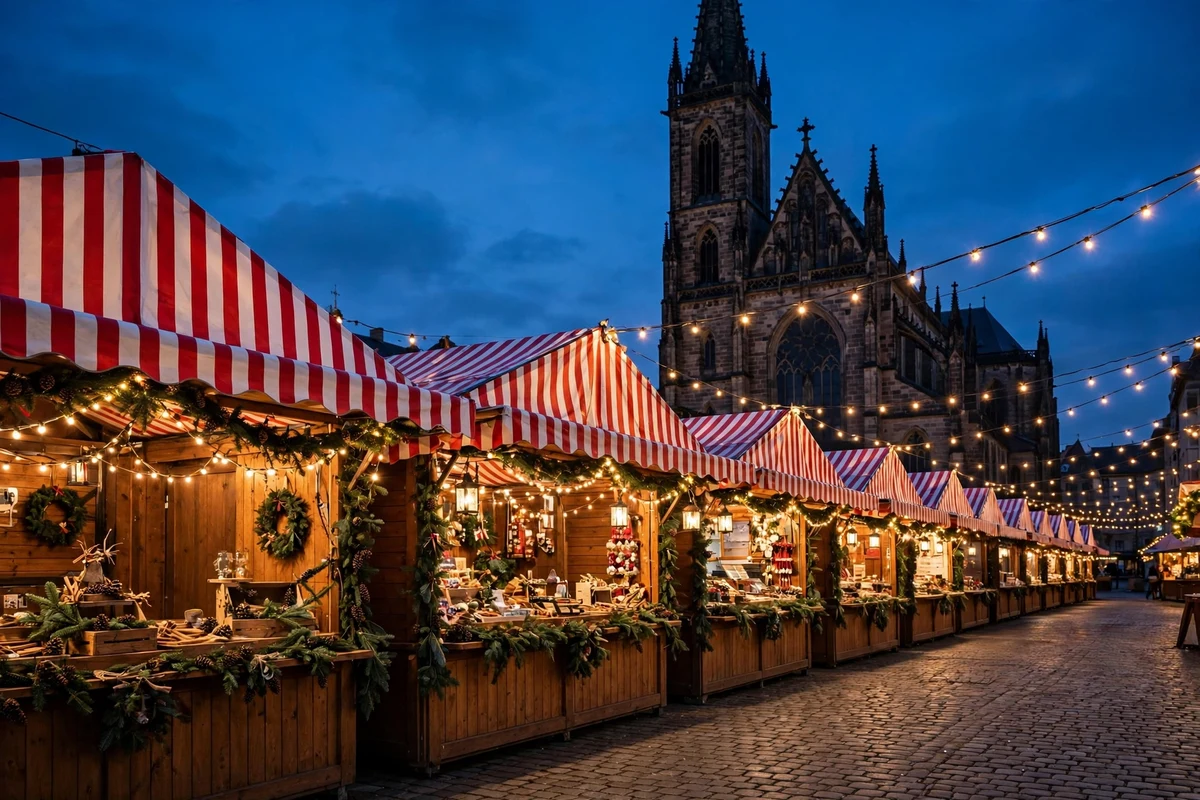
There is a moment at the Nuremberg Christkindlesmarkt, usually just as the light starts to go, when the whole square seems to hold its breath. The stalls are built of regional spruce and topped with red-and-white striped cloth roofs, and when their lights come on — around half past four in the afternoon — the Hauptmarkt turns into what locals call the “little town of wood and cloth”. It is a scene that has drawn visitors to this corner of Franconia for centuries, and in 2026 it returns on Friday 27 November.
Nuremberg’s market is not just another stop on the German Christmas market circuit. It is one of the oldest and most famous Christmas markets in the world, with around two million visitors a year making their way to the medieval old town to stand in front of the Frauenkirche, watch the Christkind open the market from its balcony, and eat sausages that have been made to the same recipe since 1497. The market is big, but it is also deliberately traditional: most of the roughly 180 stalls sell goods made by regional manufacturers, and the food on offer is unmistakably Franconian.
This guide covers everything you need to plan a visit in 2026: the dates and opening hours, the opening ceremony, what to eat and what to buy, and a few practical tips that make the difference between a relaxed evening and a crowded one. Every date, time and detail below comes from the market’s published information for this year, so you can plan with confidence.
Nuremberg Christkindlesmarkt 2026 at a Glance
| Dates | Friday 27 November – Thursday 24 December 2026 |
| Location | Hauptmarkt, Nuremberg, in front of the Frauenkirche and next to the Schöner Brunnen |
| Hours | Daily 10:00–21:00; Christmas Eve 10:00–14:00 |
| Opening ceremony | Friday 27 November at 17:30, with the Christkind’s prologue from the Frauenkirche balcony |
Dates and Opening Hours
The Nuremberg Christkindlesmarkt 2026 runs from Friday 27 November to Thursday 24 December 2026. It is open every day from 10:00 in the morning until 21:00 in the evening, with one exception: on Christmas Eve, the final day, the market closes early at 14:00. If you are planning a trip around the last weekend before Christmas, keep that early finish in mind — the market’s last full day is Wednesday 23 December.
The opening ceremony is the single most important moment of the whole season, and it is worth planning around. On Friday 27 November at 17:30, the Christkind — a young woman chosen from Nuremberg, dressed as the Christmas Angel — gives her prologue from the balcony of the Frauenkirche, the church that stands at the edge of the Hauptmarkt. The stalls pause briefly from about 17:25 to 18:00 while the ceremony takes place, so trading stops and the square falls quiet for the prologue. Arrive well before half past five if you want a view of the balcony, because the opening Friday is one of the busiest nights of the year.
The main market is not the only thing happening on the Hauptmarkt in December. Two smaller markets run alongside it with different closing dates. The Kinderweihnacht, the children’s Christmas market, stays open until 30 December, six days after the main market closes. The Markt der Partnerstädte, the market of Nuremberg’s sister cities, runs until 23 December. Both are worth a look in their own right, and they give you a reason to linger in the city even after the main stalls have packed up.
What It Is
The Christkindlesmarkt — “Christ Child Market” — is one of Germany’s oldest Christmas markets. Advent markets in Nuremberg were first mentioned in the 16th century, and the earliest proper documentation of the market in this form is an inscribed box from 1628. That is nearly four hundred years of recorded history, and the market has survived more than one interruption: it stopped during the Second World War and was re-established in 1948, with the opening ceremony that still runs today.
What you see when you walk onto the Hauptmarkt is a deliberate piece of tradition. About 180 stalls fill the square, built of regional spruce with red-and-white striped cloth roofs — the reason the market is nicknamed the “little town of wood and cloth” (Stadt aus Holz und Tuch). More than 30 of the stalls date back to 1890, and around two million visitors a year come to see it. The setting matters as much as the stalls: the market stands in the medieval old town, in front of the Frauenkirche and next to the Schöner Brunnen fountain, so the whole square reads as one picture rather than a collection of booths.
The opening ceremony is part of that tradition rather than a modern addition. The Christkind is not a mascot but a real young woman from Nuremberg, chosen for the role, and her prologue from the Frauenkirche balcony is the moment the market officially begins. It is the reason the stalls pause for half an hour on opening night, and it is the moment most regular visitors would tell you not to miss.
What to Eat
Food is half the reason to go, and two Nuremberg specialities dominate the market. If you eat only two things at the Christkindlesmarkt, make them these.
First, the Nürnberger Rostbratwurst — order “Drei im Weggla”. The city’s small grilled sausages are seasoned with marjoram, and their size and ingredients were written down as early as 1497. Only a sausage made within the city limits, weighing about 23 grams and roughly as long as your little finger, may be called an “Original Nürnberger”. At a street stall they are served three in a bun — “Drei im Weggla” in Franconian dialect — grilled over beech wood. It is the market’s signature snack, and it is the one thing you will see in almost every visitor’s hand.
Second, the Nürnberger Lebkuchen. Gingerbread was baked in Franconia as early as the 13th century, and Nuremberg became its most famous exporter. Elisenlebkuchen is the finest variety, made with at least 25% nuts and barely any flour. Lebkuchen-Schmidt, baking since 1927, is the best-known maker; its stall and its main store at the Hauptmarkt sell the classic chocolate-covered tins that are collector’s items in their own right. A tin of Lebkuchen is also one of the easiest gifts to carry home, which is part of why the stalls are always busy.
Beyond those two, try the sweet roasted almonds and the blueberry mulled wine (Heidelbeerglühwein) sold around the square. The blueberry version is a local twist on the usual mulled wine, and like the sausages and the Lebkuchen it is something you will find done best here, at the market where it belongs.
What to Buy
Most stalls sell goods made by traditional regional manufacturers, and that is the point: the Christkindlesmarkt is a place to buy things made in the region, not generic souvenirs. Look for handmade Christmas tree ornaments, gold-foil angels (the Rauschgoldengel), nutcrackers, cribs, candles, toys and wooden crafts. The Rauschgoldengel, the delicate gold-foil angel, is the market’s most recognisable ornament, and it makes a small, light gift that travels well.
The Markt der Partnerstädte adds an international layer to the shopping. Its stalls sell gifts and food from Nuremberg’s partner cities in countries including France, Italy, the Czech Republic, Scotland, Nicaragua, Togo and Ukraine. It is a good place to find something you will not see at every other German Christmas market, and it is worth a separate wander rather than a quick pass on the way to the sausage stalls.
A practical note for shoppers: the stalls are small and the aisles fill up quickly in the early evening, so if you are buying fragile ornaments, do it in the morning when the market is quiet and the stalls are easy to reach. The Lebkuchen tins, the ornaments and the wooden crafts all pack better when you are not juggling them through a crowd.
Tips for Visiting
Timing is the single biggest factor in how much you enjoy the market. Mornings are quietest, and the market lights up around 16:30, so a late-afternoon visit gives you the lights without the worst of the crowds — if you arrive before the early-evening peak. The market is at its busiest in the early evening, especially on the opening Friday and the weekends before Christmas, so if you can choose your day, a weekday morning is the calmest option and a pre-Christmas weekend evening is the most crowded.
Arrive by train. The Hauptmarkt is a short walk from Nuremberg Hauptbahnhof through the old town, and driving into the old town in December is slow, with parking scarce. The walk from the station is part of the experience anyway: it takes you through the old town and into the square, rather than dropping you into a car park on the edge of it.
Bring cash. Many small stalls still prefer cash, and a mug of mulled wine usually comes with a deposit on the mug — keep it as a souvenir or return it for the deposit back. It is a small detail, but it catches out visitors who arrive expecting every stall to take a card.
If you are planning a longer Germany Christmas market trip, Nuremberg pairs naturally with Cologne. Cologne’s markets open on 16 November, eleven days before Nuremberg, and Cologne is also the city of the Cologne Carnival 2027 — the two destinations link naturally to each other, and the gap between their opening dates makes a two-stop trip easy to plan.
What to Watch Out For
Crowds are the main thing to plan around. The market is at its busiest in the early evening, especially on the opening Friday and the weekends before Christmas, and the Hauptmarkt is a single square with around 180 stalls in it, so it fills up fast. If you dislike crowds, go in the morning, when the market is quietest, and avoid the opening ceremony crowds unless seeing the prologue is the reason you came.
Cash is the second practical point. Many small stalls still prefer cash, so bring enough with you rather than assuming you can pay by card at every stall. The mulled-wine mug deposit is part of the same picture: you will pay a deposit on the mug, and you can either keep the mug as a souvenir or return it for the deposit back.
Transport is the third. Driving into the old town in December is slow and parking is scarce, so the train is the better option — the Hauptmarkt is a short walk from Nuremberg Hauptbahnhof through the old town. Finally, remember the Christmas Eve hours: on 24 December the market closes at 14:00, so do not plan a full afternoon visit on the last day.
FAQs
When does the Nuremberg Christkindlesmarkt 2026 open?
It opens on Friday 27 November 2026, with the opening ceremony at 17:30. The Christkind gives her prologue from the balcony of the Frauenkirche, and the stalls pause from about 17:25 to 18:00 for the ceremony.
What are the opening hours?
The market is open daily from 10:00 to 21:00. On Christmas Eve, 24 December, it closes early at 14:00. The Kinderweihnacht stays open until 30 December and the Markt der Partnerstädte until 23 December.
Where is the market?
On the Hauptmarkt, Nuremberg’s main square in the medieval old town, in front of the Frauenkirche and next to the Schöner Brunnen fountain. It is a short walk from Nuremberg Hauptbahnhof through the old town.
What should I eat at the Christkindlesmarkt?
The two specialities are the Nürnberger Rostbratwurst — order “Drei im Weggla”, three small marjoram-seasoned sausages in a bun, grilled over beech wood — and Nürnberger Lebkuchen, especially Elisenlebkuchen, made with at least 25% nuts and barely any flour. Also try the sweet roasted almonds and the blueberry mulled wine (Heidelbeerglühwein).
How old is the Nuremberg Christmas market?
Advent markets in Nuremberg were first mentioned in the 16th century, and the earliest proper documentation of the market in this form is an inscribed box from 1628. The market stopped during the Second World War and was re-established in 1948.
The Short Version
The Nuremberg Christkindlesmarkt 2026 runs from Friday 27 November to Thursday 24 December on the Hauptmarkt, in front of the Frauenkirche and next to the Schöner Brunnen. It is open daily from 10:00 to 21:00, closing at 14:00 on Christmas Eve, and it opens with the Christkind’s prologue from the Frauenkirche balcony at 17:30 on 27 November. Around 180 spruce stalls with red-and-white striped roofs — the “little town of wood and cloth” — draw around two million visitors a year to one of Germany’s oldest Christmas markets, first documented in 1628 and re-established in 1948. Eat the Nürnberger Rostbratwurst (“Drei im Weggla”) and the Elisenlebkuchen, browse the handmade ornaments and the sister-cities market, and go in the morning for the quietest visit. Arrive by train from Nuremberg Hauptbahnhof, bring cash, and remember the mug deposit on your mulled wine.