
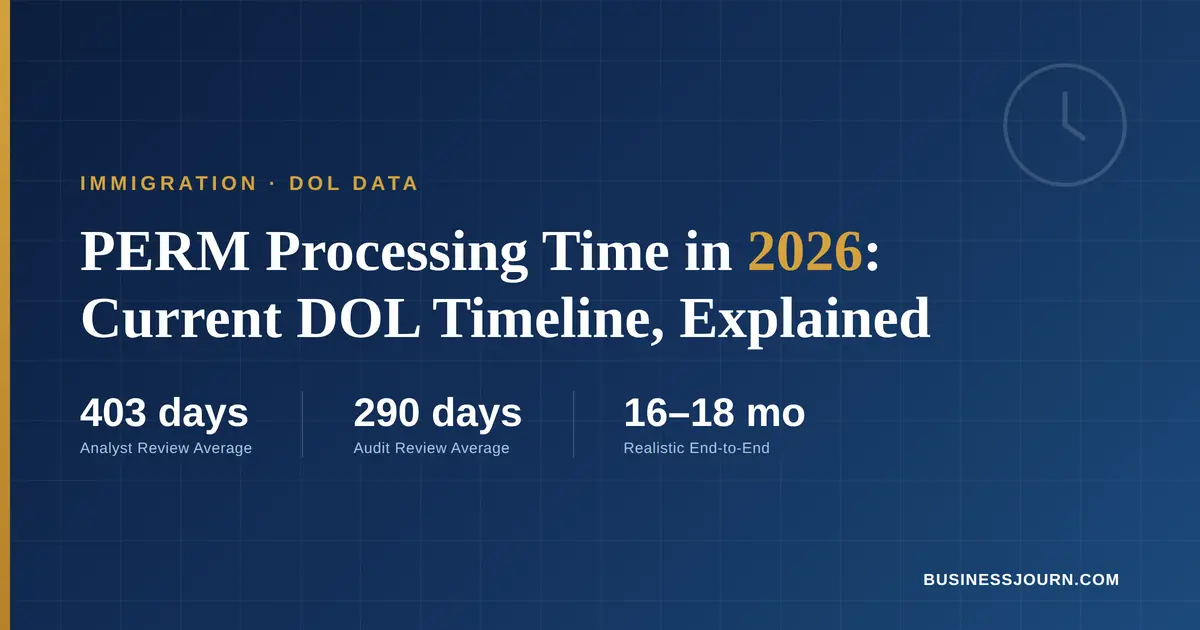
If you’re waiting on a PERM labor certification, the honest answer is that the Department of Labor’s own data, updated as of mid-July 2026, shows standard applications averaging 403 calendar days at the Analyst Review stage, with audited cases running an additional 290 days once they enter audit review. That’s before you count the months spent on the prevailing wage determination and required recruitment that happen before DOL even opens your file.
Those numbers change every month, and articles that don’t tell you which month they’re quoting are usually already out of date by the time you read them. This one pulls directly from the DOL’s FLAG system processing times page, so you know exactly what you’re looking at and when it was current.
Current PERM Processing Times
The DOL publishes two separate PERM data sets, and they answer different questions. Here’s both, current as of the agency’s most recent updates.
Processing queue — which filing dates are being worked now:
| Processing Stage | Priority Date Being Worked |
|---|---|
| Analyst Review (standard queue) | July 2025 |
| Audit Review | December 2025 |
| Reconsideration Request to the CO | March 2026 |
Average calendar days to process :
| Determination | Average Days |
|---|---|
| Analyst Review | 403 |
| Audit Review | 290 |
Prevailing Wage Determination queue:
| Wage Type | Receipt Date Being Worked |
|---|---|
| PERM, OEWS | April 2026 |
| PERM, Non-OEWS | March 2026 |
These figures come straight from flag.dol.gov, the DOL’s official portal for PERM and prevailing wage processing. Because the agency updates this page monthly, treat any number you see elsewhere — including this one after a few months pass — as a snapshot, not a permanent fact.
A limitation worth stating plainly: these are averages and queue positions, not individual predictions. DOL doesn’t publish a per-case timeline calculator, and two applications filed the same week can still finish months apart depending on complexity, the analyst assigned, and whether either gets flagged for audit. Use these numbers to plan a realistic range, not a fixed date.
Average Processing Time vs Priority Date — Why They’re Different Numbers
This is where most PERM articles get muddled, and it’s worth untangling because it explains why you’ll see wildly different figures across the internet for what’s supposedly the same statistic.
Priority date tells you which filing month DOL is currently working through. If the Analyst Review priority date is July 2025, that means the agency is adjudicating applications filed around that month right now, in July 2026 — a roughly 12-month gap between filing and active review.
Average processing time is a different, backward-looking measure: it’s the average number of days it took to close cases that were completed in a given month, from the date they were filed to the date of the decision. The 403-day figure for June 2026 reflects cases that finished processing that month — many of which were filed well over a year earlier.
Neither number alone tells you exactly how long your specific case will take, because DOL doesn’t process every case at the same speed. But together, they give you a realistic range: the priority date shows you where the queue currently stands, and the average shows you how long cases have actually been taking end to end. If your case was filed after the current priority date, you’re still waiting for the queue to reach you.
The Three Stages of PERM and How Long Each Takes
PERM isn’t one clock — it’s three, and only one of them is fully in DOL’s hands.
Prevailing Wage Determination (PWD)
Before recruitment can even start, the employer must request a prevailing wage determination from the National Prevailing Wage Center, confirming the minimum wage they’re required to offer for the role. As of late June 2026, DOL was processing OEWS wage requests filed in April 2026 and non-OEWS requests filed in March 2026 — meaning current PWD turnaround runs roughly two to three months, though it can extend if the request needs a redetermination.
Recruitment
Once the PWD is issued, the employer must complete a minimum 60-day recruitment process, including specific mandatory steps like a 30-day job order with the state workforce agency and two Sunday newspaper advertisements, among other requirements depending on the occupation. This stage is controlled entirely by the employer and their counsel — it can’t be shortened below the regulatory minimum, but it also can’t be delayed by DOL backlogs, since it happens before filing.
DOL Analyst Review (ETA-9089 Adjudication)
This is the stage the “403 days” figure describes. Once the ETA-9089 is filed, it sits in DOL’s queue until an analyst reaches it. This is the longest and least predictable stage, since it depends entirely on DOL’s staffing and case volume rather than anything the employer controls.
Add these together and a realistic total — PWD, recruitment, and Analyst Review, assuming no audit — currently lands somewhere in the range of 16 to 18 months from the initial PWD request to certification, based on current DOL processing data.
What Happens If Your Case Is Audited
DOL tracks audited cases in a completely separate queue with its own average processing time — currently 290 days once a case is in audit review, on top of whatever time already passed before the audit was triggered. As of mid-July 2026, DOL was working through audits filed around December 2025.
An audit doesn’t mean something went wrong with your case necessarily — DOL can select applications for audit at random, or based on specific factors like unusual job requirements, wage discrepancies, or recent layoffs in the same occupation at the sponsoring company. What it does mean is a meaningfully longer wait, since audit review runs as its own queue rather than skipping ahead in the standard line.
If your case is selected for audit, the employer will typically need to submit additional documentation supporting the recruitment process and the legitimacy of the job requirements. Cases with clean, well-documented recruitment files tend to move through audit review more smoothly than ones where the paperwork was thin to begin with.
A Worked Example: Filing Today vs. Filing a Year Ago
Say your employer filed your ETA-9089 in July 2025. Based on the current Analyst Review priority date of July 2025, your case is likely being actively worked on right now, in July 2026 — roughly 12 months after filing, consistent with the reported average of over 400 days when you factor in the time to actual completion.
Now say your employer is filing today, in July 2026. Given the current pace, you’re realistically looking at a similar or slightly longer wait before Analyst Review reaches your filing month — plus the 2-3 months for PWD and the 60-day recruitment period beforehand, unless audited. The honest planning number, from PWD request to certification, is closer to a year and a half.
That’s the reality DOL’s own numbers point to. It’s not a guarantee for any individual case, but it’s a far more grounded estimate than a flat “X months” figure with no date attached to it.
Who These Averages Apply To — And Who They Don’t
The 403-day and 290-day figures describe standard, single-employer, single-worker PERM filings — the large majority of cases. They’re a weaker guide if any of the following apply to you:
- Schedule A occupations (certain nurses and physical therapists) skip PERM’s labor market test entirely and follow a different process, so these timelines don’t apply.
- National Interest Waiver (NIW) or EB-1 cases don’t require PERM at all.
- Cases with prior audits, denials, or reconsideration requests on file tend to run longer than the standard average, since they’re often re-entering the queue rather than moving through it fresh.
If none of these apply, the standard timeline is a reasonable planning baseline. If one does, the number to anchor on is different, and it’s worth asking your immigration attorney which queue your case actually falls into.
One thing that does not change your PERM timeline: whether the underlying green card category is EB-2 or EB-3. DOL processes PERM applications in the same queue regardless of which employment-based category the employer will file the I-140 under, so EB-3 PERM processing time follows the same Analyst Review averages covered above — the EB-2 vs. EB-3 distinction only starts to matter later, at the Visa Bulletin stage.
Common Mistakes That Add Delay
A few patterns show up repeatedly in cases that take longer than the average, based on what triggers audits and reconsideration requests in the data above:
- Filing the ETA-9089 before the recruitment report is fully reconciled — inconsistencies between the recruitment steps and what’s stated on the form are a common audit trigger.
- Underestimating how long the PWD takes and starting recruitment before the wage determination is final, which can force recruitment to be redone if the wage changes.
- Letting the 180-day I-140 filing window slip after certification, which forces the entire PERM process to restart.
- Assuming a stated processing time is still current months after an article was published, rather than checking the live DOL page before making decisions like a job offer timeline or immigration status planning.
None of these guarantee a faster case if avoided, but they’re the difference between a case moving with the standard queue and one that adds avoidable months on top of it.
Is PERM Processing Time Improving in 2026?
There’s a real trend here, and it’s cautiously positive. DOL’s own reported average for Analyst Review determinations was 512 calendar days in February 2026, still around 501 days through April, and had dropped to 403 days by June 2026. The queue has moved in step with that: DOL was working Analyst Review cases filed around August 2024 in January 2026, and had advanced to July 2025 filings by July 2026 — a meaningful jump forward over roughly six months.
So yes, by the numbers, PERM processing time is improving in 2026, not worsening. But a few things temper how much to read into it. Prevailing wage determination filings rose sharply starting in March 2026, which tends to feed into higher PERM filing volume a few months later — and a surge in new filings could slow the queue back down even while DOL is actively working through the current backlog. Treat the improvement as real but not guaranteed to continue, and check the current DOL numbers before assuming the trend holds for your filing date.
PERM Status Check: Where to Look
The most reliable place for a PERM status check is DOL’s own case status search tool, at flag.dol.gov/case-status-search, where you can look up a specific filed application using its case number. That’s the authoritative source for where your individual case actually stands, rather than estimating from queue averages.
Beyond the official tool, community sites like Trackitt let applicants self-report their PERM filing and decision dates, which some people use as a rough, crowdsourced cross-check against the DOL’s published averages. Treat that kind of data the way you’d treat any user-submitted source — useful for a sense of what others in a similar filing window are experiencing, but not a substitute for checking your own case directly.
There’s no official PERM processing time calculator from DOL — the agency publishes averages and queue positions, not a per-case estimate tool. A handful of third-party trackers built on DOL’s public disclosure data (case-level filing and decision dates) offer rough predictors based on historical patterns, but these are estimates built from past cases, not DOL projections, so treat any calculator’s output as a ballpark rather than a commitment.
What to Do While You Wait
- Confirm your PERM’s 180-day window. Once certified, PERM is only valid for 180 days — the employer must file Form I-140 within that window, or the certification expires and the process has to start over.
- Understand AC21 portability before considering a job change. If your I-140 has been pending for 180 days or more, AC21 may allow you to port your green card process to a new employer in a same or similar occupation — but this only applies at the I-140 stage, not during PERM itself. Changing jobs while PERM is still pending generally restarts the process with the new employer.
- Keep your documentation current. If audited, having accurate records of recruitment steps, job postings, and wage determinations on hand shortens the back-and-forth.
- Check the DOL processing times page monthly, not once. Since the queue moves roughly a month at a time, checking flag.dol.gov/processingtimes periodically gives you a more current read than relying on an article that might be several months old.
- Loop in your immigration attorney before making employment decisions — job changes, promotions with material duty changes, or company changes can all affect a pending case depending on the stage.
FAQs
Does PERM have premium processing?
No. Unlike the I-140 petition that follows PERM certification, which offers premium processing for a fee and a 15-business-day response, PERM and prevailing wage determinations have no expedited option. The only way to protect your timeline is filing early and accurately to avoid an audit.
Can I change jobs while my PERM is pending?
Generally, no without restarting the process. AC21 job portability protections apply once the I-140 has been pending 180 days or more — not during the PERM stage itself. Talk to your immigration attorney before making any employment changes while PERM is in process.
Does PERM expire?
Yes. Once certified, PERM is valid for 180 days, during which the employer must file Form I-140. If that window passes without filing, the certification expires and the employer would need to restart the PERM process.
What happens after PERM is certified?
The employer files Form I-140, the Immigrant Petition for Alien Worker, with USCIS, within the 180-day certification window. This is where the I-140 processing time becomes relevant: with premium processing, USCIS commits to a decision (or a Request for Evidence) within 15 business days for a fee; without it, standard I-140 processing runs on USCIS’s regular queue, which moves independently of anything on the PERM side. From there, the timeline to actually filing for a green card depends on visa availability under the State Department’s Visa Bulletin, which varies significantly by country of chargeability, particularly for applicants born in India or China.
Key Takeaways
As of DOL’s most recent updates, standard PERM applications are averaging 403 days at Analyst Review, with audited cases adding roughly 290 more days in a separate queue. Add the prevailing wage determination and mandatory 60-day recruitment period, and a realistic total timeline currently runs 16 to 18 months for non-audited cases. Because these figures shift monthly, the most reliable approach is checking flag.dol.gov/processingtimes directly and tracking your specific case through the DOL’s case status tool, rather than relying on a fixed number from any single article — including this one.