
Every startup needs money, but not every startup needs investors on day one. Many founders believe fundraising should begin with a pitch deck and meetings with venture capital firms. In reality, the strongest companies often spend their early months solving customer problems, validating demand, and generating revenue before raising outside capital.
This approach is known as a startup booted fundraising strategy.
Instead of relying on investor money to survive, founders use personal savings, early customer revenue, grants, strategic partnerships, and other non-dilutive funding sources to build momentum. When they eventually raise capital, they negotiate from a position of strength rather than urgency.
This doesn’t mean venture capital is bad. It means founders should understand when external funding creates value and when it creates unnecessary pressure.
In this guide, you’ll learn how to fund a startup step by step, how to choose the right funding sources, what investors expect to see, and how to avoid mistakes that reduce ownership without improving the business.
What Is a Startup Booted Fundraising Strategy?
A startup booted fundraising strategy is a funding approach where founders focus on building a business with minimal outside investment during the early stages.
Instead of raising large amounts of capital immediately, the company grows through:
- Customer revenue
- Founder savings
- Service income
- Pre-orders
- Government grants
- Revenue-based financing
- Strategic partnerships
The goal is simple.
Build a business that can support itself before relying on outside investors.
This approach gives founders more flexibility because every major decision is based on customer demand rather than investor expectations.
Why More Founders Are Choosing This Approach
The startup funding landscape has changed significantly over the past few years.
Investors are paying closer attention to profitability, customer retention, and efficient use of capital. Many startups that previously raised funding based on rapid growth alone now face tougher questions about revenue and long-term sustainability.
For founders, this creates an opportunity. Rather than competing for limited investment, they can focus on building a business customers are willing to pay for.
Some of the biggest advantages include:
- Greater ownership
- Better control over product decisions
- Less pressure to pursue unrealistic growth
- Stronger financial discipline
- Improved negotiating position if investment is needed later
A startup that generates consistent revenue is often more attractive to investors than one with a polished presentation but no paying customers.
Bootstrapping vs Traditional Fundraising
Both funding paths can lead to successful businesses, but they involve different priorities.
| Booted Fundraising | Traditional Venture Funding |
|---|---|
| Growth funded through revenue | Growth funded through investment |
| Founders retain more ownership | Equity is exchanged for capital |
| Focus on profitability | Focus on rapid expansion |
| Smaller operational budgets | Larger spending capacity |
| Customer validation comes first | Funding often comes before revenue |
Neither approach is universally better.
The right choice depends on your market, business model, and growth goals.
Start by Solving a Real Problem
No funding strategy can compensate for a weak business idea.
Before thinking about investors, founders should answer three questions:
Does the problem exist?
Talk directly to potential customers.
Ask how they currently solve the problem.
Look for recurring frustrations instead of isolated complaints
Are people willing to pay?
Interest alone isn’t enough.
Someone saying, “That’s a good idea,” is very different from someone paying for it.
Early sales provide stronger validation than survey responses.
Can your solution stand out?
Customers rarely switch products without a reason.
Your startup should offer at least one meaningful advantage, such as:
- Lower cost
- Better experience
- Faster delivery
- Simpler workflow
- Higher quality support
Strong validation reduces financial risk and improves every future fundraising conversation.
Build an MVP Before Raising Capital
Many founders delay launching because they want every feature to be perfect.
That often leads to wasted time and unnecessary development costs.
Instead, build a Minimum Viable Product (MVP).
An MVP solves one core problem well.
Nothing more.
For example, if you’re creating accounting software, the first version doesn’t need advanced reporting, automation, or integrations.
It only needs to help customers complete the primary task successfully.
Early users will tell you what to build next.
This saves both time and money.
Your First Customers Are More Valuable Than Your First Investors
Customer revenue does more than improve cash flow.
It proves that people trust your solution enough to spend money on it.
Investors pay close attention to this.
Suppose your software attracts 100 paying customers within six months.
That tells investors several important things:
- Demand exists.
- Pricing is acceptable.
- The product solves a real problem.
- Customers see ongoing value.
Revenue reduces uncertainty, and reducing uncertainty often increases company valuation.
Funding Options That Don’t Require Giving Up Equity
Many founders assume venture capital is the only source of startup funding.
In reality, several alternatives can provide growth capital while allowing founders to retain ownership.
Personal Savings
Using personal savings is one of the most common ways to launch a startup.
It allows founders to move quickly without approval from investors.
However, set a clear spending limit.
Avoid risking money that would affect your essential living expenses.
Freelance or Consulting Income
Many software founders finance product development through client work.
This approach creates two benefits.
First, service income pays the bills.
Second, client projects often reveal real customer problems worth solving through software.
Several successful SaaS companies started this way.
Customer Pre-Sales
Customers sometimes pay before a product is fully complete.
Examples include:
- Lifetime deals
- Early-access programs
- Annual subscriptions
- Founding member pricing
Pre-sales generate working capital while validating demand.
Government Grants
Many governments offer grants for innovation, research, exports, manufacturing, technology, and sustainability.
Unlike equity funding, grants generally do not require founders to give up ownership.
Although the application process may take time, the long-term value can be significant.
Revenue-Based Financing
Revenue-based financing allows startups to receive capital in exchange for a percentage of future revenue rather than equity.
This option works well for businesses with recurring revenue because repayments adjust with monthly income.
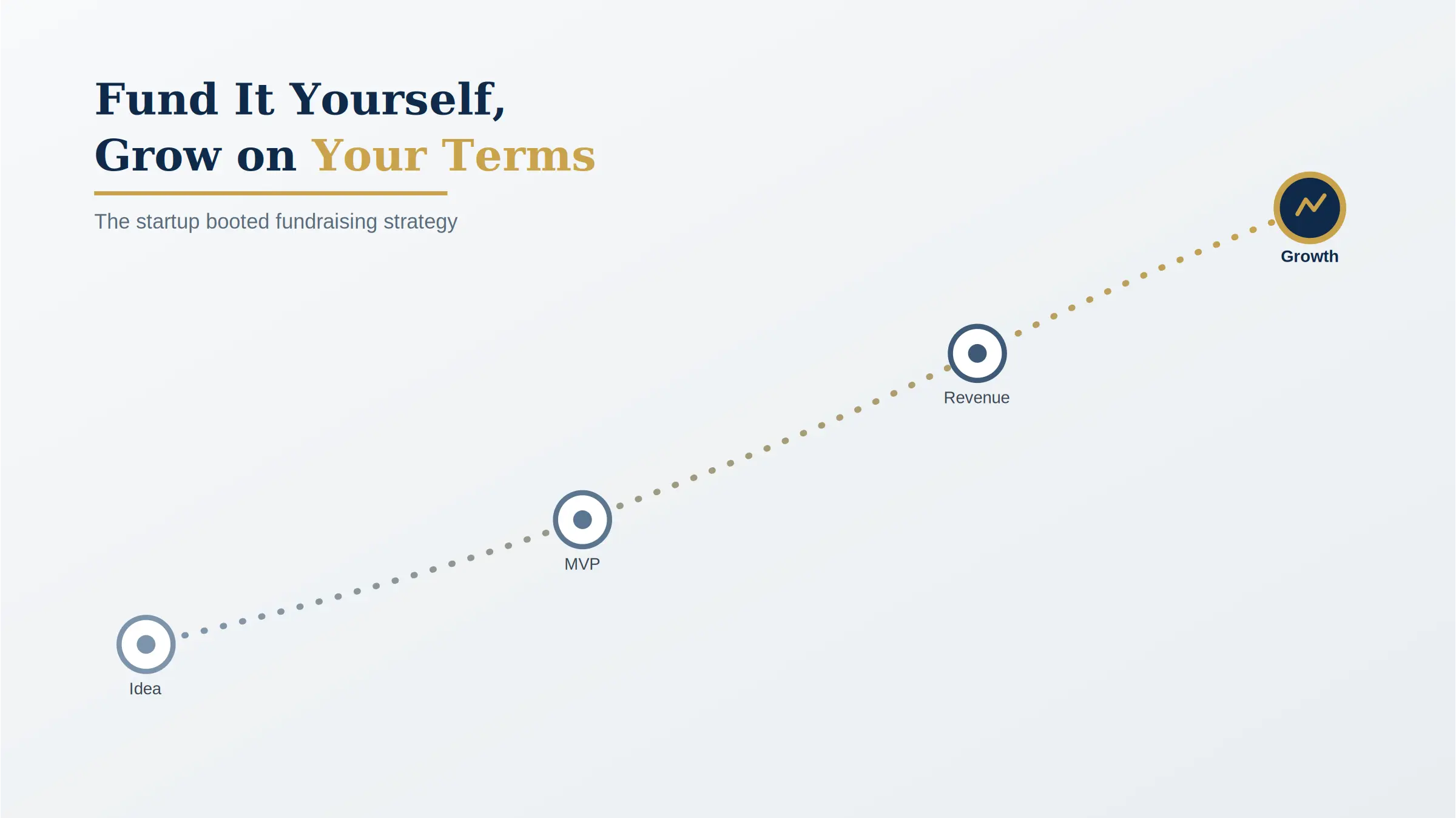
Create a Simple Funding Roadmap
Many founders try to raise money too early because they don’t have a structured growth plan.
Instead, think of funding as a series of milestones.
| Stage | Primary Goal |
|---|---|
| Idea | Identify a real customer problem |
| Validation | Confirm people will pay |
| MVP | Launch the first version |
| Early Revenue | Acquire paying customers |
| Product Improvement | Increase customer satisfaction |
| Predictable Growth | Build recurring revenue |
| External Funding (Optional) | Accelerate proven growth |
Each stage prepares the business for the next.
Skipping milestones often creates expensive problems later.
Focus on Cash Flow, Not Just Revenue
Revenue attracts attention.
Cash flow keeps the business alive.
Imagine a startup generating $40,000 in monthly sales.
It sounds successful.
But if customers pay after 90 days while expenses are due every month, the company may still struggle to cover payroll and operating costs.
Monitor:
- Monthly cash received
- Operating expenses
- Outstanding invoices
- Emergency reserves
Healthy cash flow gives founders more freedom when deciding whether external funding is necessary.
Know Your Numbers Before Talking to Investors
Investors expect founders to understand the financial health of their business.
You don’t need complex spreadsheets in the beginning, but you should know your key metrics.
Start with these:
| Metric | Why It Matters |
|---|---|
| Monthly Recurring Revenue (MRR) | Measures predictable income |
| Customer Acquisition Cost (CAC) | Shows marketing efficiency |
| Customer Lifetime Value (LTV) | Estimates long-term customer value |
| Gross Margin | Measures profitability after direct costs |
| Burn Rate | Tracks monthly cash usage |
| Runway | Estimates how long available cash will last |
These numbers help founders make better decisions long before investor meetings begin.
Build a Business Investors Want to Join
Many founders spend months trying to convince investors their startup has potential.
A better approach is to build a business where the numbers tell the story.
When customers stay, revenue grows, and expenses remain under control, fundraising becomes much easier.
Investors prefer businesses that have already reduced the biggest risks.
Product-market fit, recurring revenue, and healthy unit economics speak louder than ambitious forecasts
When Should a Startup Raise Outside Funding?
Bootstrapping doesn’t mean avoiding investors forever.
It means raising money when it helps your business grow faster, not when you’re trying to survive.
Many founders approach investors too early. They have an idea, a prototype, or a few beta users, but no clear evidence that customers are willing to pay.
This usually results in:
- Lower company valuation
- More equity given away
- Longer fundraising cycles
- Less negotiating power
Instead, focus on building traction first.
You should consider raising capital when you can clearly answer these questions:
- Is there consistent demand for the product?
- Are customers paying regularly?
- Is revenue increasing month after month?
- Can additional capital produce measurable growth?
- Do you know exactly how the money will be used?
If the answer is yes, fundraising becomes much easier.
The Best Funding Options for Bootstrapped Startups
Venture capital is only one funding option.
Many successful startups combine several funding sources before approaching institutional investors.
Angel Investors
Angel investors are individuals who invest their own money into early-stage businesses.
Compared with venture capital firms, angel investors often:
- Invest smaller amounts.
- Make faster decisions.
- Offer industry experience.
- Introduce founders to customers and partners.
The right angel investor can provide valuable guidance without taking significant control over the company.
Startup Accelerators
Accelerators help startups grow through mentorship, education, networking, and small investments.
Programs usually last several months and end with a presentation to investors.
Besides funding, accelerators help founders improve:
- Product strategy
- Customer acquisition
- Sales
- Financial planning
- Investor readiness
Choose an accelerator that has experience in your industry instead of applying to every available program.
Revenue-Based Financing
Revenue-based financing allows startups to receive capital without selling equity.
Instead of fixed loan payments, repayments are based on a percentage of monthly revenue.
Benefits include:
- No ownership dilution
- Flexible repayment
- Faster approval than many traditional loans
- Payments adjust with business performance
This option works particularly well for subscription businesses with predictable recurring revenue.
Strategic Partnerships
Sometimes the best investor is also a future customer.
Large companies often partner with startups that solve problems within their industry.
Partnerships may include:
- Product integration
- Distribution agreements
- Co-marketing campaigns
- Licensing arrangements
- Upfront development payments
These relationships provide both revenue and credibility.
Government Grants
Many founders overlook grants because they assume only research organizations qualify.
In reality, many governments support innovation, manufacturing, technology, exports, clean energy, healthcare, and digital transformation.
Although the application process requires preparation, grants provide funding without requiring founders to give up equity.
Build a Fundraising Plan Before You Need One
One of the biggest fundraising mistakes is waiting until cash is almost gone.
Instead, prepare long before additional capital becomes necessary.
Your fundraising plan should answer four questions.
How much money do you need?
Avoid raising money without a clear target.
Estimate:
- Hiring costs
- Product development
- Marketing
- Infrastructure
- Legal expenses
- Operating reserves
Every dollar should have a purpose.
Before raising capital, founders should also build realistic financial projections. A well-structured financial model helps estimate future revenue, expenses, cash flow, and funding requirements. If you’re creating one for the first time, our guide on startup booted financial modeling explains how to build accurate forecasts and make better funding decisions.
How long should the funding last?
Most startups aim for enough capital to support operations for 12 to 18 months.
This gives founders time to execute their growth strategy without immediately starting another fundraising round.
What milestones will you achieve?
Investors don’t fund ideas.
They fund progress.
Examples include:
- Reach $25,000 in Monthly Recurring Revenue
- Launch Version 2.0
- Acquire 1,000 paying customers
- Expand into two new markets
- Build a five-person product team
Specific milestones build confidence.
How will investors benefit?
Founders should explain how new funding creates additional value.
For example:
Instead of saying:
“We need money for marketing.”
Say:
“This investment will allow us to expand customer acquisition through channels that currently produce a 4:1 return on advertising spend.”
Specific plans are far more convincing than general statements.
The Startup Metrics That Matter Most
Successful fundraising depends on measurable business performance.
These are the numbers investors review most often.
Monthly Recurring Revenue (MRR)
MRR measures predictable monthly subscription income.
Growing MRR shows that customers continue paying for your product.
Customer Acquisition Cost (CAC)
CAC measures the average cost of acquiring one customer.
Formula:
Sales and Marketing Costs ÷ New Customers
Lower acquisition costs improve profitability.
Customer Lifetime Value (LTV)
LTV estimates how much revenue one customer generates before leaving.
A healthy business generally maintains an LTV that is several times higher than CAC.
Gross Margin
Gross margin shows how much revenue remains after direct operating costs.
Higher margins create more flexibility for hiring, marketing, and product development.
Burn Rate
Burn rate measures how much cash your business spends every month.
Reducing unnecessary expenses extends your runway.
Runway
Runway estimates how long your startup can continue operating before additional funding becomes necessary.
A longer runway provides founders with more strategic options.
Lessons From Successful Bootstrapped Companies
Many well-known companies grew without depending on large venture capital investments.
While every business follows a different path, several common lessons stand out.
Mailchimp
Mailchimp spent years improving its product before becoming one of the world’s largest email marketing platforms.
The founders focused on customer satisfaction, recurring revenue, and sustainable growth instead of rapid fundraising.
Lesson:
Strong products attract long-term customers.
Basecamp
Basecamp grew by solving a specific problem for businesses that needed simple project management software.
Rather than adding endless features, the company concentrated on usability and profitability.
Lesson:
A focused product often outperforms a complicated one.
Atlassian
Atlassian built developer tools used by millions of teams worldwide.
Its founders prioritized product quality and organic growth before accessing larger sources of capital.
Lesson:
Satisfied users become your strongest marketing channel.
Common Fundraising Mistakes
Many startups struggle because of avoidable decisions.
Learning these mistakes early can save significant time and money.
Raising Money Too Early
If your product has little traction, investors assume higher risk.
Higher risk usually means lower valuations.
Validate demand first.
Hiring Too Quickly
New employees increase monthly expenses immediately.
Hire only when existing revenue can support additional salaries.
Ignoring Customer Retention
Acquiring customers is expensive.
Keeping existing customers is usually much more profitable.
Improve support, onboarding, and product quality before increasing marketing budgets.
Spending Without Measuring Results
Every major expense should produce measurable business value.
Track the return on:
- Advertising
- Software
- Consultants
- Events
- Sales activities
If an expense consistently fails to deliver results, reconsider it.
Depending on One Funding Source
Relying entirely on venture capital creates unnecessary pressure.
A balanced strategy often includes:
- Revenue
- Grants
- Partnerships
- Angel investors
- Revenue-based financing
Diversification reduces financial risk.
A Simple Startup Fundraising Checklist
Before approaching investors, review this checklist.
✓ Product solves a clear problem.
✓ Customers are paying.
✓ Revenue is growing consistently.
✓ Customer retention is improving.
✓ Financial records are organized.
✓ Cash flow is predictable.
✓ Business model is profitable or moving toward profitability.
✓ Funding has a clear purpose.
✓ Growth milestones are defined.
✓ You understand your key financial metrics.
Checking these items before fundraising improves both confidence and credibility.
FAQs
What is a startup booted fundraising strategy?
It is a funding approach where founders grow a startup using customer revenue, personal capital, grants, partnerships, and other funding sources before seeking significant outside investment.
Is bootstrapping better than venture capital?
Neither option is universally better.
Bootstrapping offers greater ownership and flexibility, while venture capital can accelerate growth when additional resources are required.
The best choice depends on your business goals and market conditions.
How much money should a startup raise?
Raise only enough capital to achieve the next major business milestone.
Excess funding often leads to unnecessary spending and greater ownership dilution.
What is the biggest fundraising mistake founders make?
Many founders begin fundraising before proving customers are willing to pay.
Revenue and customer validation usually strengthen investor confidence far more than projections alone.
Can a bootstrapped startup become a large company?
Yes.
Many successful companies started with limited capital and expanded through customer revenue before considering outside investment.
What financial metrics should founders monitor?
The most important metrics include:
- Monthly Recurring Revenue (MRR)
- Customer Acquisition Cost (CAC)
- Customer Lifetime Value (LTV)
- Gross Margin
- Burn Rate
- Cash Runway
These metrics provide a clear picture of business performance.
Final Thoughts
A startup booted fundraising strategy is not about avoiding investors. It is about building a business that gives you more choices.
When founders focus on solving real customer problems, generating revenue, and managing cash carefully, they create a stronger foundation for long-term growth. Investment becomes a tool for expansion rather than a requirement for survival.