
If you’ve been told you don’t have enough jawbone for traditional dental implants, someone has probably mentioned subperiosteal implants as an option. Here’s what they actually are, how they compare to newer alternatives, and the risks most articles gloss over.
What Is a Subperiosteal Implant?
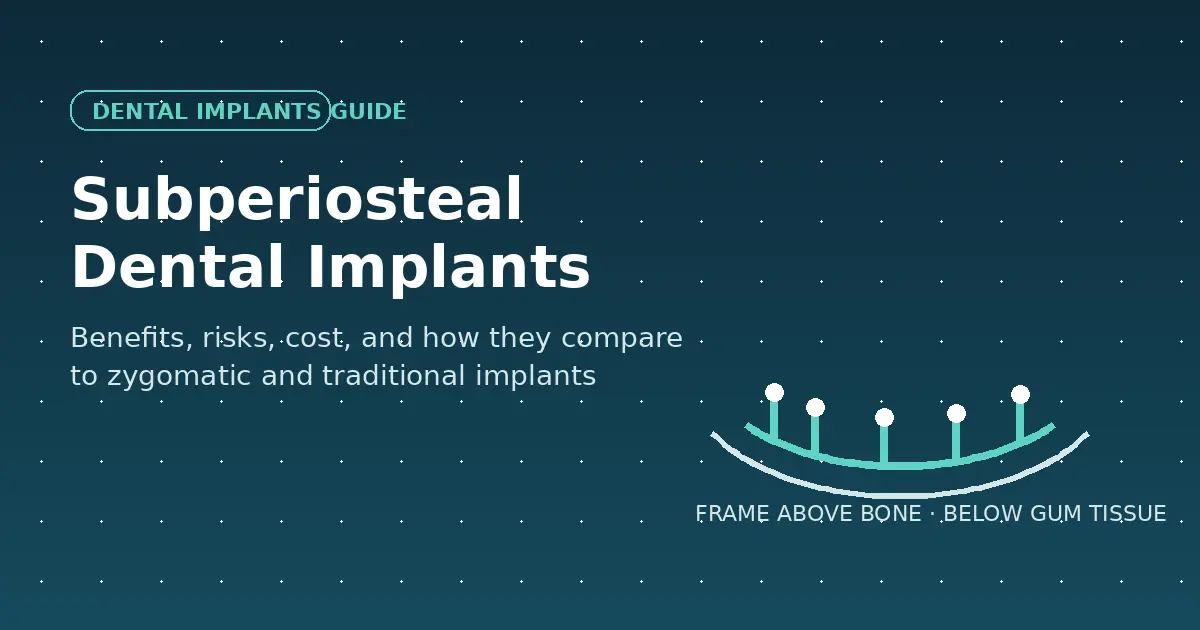
A subperiosteal implant is a custom-made metal framework that sits on top of the jawbone but underneath the gum tissue, rather than being drilled directly into the bone like a traditional implant. The frame is shaped to match the patient’s own jaw structure, and posts extending through the gum support a denture, bridge, or set of crowns once healing is complete.
The name comes from where the device sits: “sub” (below) the “periosteum,” the connective tissue layer that covers bone. So instead of anchoring into bone, the implant rests on it.
How It Differs From Endosteal (Traditional) Implants
Endosteal implants are the ones most people picture when they hear “dental implant” — a titanium post drilled directly into the jawbone, left to fuse with the bone over a few months, then topped with a crown. That fusion process, called osseointegration, is what gives traditional implants their long-term stability.
Subperiosteal implants skip that step entirely. There’s no post going into the bone, so there’s no osseointegration. Stability comes instead from the frame’s fit against the bone surface and the gum tissue healing around it. That’s the whole appeal for patients with insufficient bone — but it’s also the source of most of the long-term concerns we’ll get into below.
A Brief History — Why This Was Once the Only Option for Severe Bone Loss
Subperiosteal implants aren’t new. They were first developed in the 1940s, decades before titanium endosteal implants became the standard of care. For a long time, they were the only real option for patients with severe bone loss, because bone grafting techniques and materials were far less advanced than they are today.
As grafting procedures, sinus lifts, and later zygomatic and pterygoid implants matured, subperiosteal implants fell out of favor at most practices. The complication rates — frame exposure, chronic infection, and unpredictable long-term stability — were well documented, and better alternatives came along.
They haven’t disappeared. Digital scanning and CAD/CAM manufacturing have made the frames more precise than the older cast-metal versions, and some practices still offer them for patients who genuinely have no other option. But it’s worth knowing going in that this is a legacy technique that’s been largely superseded, not a new breakthrough — despite how some clinics market it.
How Subperiosteal Implants Are Made and Placed
- 3D imaging scan. A CBCT scan maps the exact contours of the remaining jawbone.
- Custom framework fabrication. Older techniques used a physical impression and cast metal; most practices today design the frame digitally and mill or 3D-print it in titanium or a cobalt-chrome alloy for a tighter fit.
- Surgical placement. The gum is opened, the frame is seated directly on the bone surface, and the tissue is closed back over it, with posts left protruding through the gum line.
- Healing and gum integration. Over several months, the gum tissue heals around the frame and the posts.
- Abutment and prosthetic attachment. Once healing is confirmed, the final denture, bridge, or crowns are attached to the exposed posts.
The shift from cast-metal to digitally designed frameworks is the main technical improvement in this field over the last decade — it doesn’t eliminate the risks below, but it does improve fit accuracy compared to the older method.
Who Is a Good Candidate for Subperiosteal Implants?
You May Be a Candidate If:
- You have significant jawbone loss and were told you don’t qualify for traditional implants
- You want to avoid extensive bone grafting or aren’t a candidate for it
- You’re in good general health with no uncontrolled chronic conditions
- You need a faster path to a fixed prosthetic than a full grafting timeline would allow
You May NOT Be a Good Candidate If:
- You have active gum infection or uncontrolled periodontal disease
- You have uncontrolled diabetes or an immune-compromising condition
- You smoke heavily or have a history of poor healing
- You’d qualify for a less invasive option like zygomatic or pterygoid implants (see comparison below) — most oral surgeons will steer eligible patients toward these first
A real consultation, including imaging, is the only way to know for sure. If a provider recommends subperiosteal implants without discussing zygomatic or pterygoid options first, it’s worth asking why.
Benefits of Subperiosteal Implants
- No bone grafting required — the frame sits on existing bone rather than needing new bone built up first
- Faster overall timeline than grafting-then-implant sequences, which can take a year or more
- Stability for patients with insufficient bone who have no other fixed-prosthetic option
- Less invasive than grafting-based alternatives, since there’s no drilling into bone or harvesting graft material
- Restores jaw contour and function for patients who’ve had teeth missing for years
Risks and Disadvantages
Most articles on this topic list two or three drawbacks and move on. Here’s the fuller picture, because these are the issues that actually determine whether the implant lasts.
Framework Exposure Through the Gum
This is the most common long-term complication with subperiosteal implants. Because the frame sits under thin gum tissue rather than being buried in bone, the metal can gradually work its way through the gum and become exposed. Once exposed, the area is much harder to keep clean and becomes a chronic infection risk.
Bone Resorption Under the Frame
Bone that isn’t being stimulated the way it would be by an osseointegrated post can continue to resorb (shrink) over time. Since the whole implant depends on close contact between the frame and the bone surface, resorption can loosen that fit over years, even after the gum has fully healed.
Infection Risk
Any implant that sits partly under the gum line carries infection risk, but subperiosteal implants are particularly exposed because the frame interrupts the natural gum seal in more places than a single post does. Patients with a history of periodontal disease face a higher risk here.
Limited Long-Term Clinical Data
Traditional endosteal implants have decades of large-scale studies behind them. Subperiosteal implants, especially the older cast-metal versions, don’t have anywhere near the same volume of long-term outcome data. The newer digitally fabricated frames have even less history to draw on, since they’re a relatively recent refinement.
Higher Complexity, Longer Recovery Than Some Alternatives
Placing a frame that spans a large area of the jaw is a more involved surgery than placing a single post, and recovery from the initial procedure tends to involve more swelling and discomfort than a standard implant placement.
Subperiosteal vs Other Implant Options — Full Comparison
| Implant Type | Bone Requirement | Invasiveness | Avg. Recovery | Long-Term Data |
|---|---|---|---|---|
| Subperiosteal | Minimal — frame rests above bone | Moderate–High | 3–6 months | Limited |
| Endosteal (traditional) | Requires healthy bone volume | Moderate | 3–6 months | Extensive |
| Zygomatic | Anchors in cheekbone, bypasses jaw bone loss | High | 1–3 months | Growing |
| Pterygoid | Anchors in pterygoid bone at back of jaw | High | 1–3 months | Growing |
| All-on-4/6 (with grafting) | Requires grafting first | High (staged) | 6–12 months | Extensive |
When Zygomatic or Pterygoid Implants Might Be a Better Choice
Zygomatic and pterygoid implants were developed specifically to solve the same problem as subperiosteal implants — severe bone loss — but by anchoring into denser, more stable bone elsewhere in the skull (the cheekbone or the pterygoid plate) instead of resting on top of degraded jawbone. For many patients who’d previously have been steered toward a subperiosteal frame, these are now the first-line recommendation, since they integrate with bone the same way a standard implant does and have a stronger stability track record.
The trade-off is that they require a specialist trained in these specific techniques, and they’re not offered at every practice.
Cost of Subperiosteal Implants
Subperiosteal implants generally cost more than a single traditional implant but can come in lower than a full zygomatic or pterygoid case, largely because they avoid a separate bone grafting procedure. Exact pricing varies widely by region, provider experience, and whether the case involves a full arch or a partial frame.
What Affects the Price
- Number of posts/teeth being restored
- Whether digital (CAD/CAM) or older cast-metal fabrication is used
- Anesthesia type (local vs sedation)
- Geographic location and provider experience
- Cost of the final prosthetic (denture, bridge, or individual crowns)
Insurance and Financing Considerations
Dental insurance rarely covers implant procedures in full, and subperiosteal implants are no exception — many plans treat them as elective or classify them differently than standard implants, which can affect reimbursement. It’s worth getting a written cost breakdown and checking directly with your insurer before committing, rather than relying on a general estimate from the practice. Many practices also offer in-house financing or third-party medical financing plans for implant cases.
Recovery Timeline
| Stage | Timeframe | What to Expect |
|---|---|---|
| Initial healing | 1–2 weeks | Swelling, bruising, and discomfort managed with pain medication |
| Gum integration | 3–6 months | Gum tissue heals around the frame; this is the critical stability-building phase |
| Final prosthetic placement | A few weeks after integration | Abutments and final crowns, bridge, or denture are attached |
Recovery pace depends on the extent of the case (partial frame vs. full arch) and individual healing factors like age, smoking status, and overall health.
Subperiosteal Implants vs Mini Dental Implants
Mini dental implants are a different category altogether — they’re smaller-diameter posts that still anchor directly into bone, just like standard endosteal implants, only with a narrower post that requires less bone volume. They’re generally used for stabilizing lower dentures rather than replacing individual teeth or full arches, and they’re far less invasive than a subperiosteal frame. If your bone loss is moderate rather than severe, mini implants are worth ruling out before considering a subperiosteal frame, since they carry a much longer track record and a simpler placement process.
FAQs
What is a subperiosteal implant?
It’s a custom metal framework placed on top of the jawbone, under the gum tissue, used to support replacement teeth in patients who don’t have enough bone for traditional implants.
Are subperiosteal implants still used today?
Yes, but far less often than in past decades. Most practices now recommend zygomatic or pterygoid implants, or bone grafting followed by traditional implants, before considering a subperiosteal frame.
What is the success rate of subperiosteal implants?
Long-term success rate data is limited compared to traditional implants. Reported outcomes vary significantly depending on the era of the study (older cast-metal frames vs. newer digitally designed ones) and individual patient factors like oral hygiene and gum health.
How long do subperiosteal implants last?
Some patients have kept subperiosteal implants functional for many years, but frame exposure and bone resorption mean they’re generally considered less predictable long-term than osseointegrated implants.
Are subperiosteal implants painful?
The placement surgery involves more tissue manipulation than a standard implant, so initial discomfort and swelling tend to be more pronounced. Pain is manageable with standard post-surgical medication and typically eases within the first couple of weeks.
Can a subperiosteal implant be removed or replaced if it fails?
Yes, though removal is a more involved procedure than removing a single implant post, since the frame spans a larger area. If failure occurs, patients often transition to a different implant type or a removable prosthetic afterward.
How much do subperiosteal implants cost?
Pricing varies by case complexity, location, and fabrication method, but they typically fall between the cost of a single traditional implant and a full zygomatic implant case. Get a written estimate specific to your case rather than relying on general figures.
How to Know If Subperiosteal Implants Are Right for You
- I’ve been told I don’t have enough bone for traditional implants
- I want to avoid bone grafting if possible
- I’m in good general health with no uncontrolled chronic conditions
- I understand the risks — frame exposure, infection, limited long-term data
- I’ve discussed zygomatic and pterygoid implants with my provider as alternatives
If you can check most of these boxes and your provider has ruled out the newer alternatives for your specific case, a subperiosteal implant may be worth discussing further.
Conclusion
Subperiosteal implants solved a real problem for patients with severe bone loss for decades before better alternatives existed. They can still work, and for some patients they remain the most practical option. But they come with real trade-offs — frame exposure, bone resorption, and a much thinner long-term data set than traditional or newer implant types — that are worth understanding before committing to the procedure.