
Two people can type “on-demand delivery platforms” into Google with completely different problems. One is a restaurant owner trying to decide whether DoorDash’s commission is worth it. The other is a founder trying to figure out whether to build custom delivery software or license something off the shelf. Most articles on this topic answer one question and pretend it covers both. It doesn’t, so this guide splits it cleanly: what these platforms are, how the two very different tracks — using one versus building one — actually compare, and how to choose without losing money on the decision.
What an On-Demand Delivery Platform Actually Is
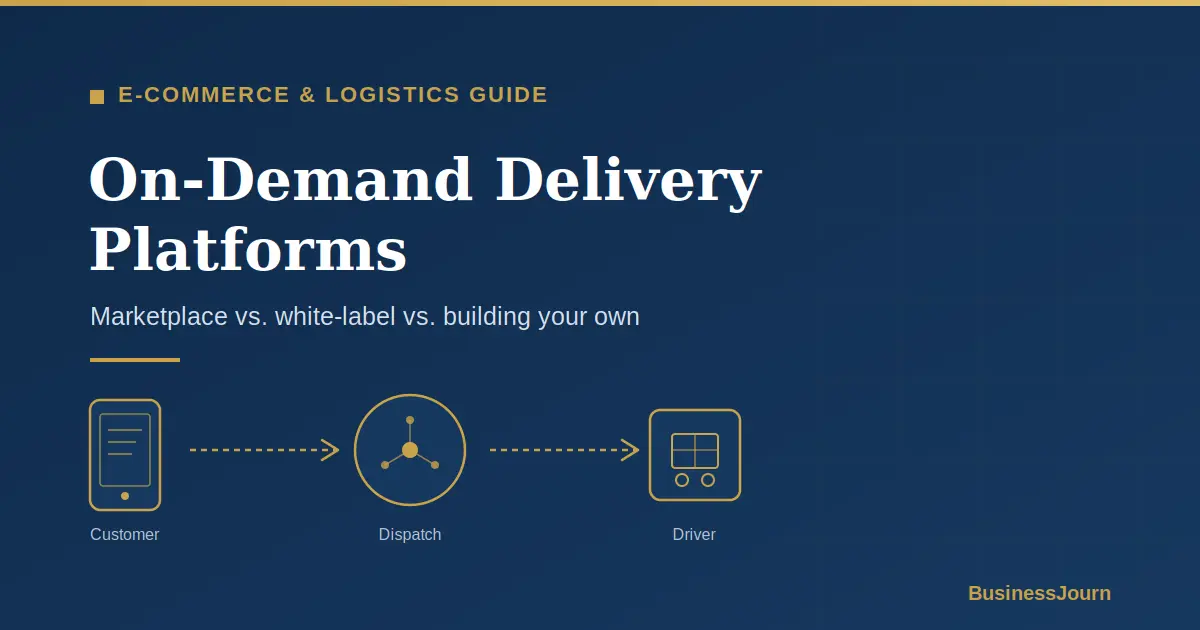
Strip away the branding and every on-demand delivery platform is the same basic system: a customer places an order through an app, a driver gets matched to fulfill it, and an admin layer coordinates payment, routing, and tracking between them. That’s three connected pieces, not one:
- The customer-facing app — browsing, ordering, payment, tracking
- The driver/partner app — accepting jobs, navigation, delivery confirmation
- The admin or dispatch layer — inventory, routing logic, payouts, analytics
Whether you’re using DoorDash as a restaurant or building your own grocery delivery app, all three pieces exist somewhere. The only thing that changes is who owns and controls each one.
The category isn’t small or slowing down — the global online food delivery market alone surpassed $380 billion in 2024, and US online food delivery revenue reached roughly $432 billion in 2025. Grocery, quick-commerce, and logistics push the total addressable market well beyond that.
The Real Question: Are You Choosing a Platform, or Building One?
This is where most guides get sloppy. “On-demand delivery platform” covers two completely different decisions, and conflating them wastes your time either way.
If you’re a restaurant, retailer, or pharmacy deciding how to offer delivery, your real choice is between joining an existing marketplace (DoorDash, Instacart, Uber Eats), licensing white-label delivery software that runs under your own brand, or managing deliveries yourself with a route-planning tool. You’re not writing code. You’re picking a vendor.
If you’re a founder or investor building a delivery business from scratch, your choice is between a custom-built platform and a ready-made/licensed solution you can relaunch under your own name. You’re weighing development cost against long-term ownership.
Everything below is organized around this split, because the right answer for one group is often the wrong answer for the other.
[INTERNAL LINK: Marketplace vs White-Label vs Own-Fleet — Full Comparison]
The Three Platform Models, Compared
| Marketplace / Aggregator | White-Label Software | Own-Fleet / Self-Hosted | |
|---|---|---|---|
| Who owns the customer relationship | The platform (DoorDash, Uber Eats) | You — branded as your business | You, entirely |
| Setup time | Days — sign up and list your business | Weeks — configuration and branding | Weeks to months, depending on scope |
| Cost structure | Commission per order (15–30% typical for food) | Subscription or per-order software fee, no order-level cut to a marketplace | Software cost plus your own driver payroll or contractor fees |
| Driver network | Provided by the platform | You supply your own drivers or contract a local fleet | You supply your own drivers |
| Customer data | Retained by the platform, limited or no access for you | Fully yours | Fully yours |
| Best fit | Businesses wanting delivery live immediately with zero setup | Businesses with existing driver capacity wanting to keep branding and data | Businesses with predictable local volume and their own delivery staff |
If you’re only going to remember one distinction from this article, make it this table. Most of the frustration business owners report with delivery (“the fees are eating my margin,” “I have no idea who my delivery customers are”) traces back to defaulting into the marketplace model without weighing the other two.
Who Should Use Each Model — and Who Shouldn’t
Marketplace/aggregator fits if:
- You need delivery live this week, not next quarter
- You have no existing driver capacity and no time to build it
- Your order volume is inconsistent or seasonal, where a flat software fee would go unused
- You’re a single location testing whether delivery demand exists before investing further
Marketplace/aggregator is a poor fit if:
- Margins are already thin enough that a 15–30% commission makes the order unprofitable
- Repeat-customer relationships and loyalty programs are central to your business model
- You’re in a regulated category (alcohol, pharmacy) where the marketplace’s compliance tooling doesn’t match your local requirements — confirm this before assuming coverage
White-label software fits if:
- You already have delivery staff or a local contractor network and are only missing the technology layer
- Order volume is high and consistent enough that a flat fee beats a percentage-based commission
- Owning customer data and branding matters to your long-term strategy
White-label software is a poor fit if:
- You have no driver capacity — the software solves the technology problem, not the staffing one
- Your volume is too low or unpredictable to justify a recurring subscription cost
Custom-built platform fits if:
- Your logistics logic is genuinely differentiated and no vendor’s feature set covers it
- You need full code ownership for long-term scale or investor requirements
- You’ve already validated demand and have the budget for a multi-month build
Custom-built platform is a poor fit if:
- You haven’t validated that real demand exists yet — build on a ready-made platform first
- You don’t have (or can’t hire) the technical team to maintain what you build after launch
What This Actually Costs You: Commission and Fee Reality
Marketplace commissions vary by category, and the gap matters more than most comparisons let on:
- Food delivery marketplaces (DoorDash, Uber Eats, Grubhub) typically charge restaurants 15–30% per order. High driver logistics costs and constant last-mile complexity are why this sits at the top of the range.
- Grocery and retail delivery (Instacart, Shipt) tends to run 5–10%, since order values are higher and goods don’t need to move as urgently as hot food.
- Quick-commerce (Gopuff, Getir-style dark-store models) sits around 10–15%, reflecting pre-stocked inventory that shortens the delivery chain.
White-label software flips this cost structure entirely: instead of a percentage taken from every order, you pay a flat subscription or per-order software fee — often a fraction of what a 20%+ marketplace commission would cost once your order volume is consistent. The tradeoff is that you’re responsible for driver supply yourself, which is exactly why white-label makes sense for businesses that already have delivery staff and are only missing the technology layer.
A Realistic Scenario: Choosing Between the Three Models
A regional grocery chain with five locations is deciding how to add delivery. Joining Instacart would get them live in days, but at a 5–10% commission and zero access to who’s actually buying from them — repeat customers become Instacart’s data, not theirs.
They already employ in-store staff who could double as delivery drivers during off-peak hours. That capacity is exactly what makes white-label software the stronger fit here: a branded app and driver tool that costs a flat monthly fee, keeps every customer interaction under their own name, and lets them build a loyalty program on real purchase history instead of renting access to it.
Contrast that with a single-location ghost kitchen with no delivery staff and no existing customer base. For them, a marketplace is the right starting point — the commission is expensive, but it buys instant access to a driver network and demand they haven’t built yet. The lesson isn’t that one model is universally better. It’s that the right model depends on what you already have (driver capacity, existing customers) versus what you still need to buy (demand, logistics infrastructure).
A second scenario worth flagging: a specialty wine retailer signs up for a general-purpose delivery marketplace assuming age verification is handled automatically. It isn’t, on every platform, in every region — and the retailer discovers this only after a compliance complaint. Regulated categories need this confirmed before launch, not after, which is why the checklist below treats it as its own line item rather than an assumption.
Where On-Demand Delivery Shows Up Across Industries
The model extends well past food, and each vertical adds its own constraint:
- Food delivery — the largest, most saturated segment (DoorDash, Uber Eats, Grubhub), competing primarily on driver density and speed.
- Grocery and quick-commerce — split between retailer-partnership models (Instacart, Shipt) and dark-store models (Gopuff, Getir) that trade real estate for delivery speed.
- Pharmacy and healthcare — heavily regulated, requiring prescription verification and identity checks that limit how many companies can compete here.
- Alcohol and specialty retail — age verification and licensing compliance built into the platform, not optional add-ons.
- Parcel and courier — B2B-focused point-to-point logistics for retailers who need white-label last-mile delivery without owning a fleet.
- Flowers, fuel, and office supplies — smaller but genuinely profitable niches where scheduling logic (same-day gifting windows, fleet refueling schedules, corporate procurement accounts) matters more than raw delivery speed.
The pattern across all of them: the segments with the highest margins are the ones with a built-in operational constraint — regulation, scheduling complexity, or inventory control — that keeps new entrants from flooding in and racing prices to the bottom.
If You’re Building One: Custom vs Ready-Made
For founders past the “which marketplace should I join” question and into “should I build a delivery platform,” the decision comes down to two factors: how differentiated your logistics logic needs to be, and how much you value owning the code long-term.
A ready-made or licensed solution gets you live in weeks, not months, at a lower upfront cost — a reasonable choice for validating demand before committing real capital. A custom build costs more upfront (realistically $10,000 on the low end, well into six figures for a full multi-city platform with AI-based dispatch), takes months rather than weeks, but gives you full ownership of the code and no ceiling imposed by a vendor’s feature set.
The founders who regret their choice almost always made it too early — either overbuilding custom infrastructure before they’d validated that demand existed, or locking into a rigid ready-made platform right as their logistics needs outgrew it. Validate first with the cheaper, faster option; commit to a custom build once you know exactly what your logistics logic actually needs to do.
Decision Checklist Before You Commit to Any Platform
Work through these before signing up for a marketplace or licensing software:
- Do you already have delivery drivers or capacity?
If yes, white-label software is worth serious consideration. If no, a marketplace buys you a driver network you don’t have to build. - How much do you value owning customer data?
If repeat-customer relationships matter to your business model, factor in what a marketplace’s data restrictions cost you long-term, not just the commission rate. - What’s your actual order volume?
Low, sporadic volume rarely justifies the setup cost of white-label software or a custom build — a marketplace’s per-order commission is cheaper than a flat fee you can’t fill. - Does your category carry regulatory requirements?
Alcohol, pharmacy, and other regulated goods need a platform built to handle age verification, licensing, and compliance — not every option supports this out of the box. Confirm it directly with the vendor rather than assuming. - What does your delivery radius and speed promise require?
A 15-minute quick-commerce promise needs a fundamentally different logistics setup than a same-day or next-day model — confirm the platform you’re evaluating actually supports your promised delivery window before committing.
Common Mistakes Businesses Make Here
- Defaulting to the biggest-name marketplace without comparing commission tiers. Rates vary meaningfully by category and sometimes by negotiated volume — assuming DoorDash’s rate applies everywhere costs real margin.
- Signing up for multiple marketplaces without checking for exclusivity clauses. Some platforms restrict simultaneous listing on competitors; read the merchant agreement before assuming you can list everywhere.
- Underestimating what “owning your driver network” actually requires. White-label software solves the technology problem, not the staffing problem — businesses that license it without a realistic driver plan end up with a branded app and no one to fulfill orders.
- Building custom software before validating demand. A functioning MVP on a ready-made platform for a few months tells you more about real order volume than any amount of planning.
- Ignoring the data-ownership tradeoff until it’s too late. Businesses that build a loyalty program or retention strategy after years on a marketplace often discover they never had access to the purchase history needed to build one.
- Assuming regulatory compliance is automatic. As the wine-retailer scenario above shows, age verification and licensing features vary by platform and region — confirm coverage before launch, not after a complaint.
Troubleshooting: Diagnosing Problems After You’ve Launched
If delivery isn’t working the way you expected after choosing a model, work through these in order rather than switching platforms immediately:
- Margin complaints (“delivery isn’t profitable”) — check whether the issue is the commission rate itself or your order minimums and item pricing not accounting for it. Many businesses absorb the commission instead of pricing it in.
- Low repeat-customer rate — if you’re on a marketplace, this is often structural, not a marketing failure: you may not have access to the contact data needed to re-engage past customers. This is the clearest signal it’s time to evaluate white-label software.
- Driver shortage or slow fulfillment on white-label software — this points to a staffing gap, not a technology gap. Adding software doesn’t create drivers; confirm you have enough delivery capacity for your order volume before assuming the platform is at fault.
- Compliance flags in a regulated category — stop and verify with the platform directly whether age verification, licensing checks, or prescription validation are actually configured for your region, rather than assumed to be default behavior.
- Underused custom build after launch — if a fully built custom platform sees low adoption, the root issue is usually that demand wasn’t validated before development started, not a flaw in the software itself.
Limitations and Warnings
- No platform model is free of tradeoffs. Marketplaces cost margin but buy speed and reach; white-label and self-hosted options cost setup time and ongoing operational responsibility. There’s no option that gives you speed, low cost, and full ownership simultaneously.
- Commission and fee figures shift. Rates in this guide reflect typical ranges, not fixed pricing — confirm current terms directly with any platform before committing, since promotional rates and category-specific pricing change over time.
- Regulated categories carry real compliance risk. Alcohol and pharmacy delivery in particular require verifying that a platform’s compliance features actually meet your local regulatory requirements — don’t assume feature parity across platforms in these categories.
- A custom build is a multi-month commitment, not a weekend project. Treat development timelines and cost estimates as a starting point for a conversation with a technical partner, not a fixed quote.
FAQs
What is an on-demand delivery platform?
A system connecting customers, merchants, and drivers in real time — usually made up of a customer app, a driver app, and an admin dashboard that handles routing, payments, and tracking.
What’s the difference between a delivery marketplace and white-label delivery software?
A marketplace (DoorDash, Instacart) supplies its own driver network and takes a commission per order, but you don’t own the customer relationship. White-label software is licensed technology you brand as your own, typically paired with your own delivery staff, without giving up customer data or paying a per-order commission.
Which delivery platform has the lowest fees?
It depends on category more than brand — grocery and retail marketplaces (5–10%) generally charge less than food delivery marketplaces (15–30%), and white-label software replaces commission entirely with a flat fee.
Should I build a custom delivery app or use a ready-made solution?
Use a ready-made or licensed solution to validate demand quickly and cheaply. Move to a custom build once you know your logistics logic needs something a vendor’s feature set can’t provide, or once long-term code ownership matters more than speed to launch.
Can a restaurant use multiple delivery marketplaces at once?
Usually yes, but check the merchant agreement first — some platforms include exclusivity terms that restrict listing on direct competitors simultaneously.
Which industries benefit most from on-demand delivery models?
Food, grocery, and quick-commerce see the highest adoption, but pharmacy, alcohol, parcel/courier, and even fuel and office-supply delivery show strong, sustained demand precisely because regulatory or scheduling complexity keeps competition from flooding the category.
Why do delivery marketplace fees vary so much between platforms and categories?
Fees track the underlying logistics cost, not just brand pricing — hot food requires urgent, weather-sensitive delivery with higher driver turnover, while grocery and retail orders have larger basket sizes and less time pressure, which is why food commissions run roughly double grocery commissions.
Is white-label delivery software worth it for a single-location business?
Usually only if that single location already has consistent order volume and existing delivery staff. Without both, the flat subscription cost of white-label software can end up more expensive per order than a marketplace’s commission would have been.
Summary
On-demand delivery platforms split into two real decisions: businesses choosing between a marketplace, white-label software, or their own fleet to offer delivery, and founders choosing between building custom technology or licensing a ready-made platform. The right choice in either track depends on what you already have — driver capacity, existing customers, validated demand — rather than which option is broadly “best.”