
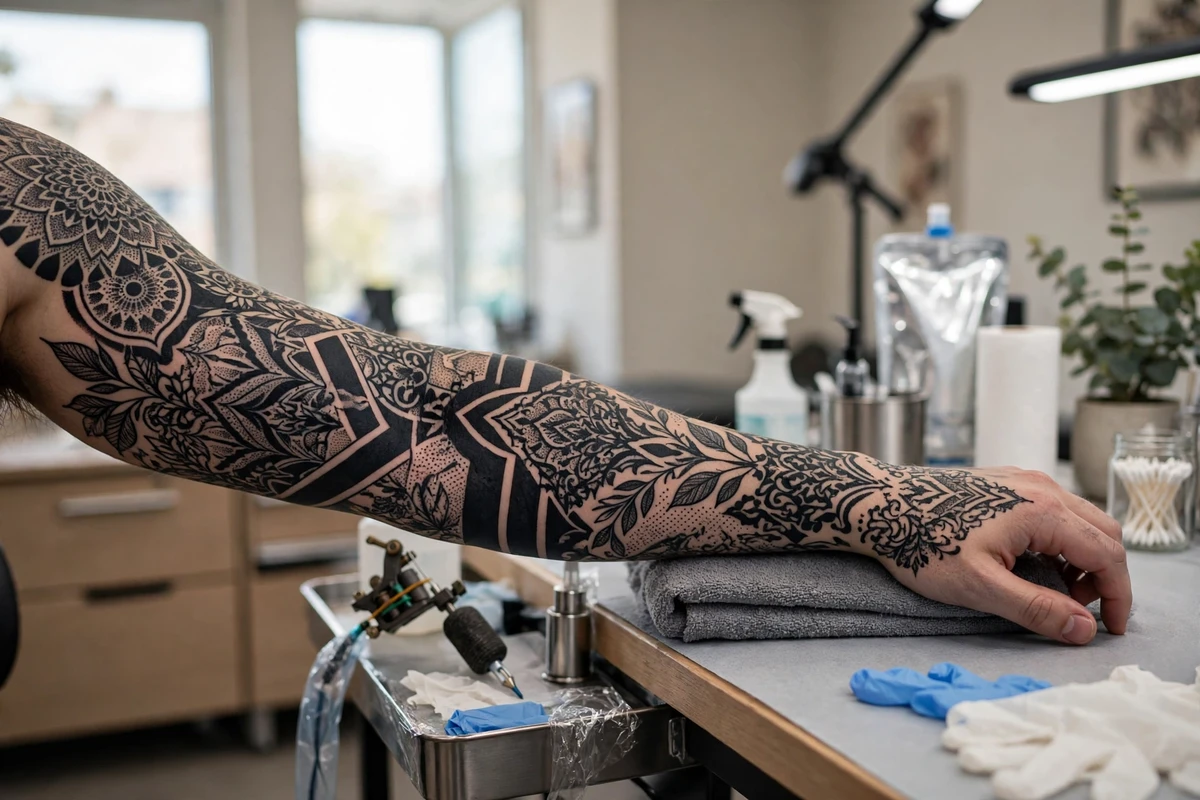
A sleeve tattoo is a commitment in a way few other tattoos are. It covers the whole arm, shoulder to wrist, so the design has to work as one piece rather than a collection of separate images. That is also what makes it so rewarding: when the elements flow together, the arm itself becomes the artwork, and every angle shows a different part of the story.
Sleeves suit almost any style, from solid black shapes to soft watercolour flowers, but each style asks something different of you — in time, in sessions, and in how much of the design you can see at once. The seven ideas below cover that range, so whether you want something bold and graphic or quiet and detailed, there is a version here that fits.
1. Full Blackwork Sleeve
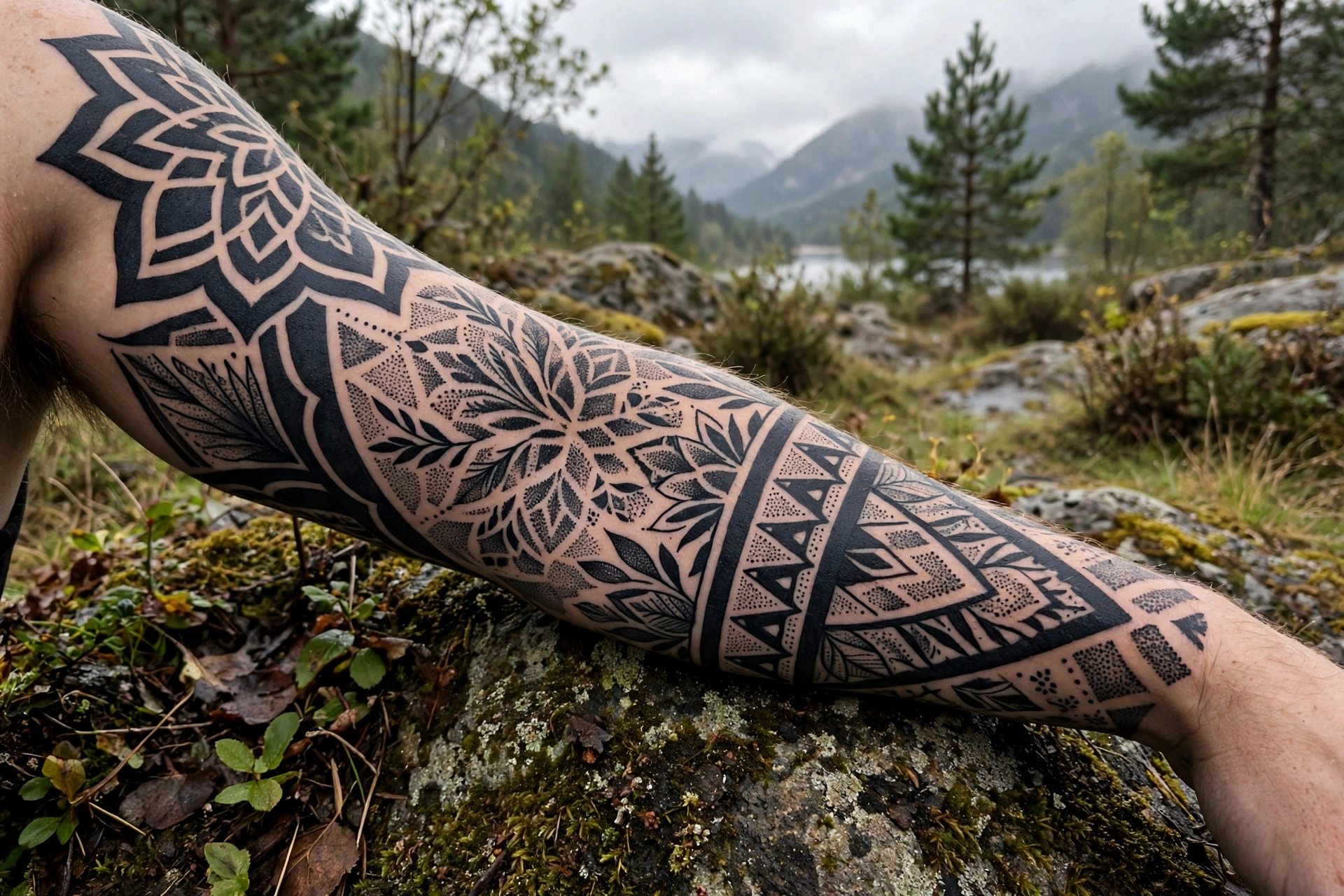
A full blackwork sleeve covers the arm in solid black shapes, bold patterns, and dotwork shading. The contrast is striking: black ink against skin reads clearly from a distance, and the design does not rely on colour or fine detail to make its point. Tribal-inspired bands, abstract blocks, and ornamental patterns all work well here, and dotwork around the edges softens the solid black so it does not feel flat.
This is the boldest option in this list, and it is also one of the most forgiving over time. Solid black holds up well as skin ages, and there is no colour to fade. The trade-off is that it is hard to change later — covering solid black takes serious work — so be sure you love the design before your artist starts.
Placement: The full arm, shoulder to wrist, with the boldest shapes on the outer arm where they are most visible. Keep the inner arm slightly lighter in coverage, since that skin is more sensitive and the area bends constantly.
2. Japanese Irezumi-Style Sleeve
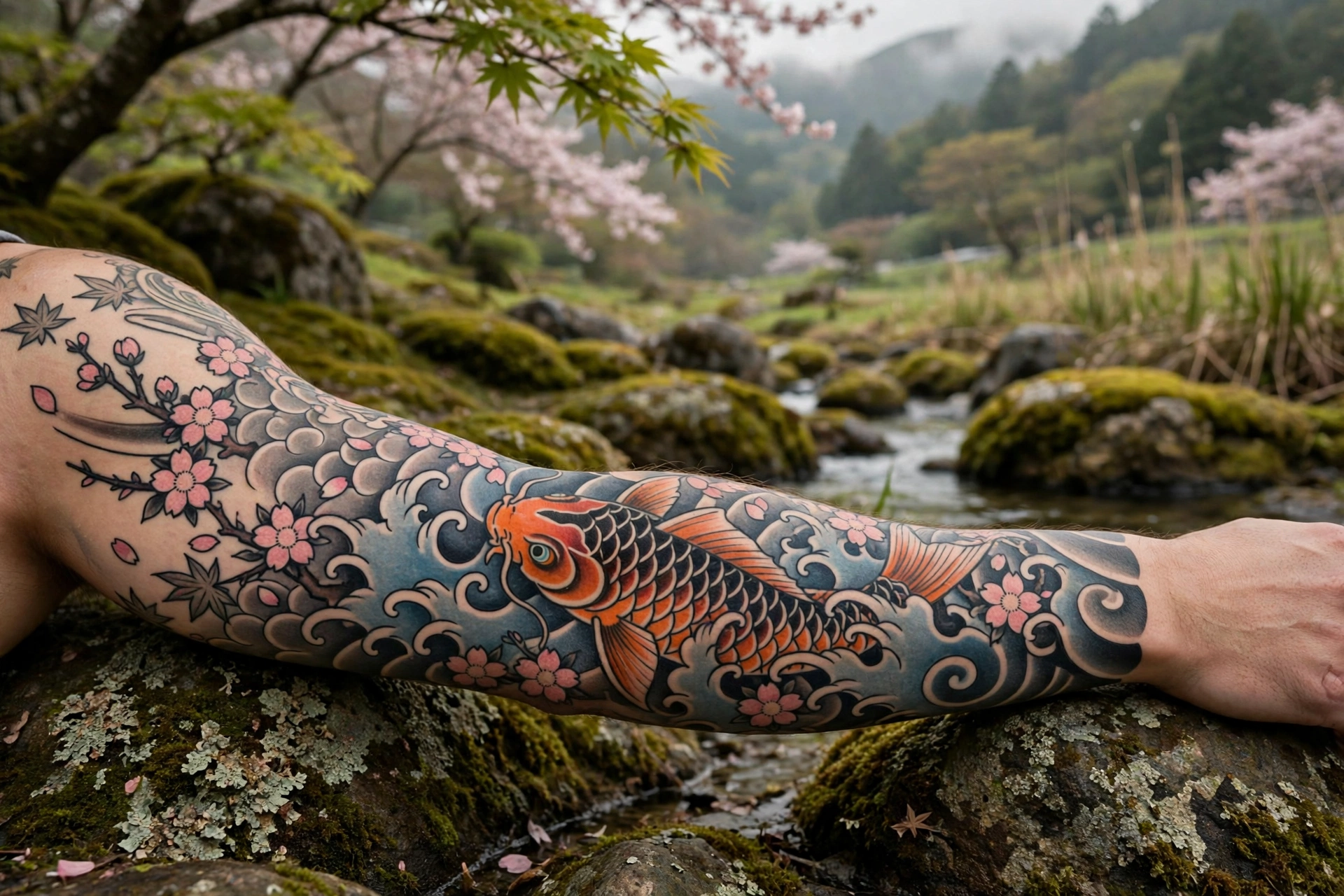
A Japanese irezumi-style sleeve follows a tradition that goes back centuries: a koi fish swimming upstream, a dragon winding around the arm, cherry blossoms and waves filling the spaces between. The background is as important as the main image — wind bars and water flow around the central figures and tie the whole sleeve together, so nothing looks pasted on.
This style needs an artist who understands the tradition, because the placement of each element follows old rules: the koi swims toward the shoulder, the flowers sit where they belong in the season. Done well, it is one of the most impressive sleeves you can wear, and it looks just as good in black and grey as it does in colour.
Placement: The full arm, shoulder to wrist, with the main figure — koi, dragon, or tiger — centred on the outer upper arm. Let the waves and blossoms flow down toward the wrist so the design reads as one continuous scene.
3. Floral Sleeve
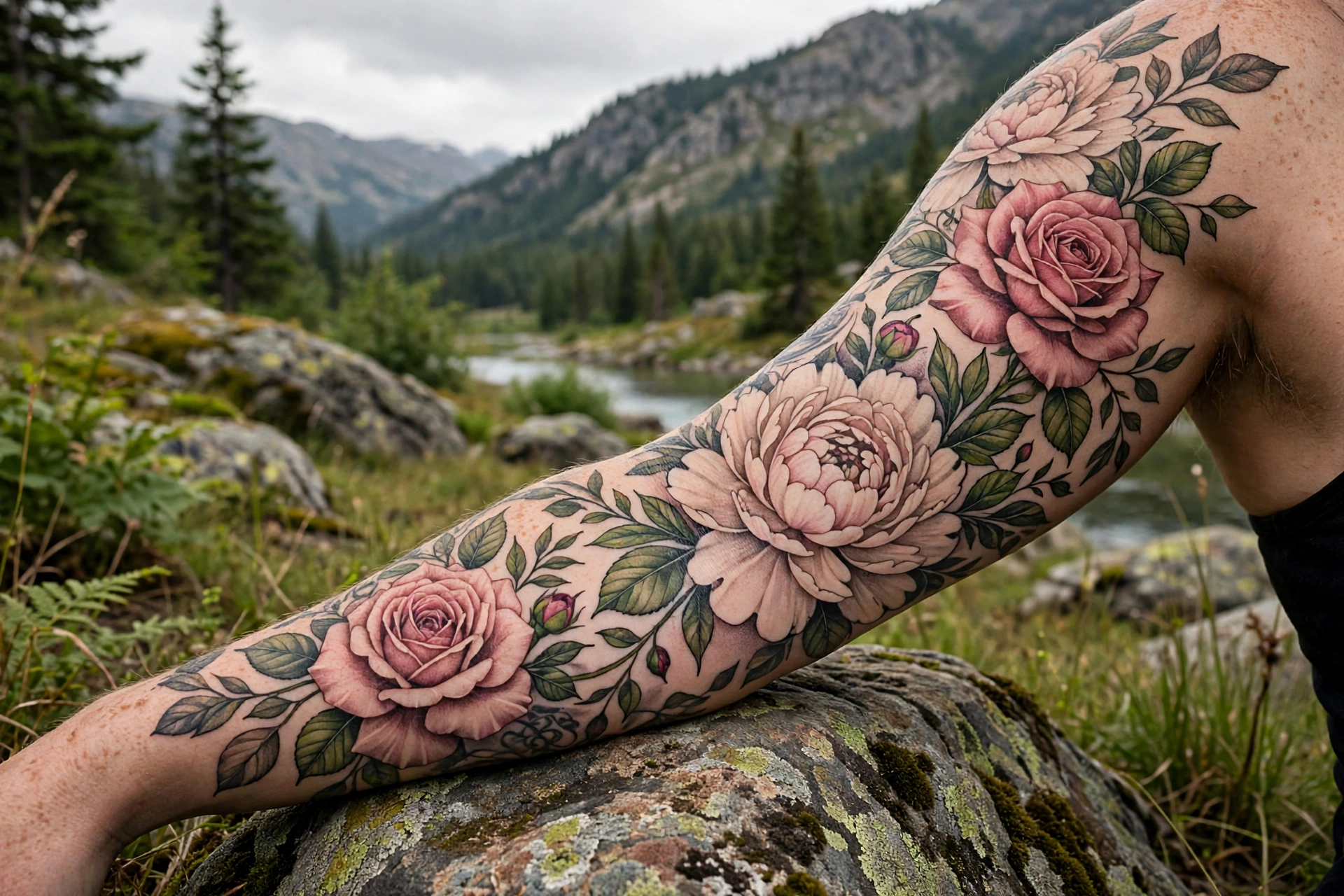
A floral sleeve turns the arm into a garden: large roses and peonies as the main blooms, smaller flowers and leaves filling the gaps, stems curving naturally around the arm. Flowers suit a sleeve because they are naturally curved and flowing, and a vine of blossoms can wrap the whole arm without ever looking forced. Colour makes it pop, but black and grey florals have a quieter, classic feel that ages beautifully.
This style is easy to personalise. A flower that means something to you, a bloom from a place you love, or a mix of your favourites — the design grows around whatever you choose. Keep the main flowers large enough to hold their detail, and let the smaller leaves and buds fill in around them.
Placement: The full arm, shoulder to wrist, with the largest blooms on the outer arm and shoulder. Let the stems follow the arm’s curve rather than running straight across it, so the design looks like it grew there.
4. Nature and Forest Sleeve
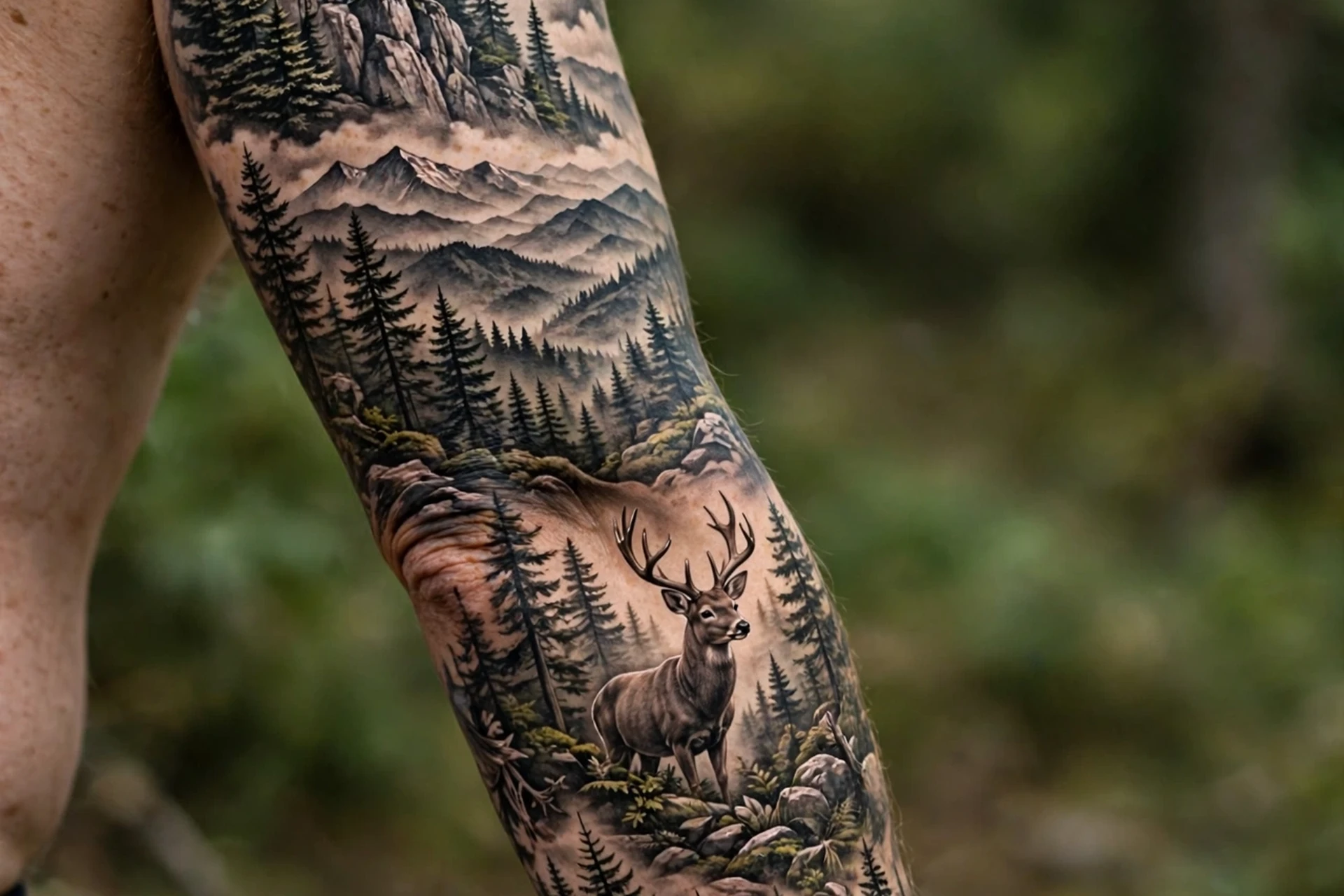
A nature and forest sleeve builds a landscape on the arm: pine trees rising from the wrist, mountains along the forearm, a deer or a wolf among the trees, birds in the sky near the shoulder. The scene reads from the wrist upward like a view through a window, and the vertical shape of the arm suits a landscape that climbs.
This style works best when the elements share one mood — a misty mountain forest, a quiet woodland at dusk — rather than mixing unrelated scenes. Black and grey shading gives it a calm, almost photographic feel, while a touch of colour in the sky or leaves can warm the whole piece up.
Placement: The full arm, shoulder to wrist, with the ground and trees starting at the wrist and the sky and birds near the shoulder. Keep the horizon line consistent so the landscape reads as one place, not several stacked pictures.
5. Geometric Sleeve
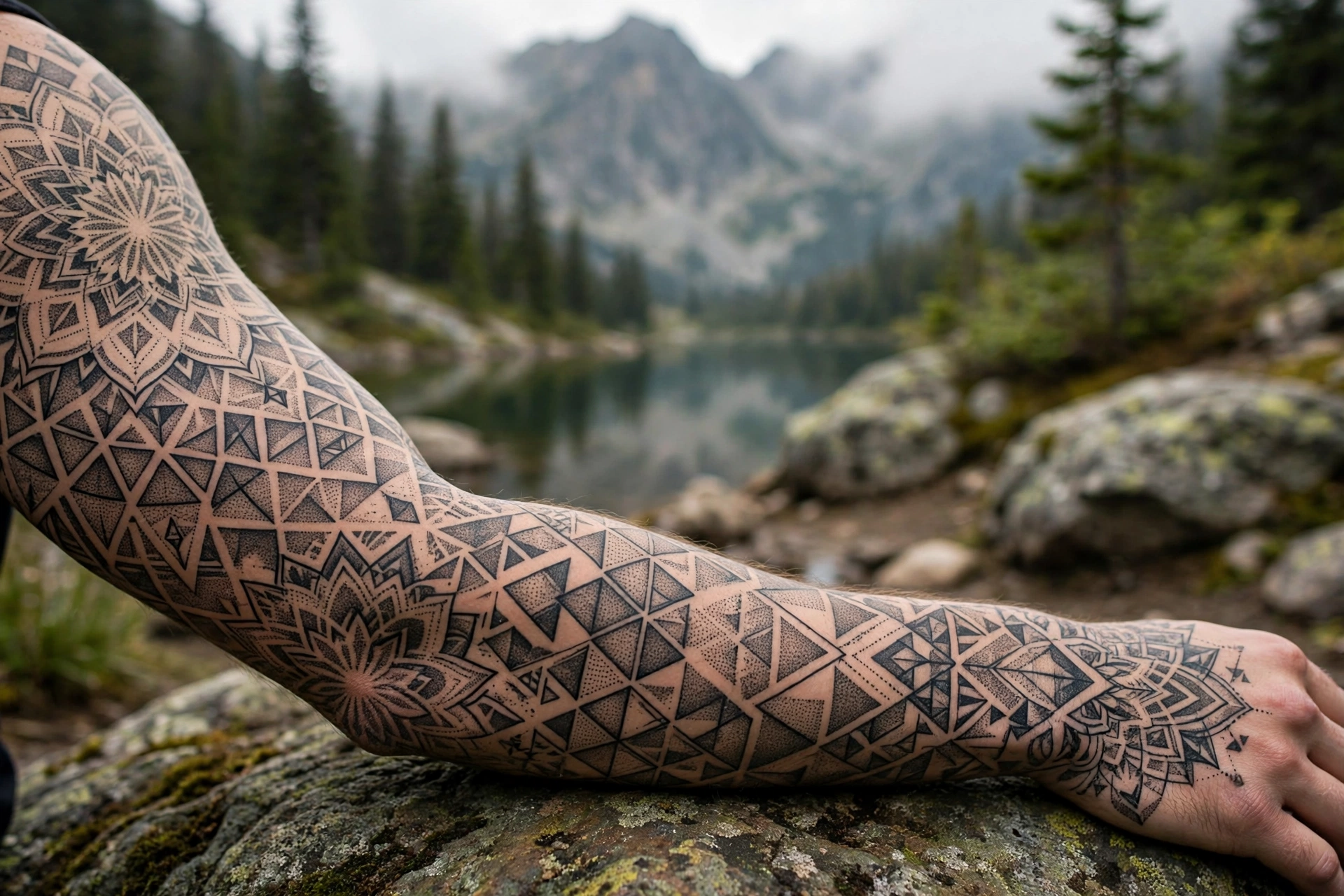
A geometric sleeve is built from clean shapes: mandalas, triangles, fine linework, and dotwork shading arranged in a pattern that wraps the arm. The appeal is precision — every line has to be straight, every shape has to line up, and when it does, the result looks almost architectural. Symmetry is the key, and a good artist will measure and stencil carefully before the needle touches skin.
This style suits people who like order and detail. It also pairs well with other styles: a geometric mandala can frame a flower, or a band of sacred geometry can sit alongside a realistic animal. Just remember that straight lines show mistakes more clearly than flowing shapes do, so choose an artist with a steady hand and a strong portfolio of geometric work.
Placement: The full arm, shoulder to wrist, with the largest mandala or central shape on the outer upper arm. Keep the pattern symmetrical around the arm so it looks planned from every angle.
6. Portrait Sleeve
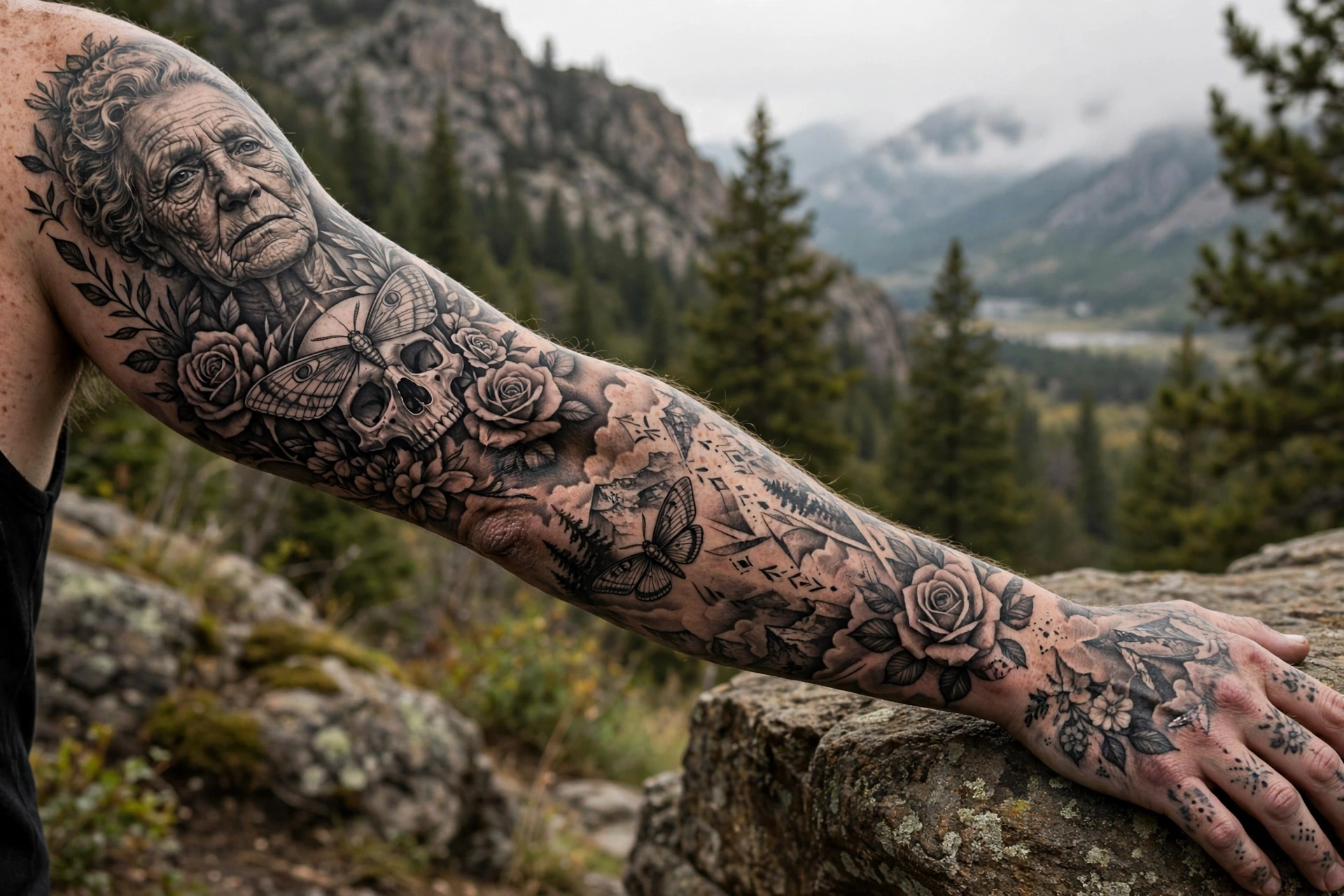
A portrait sleeve puts a face at the centre of the design: a loved one, a favourite musician, a character from a film, or a figure from history. Realistic black and grey portrait work is the hardest style on this list to get right — a face has no room for error, and a likeness that is slightly off will bother you every time you look at it. That is why the artist matters more here than in any other style.
If you go this route, bring clear reference photos and give your artist time. A good portrait needs several sessions, and the supporting elements — roses, clouds, a city skyline, a favourite object — should frame the face rather than crowd it. When it works, though, few tattoos feel as personal as a portrait done well.
Placement: The full arm, shoulder to wrist, with the portrait on the outer upper arm, the flattest and most visible part of the arm. Place the supporting elements around it so the face stays the clear focal point.
7. Patchwork Sleeve
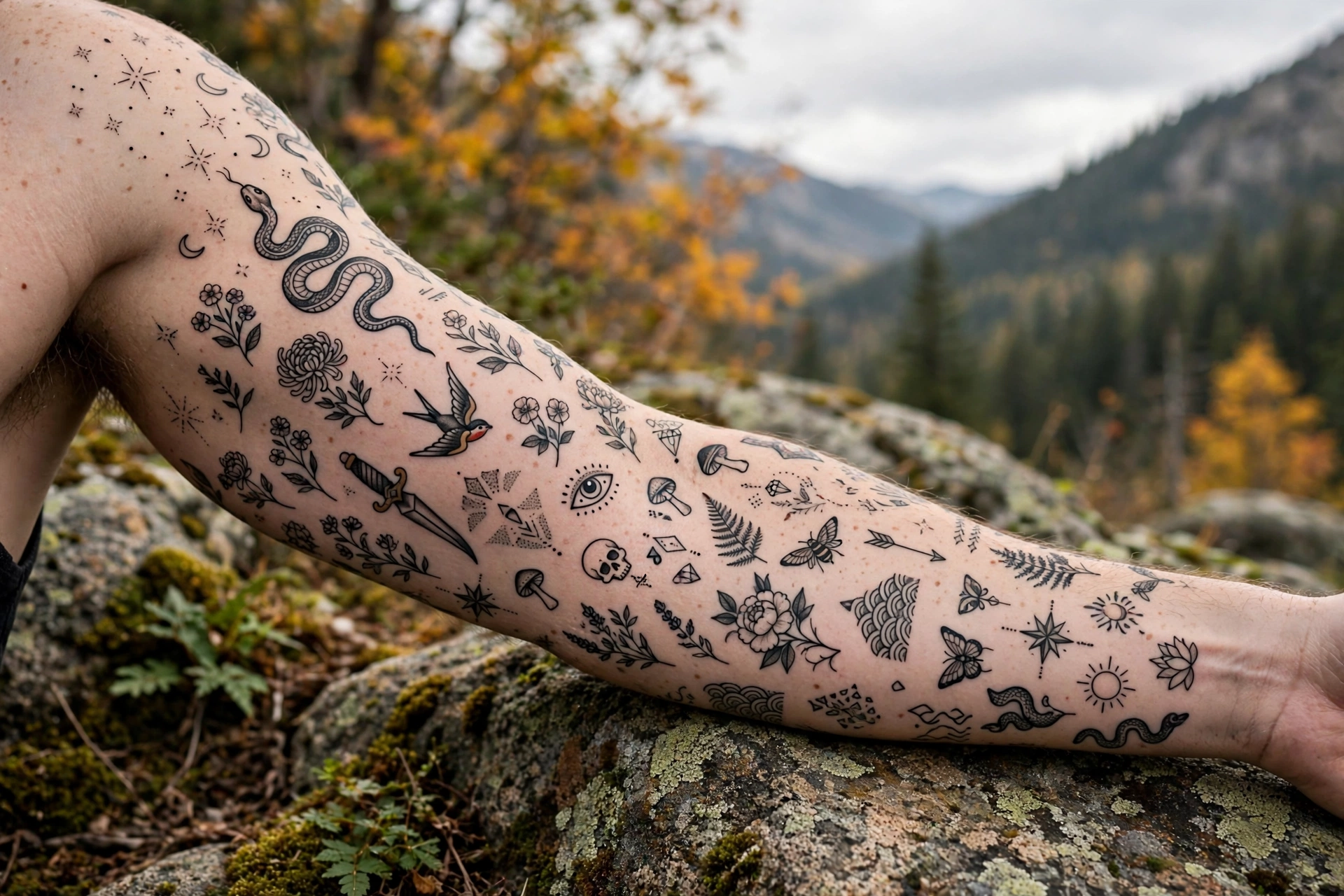
A patchwork sleeve is the opposite of a planned scene: a collection of small, separate designs — a star here, a snake there, a flower, a symbol, a tiny landscape — that fill the arm one piece at a time. There is no single background tying them together, and that is the point. Each piece means something on its own, and the sleeve grows over months or years as you add to it.
This is the most flexible sleeve on this list. You can start with one small tattoo and build from there, which makes it a good choice if you are not ready to commit to a full design in one go. The trick is keeping the pieces roughly the same size and leaving small gaps of bare skin between them, so the arm reads as a collection rather than a clutter.
Placement: The full arm, shoulder to wrist, built up piece by piece. Start with your favourite design on the outer forearm or upper arm, then add around it, keeping a little space between pieces so each one stays readable.
A sleeve tattoo works when the arm reads as one piece, whether that piece is a single flowing scene or a collection of small designs that belong together. Pick the style that matches how you want to get there: blackwork, Japanese, or geometric for something bold and graphic; floral or forest for something that grows naturally around the arm; portrait for the most personal option; patchwork if you would rather build slowly. Whichever you choose, take your time finding the right artist for that style, and plan the design as a whole before the first session. A sleeve is a long project, and the ones that look best years later are the ones that were planned, not rushed.