
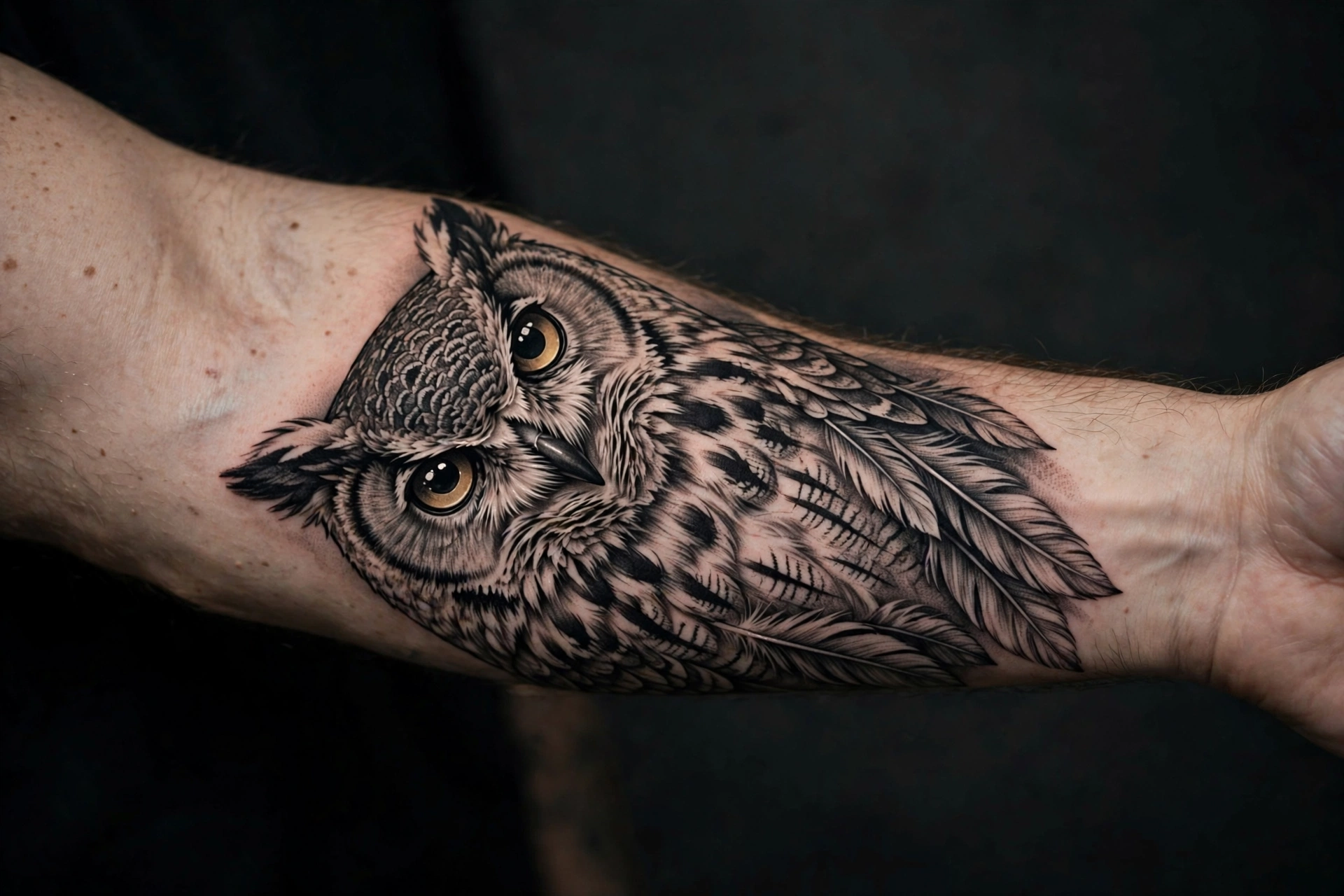
An owl tattoo can look serious, gentle, or quietly playful. The difference is rarely the bird itself. It is the shape of the eyes, the amount of feather detail, the size of the wings, and how much open skin is left around the design.
An owl carries its meaning in its face. A direct stare feels watchful and calm. A softer, rounder owl feels warm and a little whimsical. These seven ideas show different ways to use the same bird, so you can compare them before you talk to an artist.
1: Realistic Owl
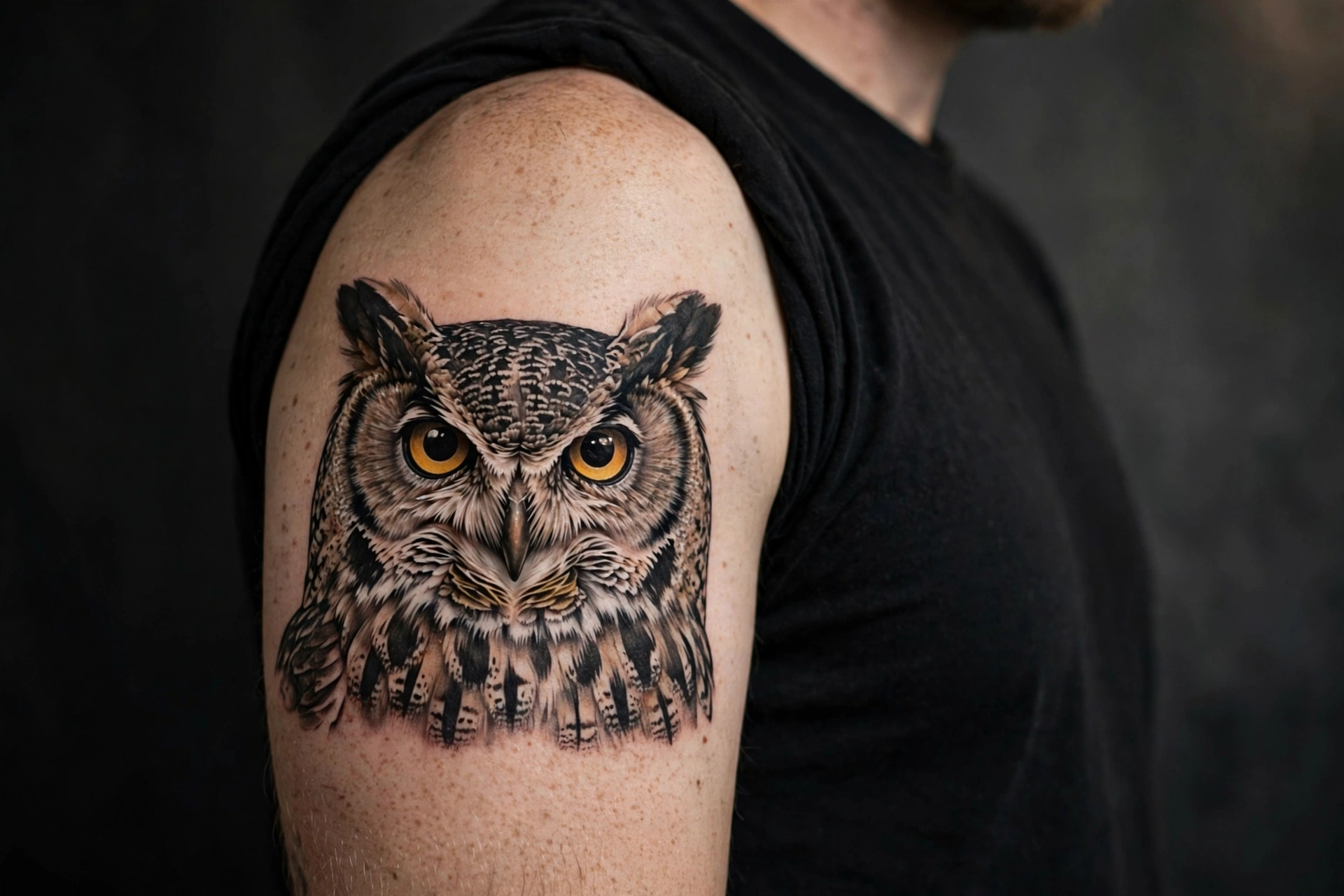
A realistic owl works best when the feathers do most of the talking. Layered shading around the face, clear eyes with a sharp catch of light, and soft, uneven feather edges give it depth without needing extra symbols.
This is a strong choice for a forearm or upper arm. The head can sit across the widest part of the arm, with the body and wings following the arm down toward the wrist. Ask your artist to keep the darkest shading around the eyes and beak, so the face still reads clearly from a normal distance.
The eyes are what make or break this design. A realistic owl with flat, dull eyes will look tired rather than watchful. Bring references that show the exact gaze you want, calm or alert, and check how the eyes sit when your arm is relaxed and turned.
Design note: Compare a front-facing owl with one turned slightly to the side. A front view feels more direct; a turned head gives the design more movement.
2: Geometric Owl

A geometric owl builds the bird from clean shapes. Triangles form the wings, straight lines shape the body, and a few circles or dots mark the eyes. The result looks modern and graphic, even at a small size.
It works well on a forearm, calf, or shoulder blade, where straight lines have room to stay straight. Keep the shapes large enough to read. Very small triangles and thin lines can blur together as the tattoo ages, while a few bold shapes will hold their form for longer.
This style suits you if you like detailed artwork but want a cleaner composition than a realistic owl. The contrast between the sharp angles and the round eyes is what makes the design work, so every shape does not need its own texture.
Design note: Check the design at actual size, not only enlarged on a screen. Ask which small facets your artist would simplify.
3: Owl and Moon
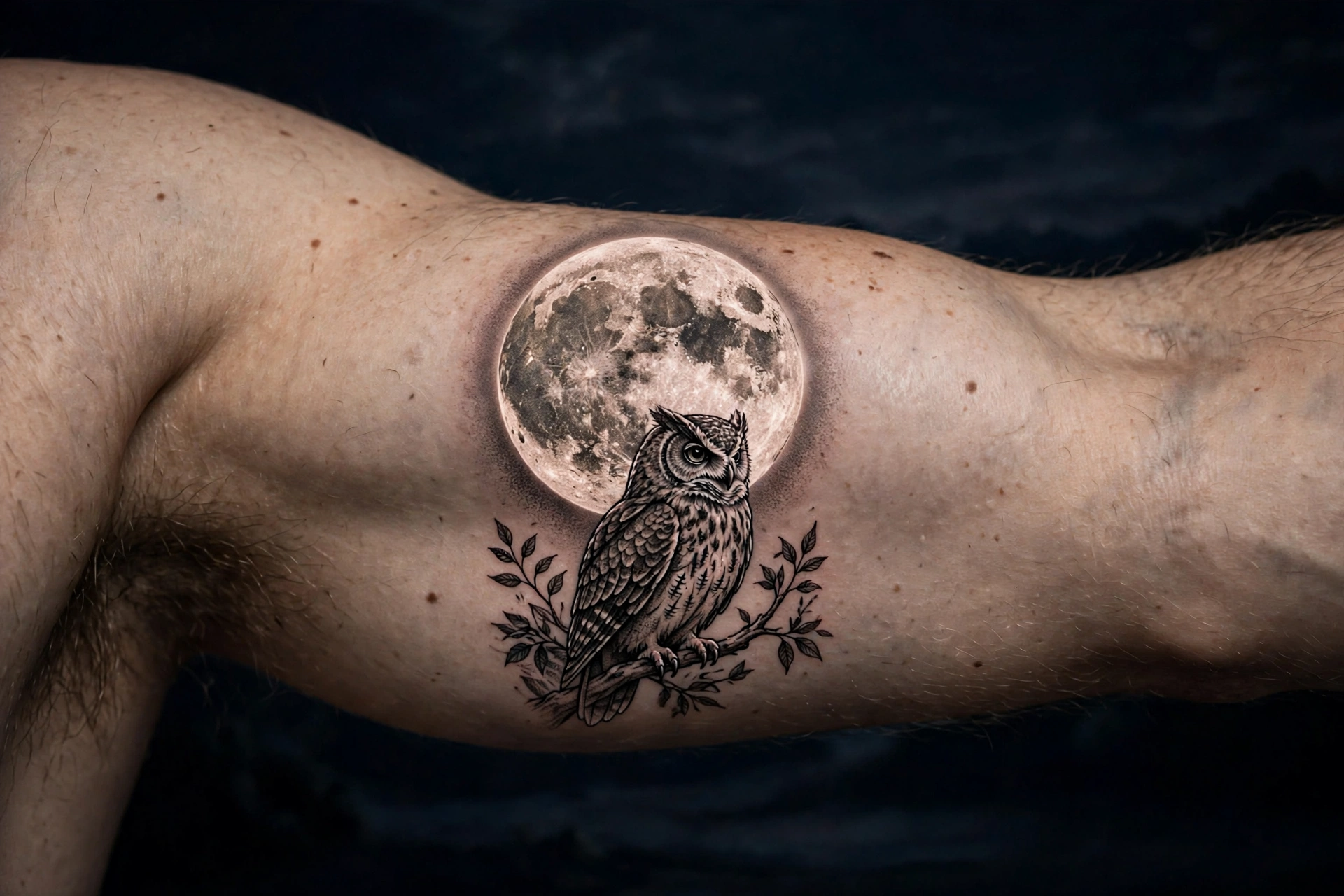
Pairing an owl with a moon gives the design a calm, night-time feel. The curved moon acts as a frame above or beside the bird, while the owl keeps the composition grounded and familiar.
Place the moon slightly off-centre rather than directly above the owl. A small gap between the two shapes helps each one read clearly. A few stars can link them, but they should stay secondary to the bird and the moon.
This suits an upper arm or shoulder, where the moon has space to curve without being squeezed. On a narrow forearm, the moon may need to be smaller than you expect to keep the owl as the main subject. A full moon behind the head gives a bold backdrop; a crescent above one ear feels lighter and more delicate.
Design note: Use one owl and one moon. Adding a branch, stars, and clouds on top of both can quickly make a simple idea feel crowded.
4: Watercolour Owl
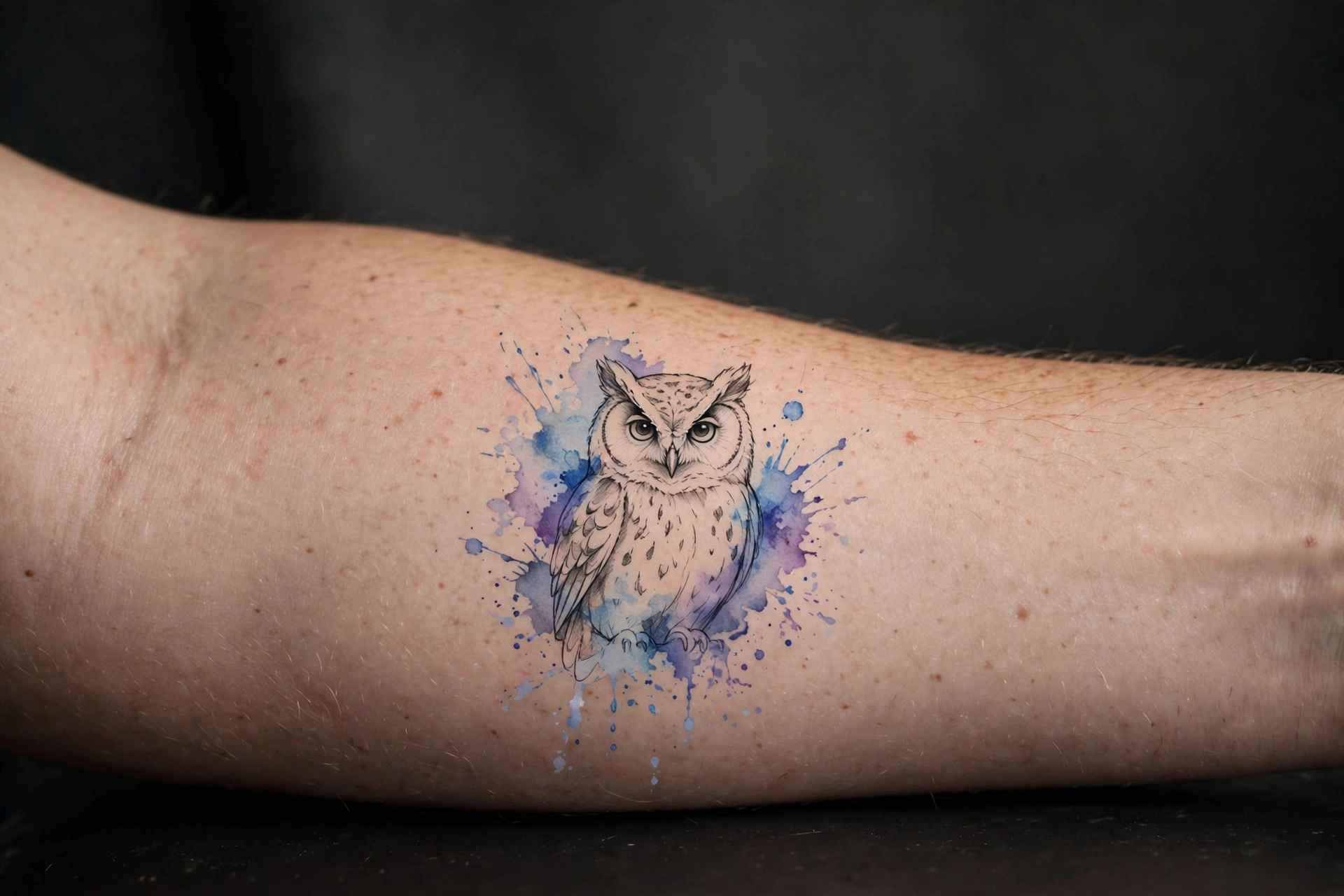
A watercolour owl uses soft washes of colour around a lightly outlined bird, with a few paint-like splashes outside the main shape. The effect is looser than a realistic owl and more colourful than a geometric one.
It suits a forearm or shoulder, where the washes have room to spread without running into another tattoo. The outline should stay clear even where the colour is soft. Without that outline, the bird can look unfinished once the colour settles.
Blue, purple, and teal washes suit an owl well, because they suggest night without making the design dark. A few warm touches around the eyes can keep the face from disappearing into the colour. Ask how the artist handles the edges, as a watercolour owl needs a defined face in the centre, with the loose colour kept to the outside.
Design note: Bring a colour reference that shows the exact shades you want. A watercolour design can shift a lot between the reference and the skin.
5: Small Minimal Owl

A small minimal owl is a single bird, sometimes with folded wings, at about the size of a coin. It is a good first tattoo because the commitment is low and the placement is easy to cover if you need to.
Good spots are the wrist, ankle, behind the ear, and the top of the shoulder. The design should be simple enough to read at that size: a clear round head, two eyes, and a short body. Fine feather detail that looks good enlarged will often disappear at this scale.
Keep the eyes simple. Two small dots or short lines are enough at this size, and they will age better than tiny, detailed eyes. A small beak and a hint of wings are all the extra detail this design needs.
Design note: Keep the owl facing outward when the arm is relaxed, so it reads correctly in normal use, not only in a photo.
6: Owl on a Branch

An owl on a branch turns the bird into a small scene instead of a standalone symbol. The branch gives the design a natural horizontal line, with the owl perched on it and a few leaves filling the space around it.
This works well as a horizontal piece across a shoulder blade, or as a vertical forearm design with the branch running along the arm. Keep the branch slim and the leaves to a few at most. A thick, crowded branch can dominate the bird and make the whole piece look heavy.
The branch also gives you a natural place for a second small detail, such as a leaf, a feather, or a small moon. Choose one extra element at most, so the owl stays the clear focus of the design.
Design note: Decide whether the owl is looking at you or looking away down the branch. That choice changes the whole feeling of the piece.
7: Blackwork Owl
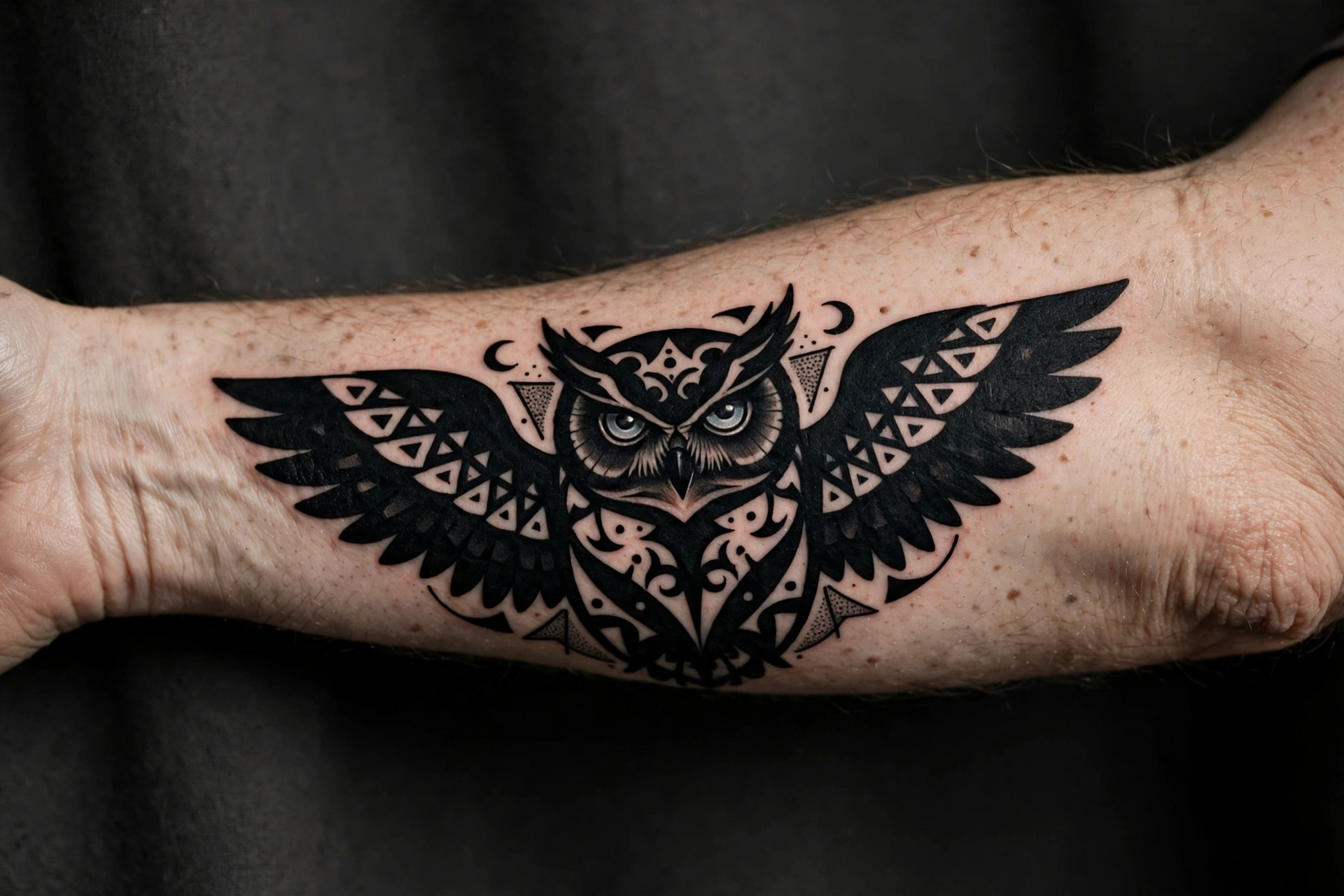
A blackwork owl trades colour for contrast. Solid black wings and body with open, uninked gaps create the shape of the bird, and the eyes are left clear so they stand out against the dark ink.
This version suits a forearm or upper arm, where there is room for the dark areas to breathe. The open gaps matter as much as the ink. If every feather is filled solid, the owl can turn into one dark block. Ask your artist to leave clear channels of skin between the wings and the body, so the bird keeps its form.
Blackwork ages well when the shapes are bold. Avoid very thin black lines inside a solid design, as they can close up over time. The eyes should be the lightest part of the design, so they stay readable even as the black settles.
Design note: Compare a blackwork owl with solid wings against one with open feather gaps. The open version reads more clearly from a distance.
Choosing Your Owl Tattoo
If you keep coming back to softer designs, start with the small minimal owl or the watercolour owl. If you want contrast, compare the blackwork owl with the realistic owl. The geometric version is the clearest choice for a modern look, while the owl and moon and the owl on a branch are the best options if you want one extra element in the design.
Save two designs you like most and note what draws you to each: the eyes, the wing shape, the colour, or the extra motif. Those specific preferences give your artist a useful starting point for an owl tattoo that feels like your own.