
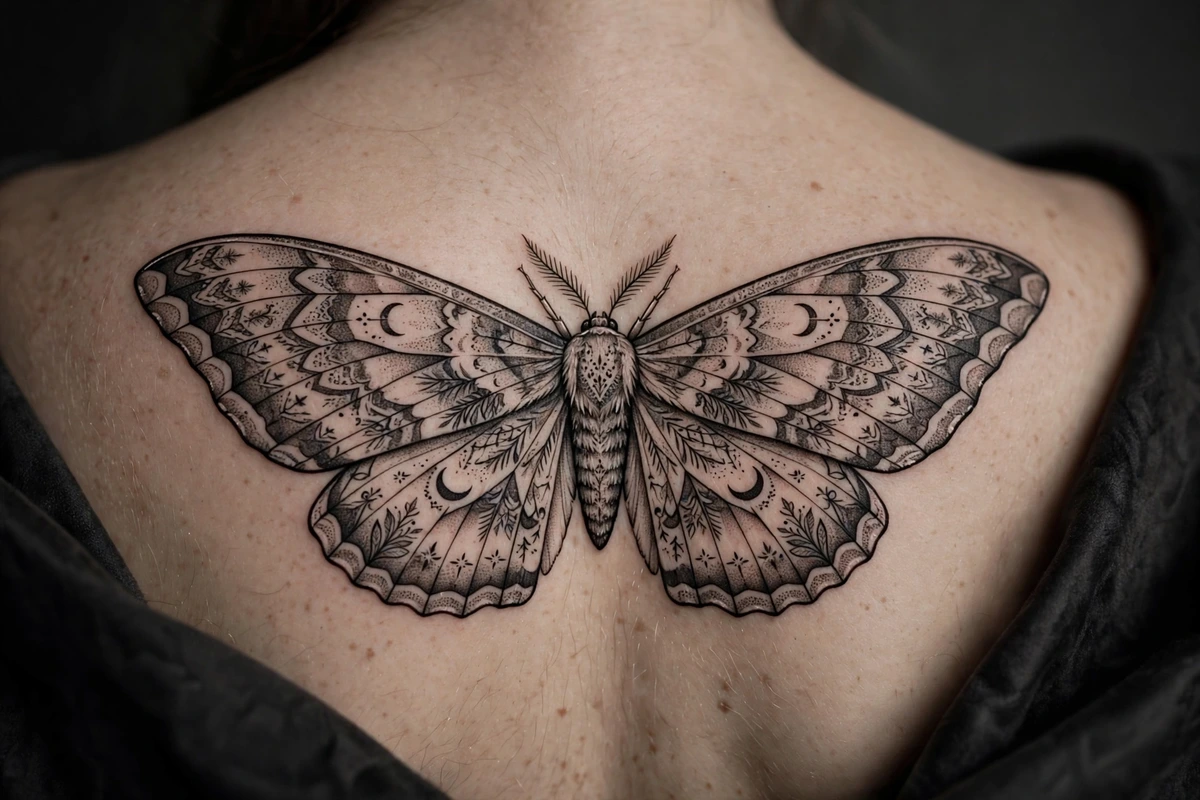
Moths don’t get the same attention butterflies do, and that’s exactly why they make such good tattoos. A moth carries a quieter kind of beauty — soft wings, dusty patterns, and a habit of flying toward light in the dark. That contrast gives a moth tattoo a mood no other insect design quite matches: mysterious without being heavy, delicate without being fragile.
Moths also suit almost any style. They work as a large, detailed back piece, a fine-line design on the wrist, or a small black shape tucked behind the ear. The seven ideas below cover that full range, so whether you want something bold or barely-there, there’s a version here that fits.
1. Realistic Death’s-Head Moth
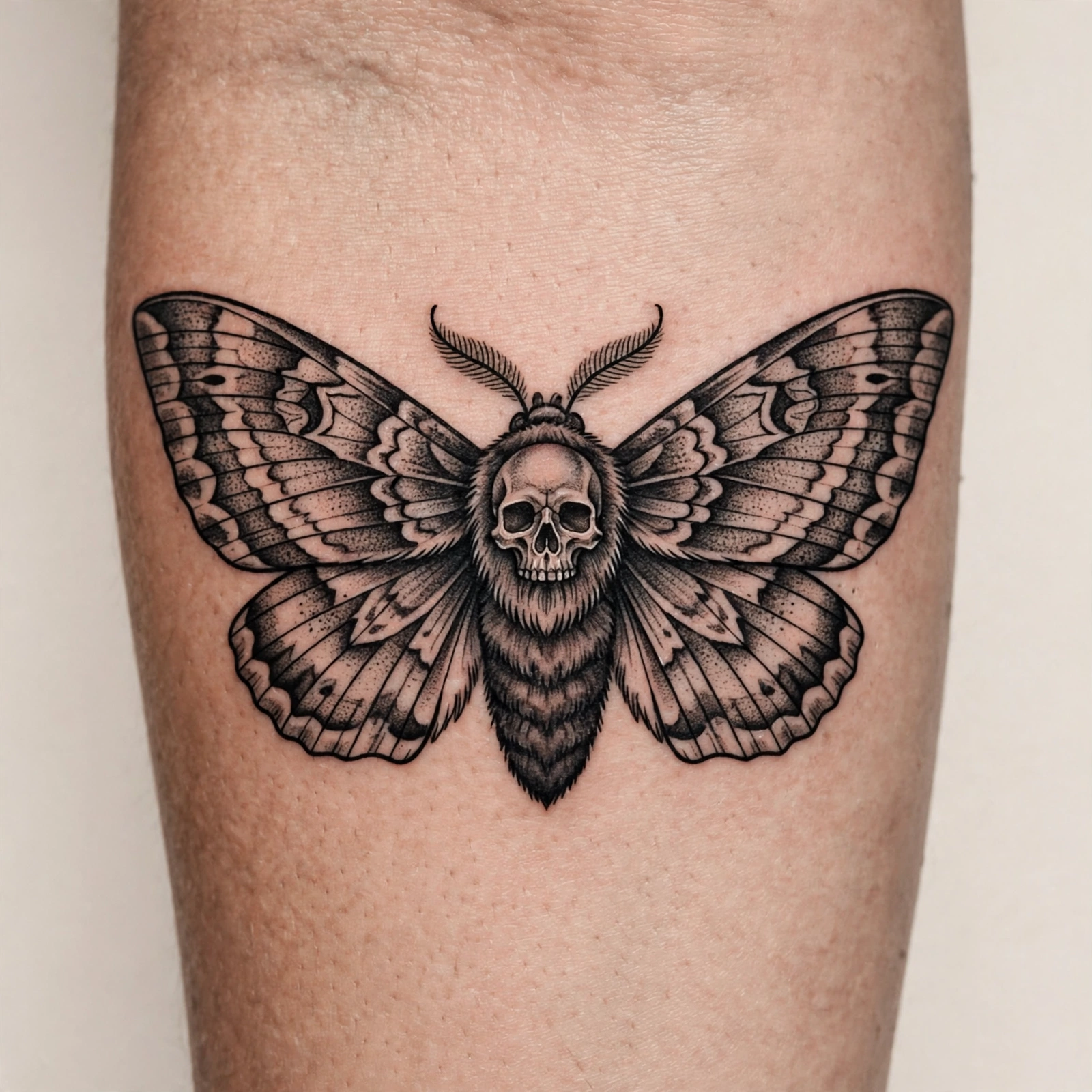
The death’s-head moth is the most recognisable moth in tattooing, thanks to the skull-shaped marking on its thorax and its richly patterned wings. Done realistically, in black and grey with careful shading, it reads as both elegant and a little unsettling — a design that rewards a closer look. The wing patterns give the artist plenty to work with, from dusty browns to soft grey gradients, and the skull detail stays subtle rather than cartoonish when it’s kept true to the real insect.
Placement: The chest or upper back suits this one best, where the wings can spread wide and the detail has room to breathe. A forearm version works too, if you keep the design large enough for the wing patterns to stay crisp.
2. Fine-Line Moth
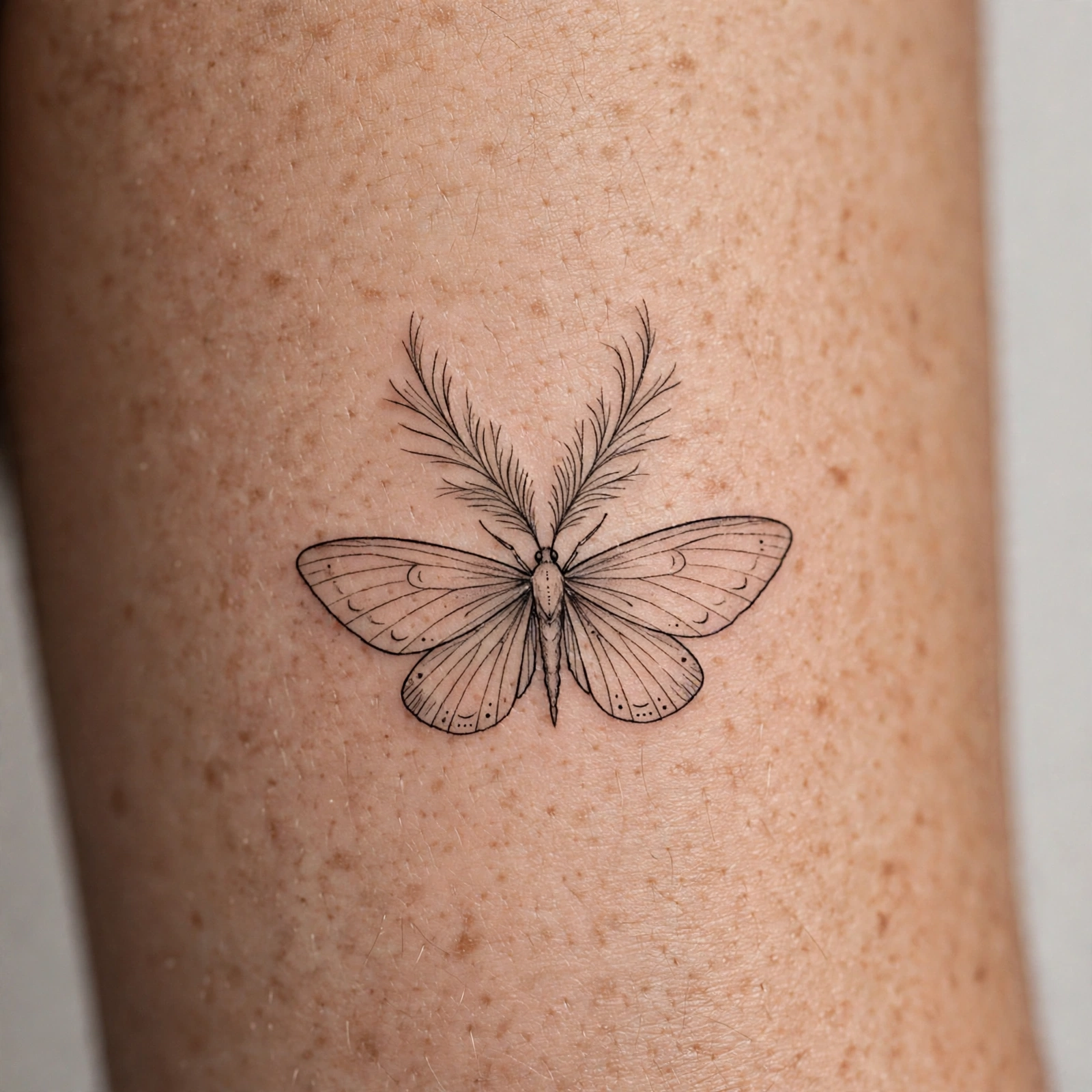
A fine-line moth strips the design back to thin, precise linework — delicate wings, feathery antennae, and just enough shading to give it shape. There’s no heavy black fill here, which makes the tattoo feel light and airy, almost like the moth could lift off the skin. It suits people who want a tattoo with presence but without a bold, dark look.
Placement: The inner forearm, collarbone, or ankle are natural spots. Fine lines age best where the skin sees less friction, so avoid the hands and fingers for this style.
3. Watercolour Moth
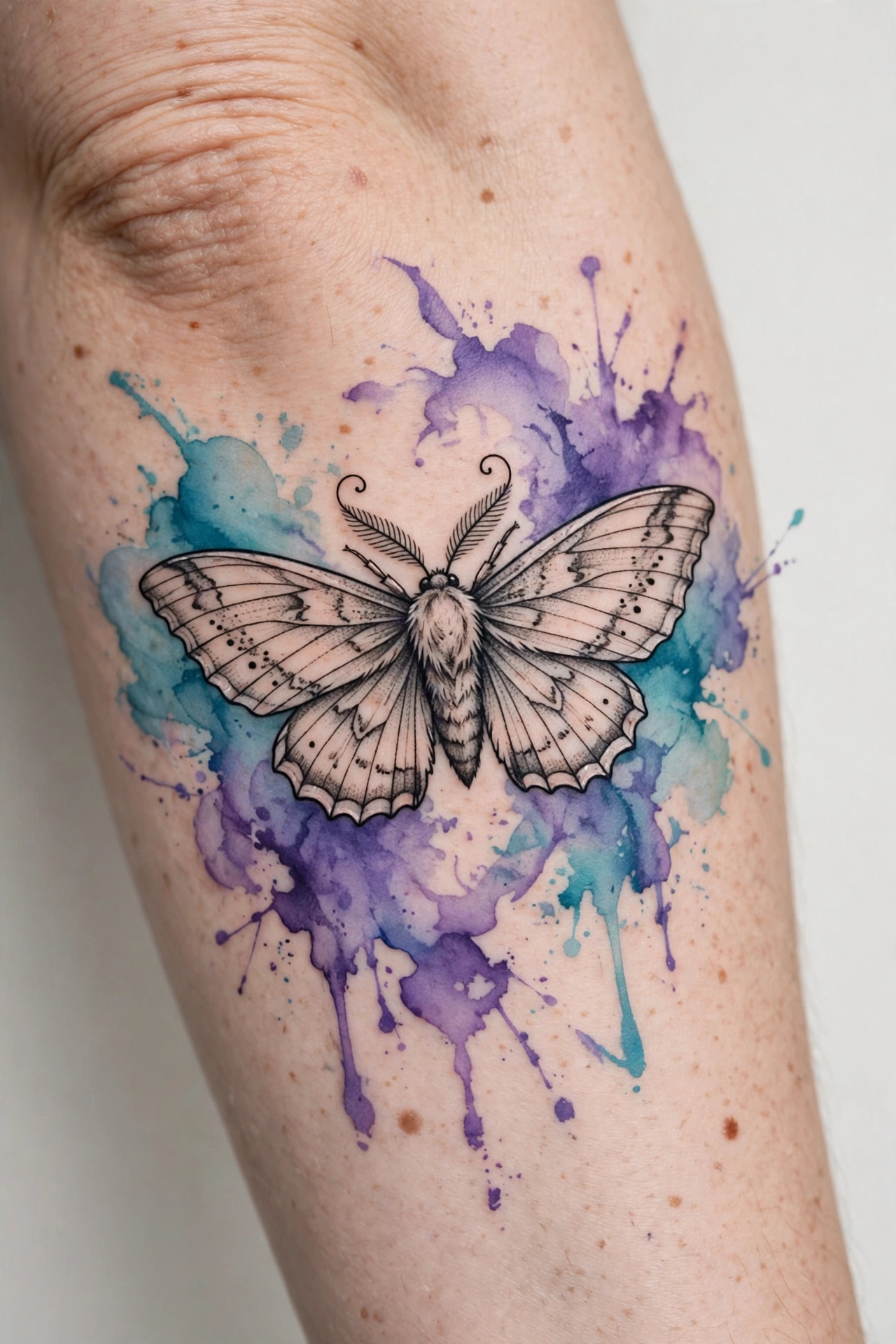
A watercolour moth pairs a detailed moth outline with soft, flowing washes of colour — purples, teals, and dusty pinks bleeding gently beyond the wing edges. The contrast between the precise insect and the loose colour is what makes this style work: the moth stays the clear focus while the colour gives it movement and warmth. Ask your artist to keep the washes soft rather than saturated, so the design still reads well years from now.
Placement: The upper arm or thigh gives the colour room to spread without crowding the moth itself. A shoulder placement also works, letting the washes flow naturally with the shape of the arm.
4. Blackwork Moth
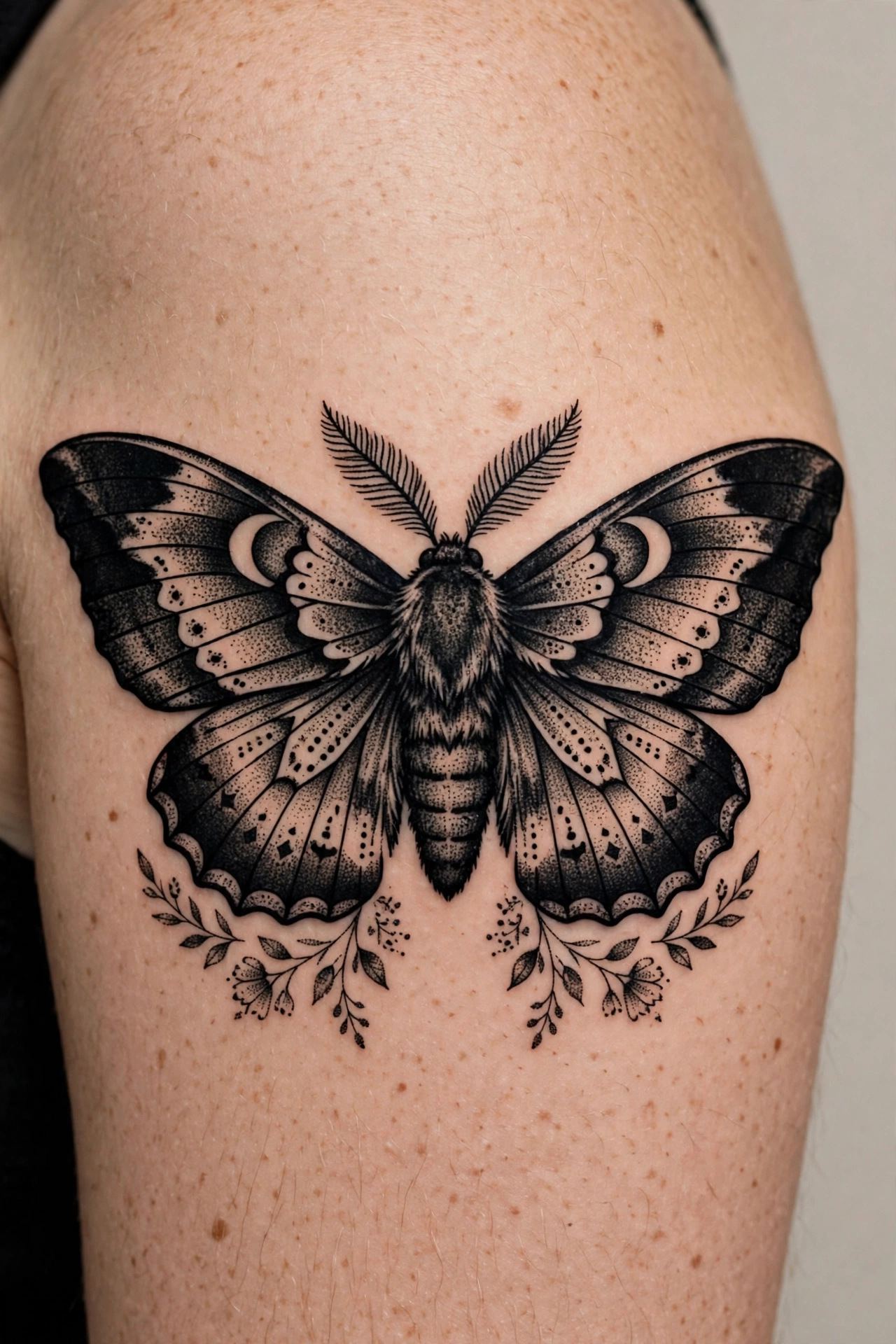
Blackwork takes the moth in the opposite direction from fine-line: solid black wings, bold shapes, and dotwork shading for texture. The result is dramatic and graphic, with the moth’s silhouette doing most of the work. Dotwork along the wing edges and body keeps the solid black from feeling flat, and a few small negative-space details — a thin line here, a tiny crescent there — can add depth without softening the design.
Placement: The forearm, calf, or upper back all suit blackwork well. Larger placements are better, since the solid black needs space to hold its shape as the tattoo settles.
5. Moth and Moon
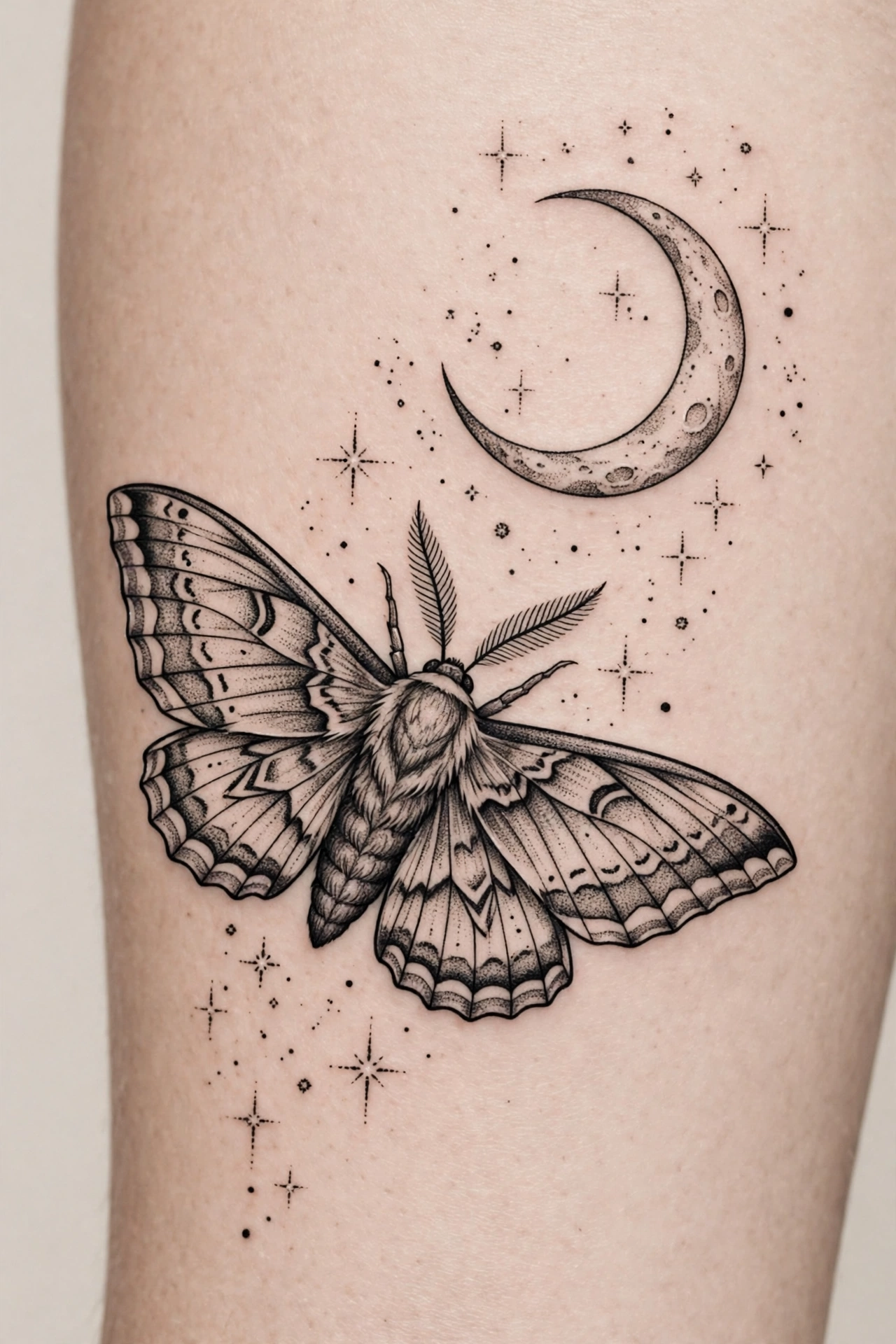
A moth flying toward a crescent moon is one of the most natural pairings in tattoo design — it draws on the real behaviour of moths, drawn to light in the dark. The composition usually has the moth below or beside a slender crescent, sometimes with a scatter of tiny stars. It gives the tattoo a sense of story and movement that a moth alone doesn’t quite have, and it works in black and grey just as well as with a touch of colour in the moon.
Placement: The upper arm, shoulder blade, or side of the ribs suits this design, where the moth and moon can sit in a natural vertical or diagonal flow. Keep the moon small enough that it frames the moth rather than competing with it.
6. Small Minimal Moth

Not every moth tattoo needs to be a statement piece. A small minimal moth — a simple black outline, a few wing details, nothing more — is easy to place, easy to hide, and easy to love for a long time. It keeps the moth’s distinctive shape, with its broad wings and feathery antennae, while stripping away everything extra. For a first tattoo, it’s a gentle place to start.
Placement: The wrist, behind the ear, the ankle, or the side of a finger. Small designs like this heal quickly and sit well almost anywhere, though the wrist and ankle tend to hold fine detail the longest.
7. Ornamental Moth
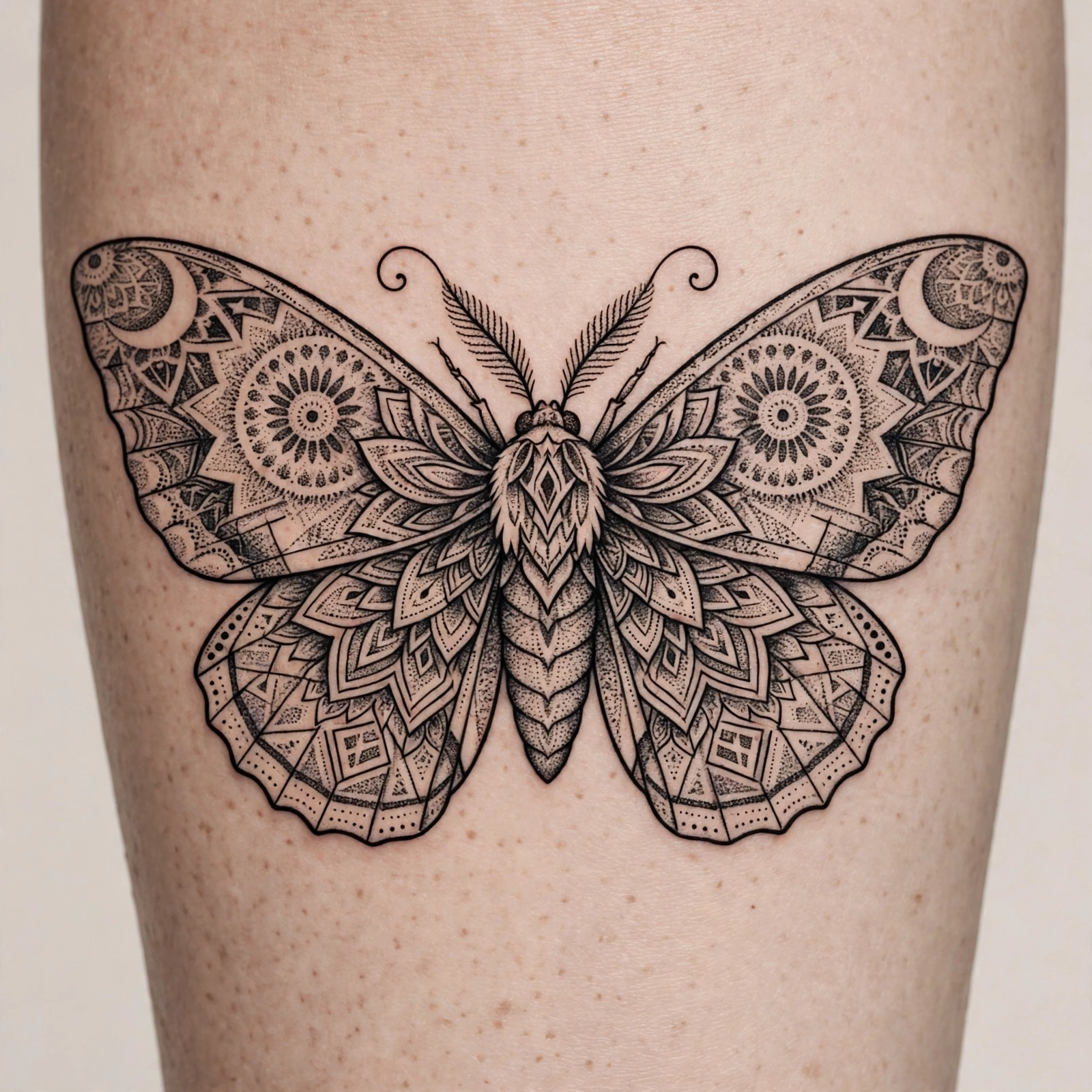
An ornamental moth turns the insect into a piece of jewellery on the skin: symmetrical mandala patterns across the wings, fine dotwork, and geometric details that mirror each other from side to side. The moth’s natural symmetry makes it a perfect base for this style, and the result feels decorative and deliberate rather than purely naturalistic. It’s a good choice if you like ornamental or mandala tattoos but want something with a clearer focal point than a standalone mandala.
Placement: The centre of the upper back or the sternum is ideal, where the symmetry can sit straight and the wings can mirror each other cleanly. A forearm version works too, with the moth’s body running along the arm.
A moth tattoo works because it sits in the space between beautiful and mysterious — detailed enough to admire up close, quiet enough to wear every day. Pick the style that matches how bold you want to be: realistic or blackwork for a strong statement, fine-line or minimal for something subtle, and moth-and-moon or ornamental when you want the design to tell a little more of a story. Whichever you choose, give the wings room — a moth cramped into too small a space loses the detail that makes it special.