
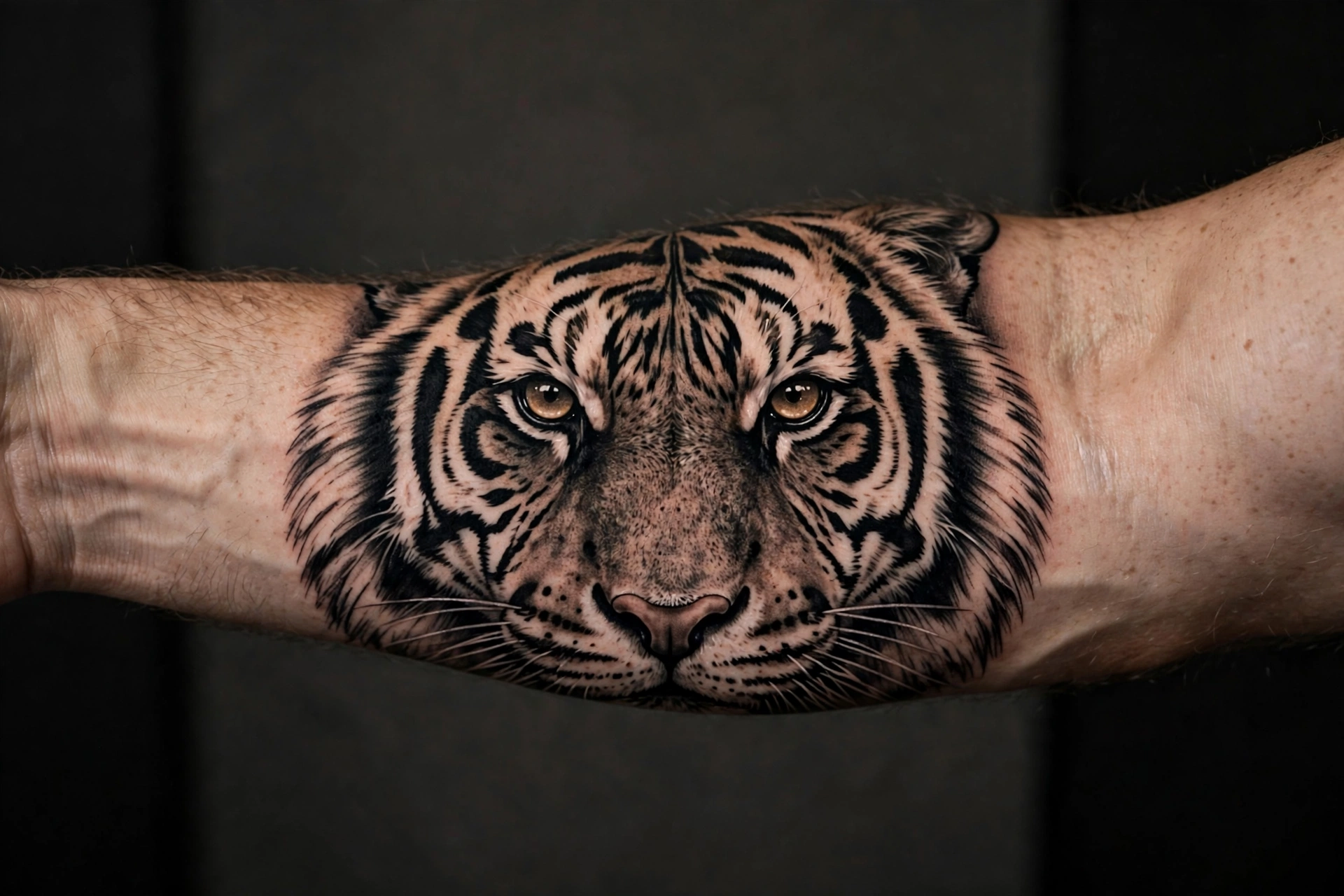
A tiger tattoo works on the forearm because the animal already has a long, vertical shape. The face, the stripes, and the direction of the gaze all follow the arm, so the design rarely needs to be squeezed or stretched to fit.
The choice is not really between a good tiger and a bad one. It is between a calm tiger and a fierce one, a detailed portrait and a graphic pattern, and a design that covers the whole forearm or one that sits quietly on one side of it. These seven ideas show those choices clearly, so you can compare them before you talk to an artist.
1: Realistic Tiger Face
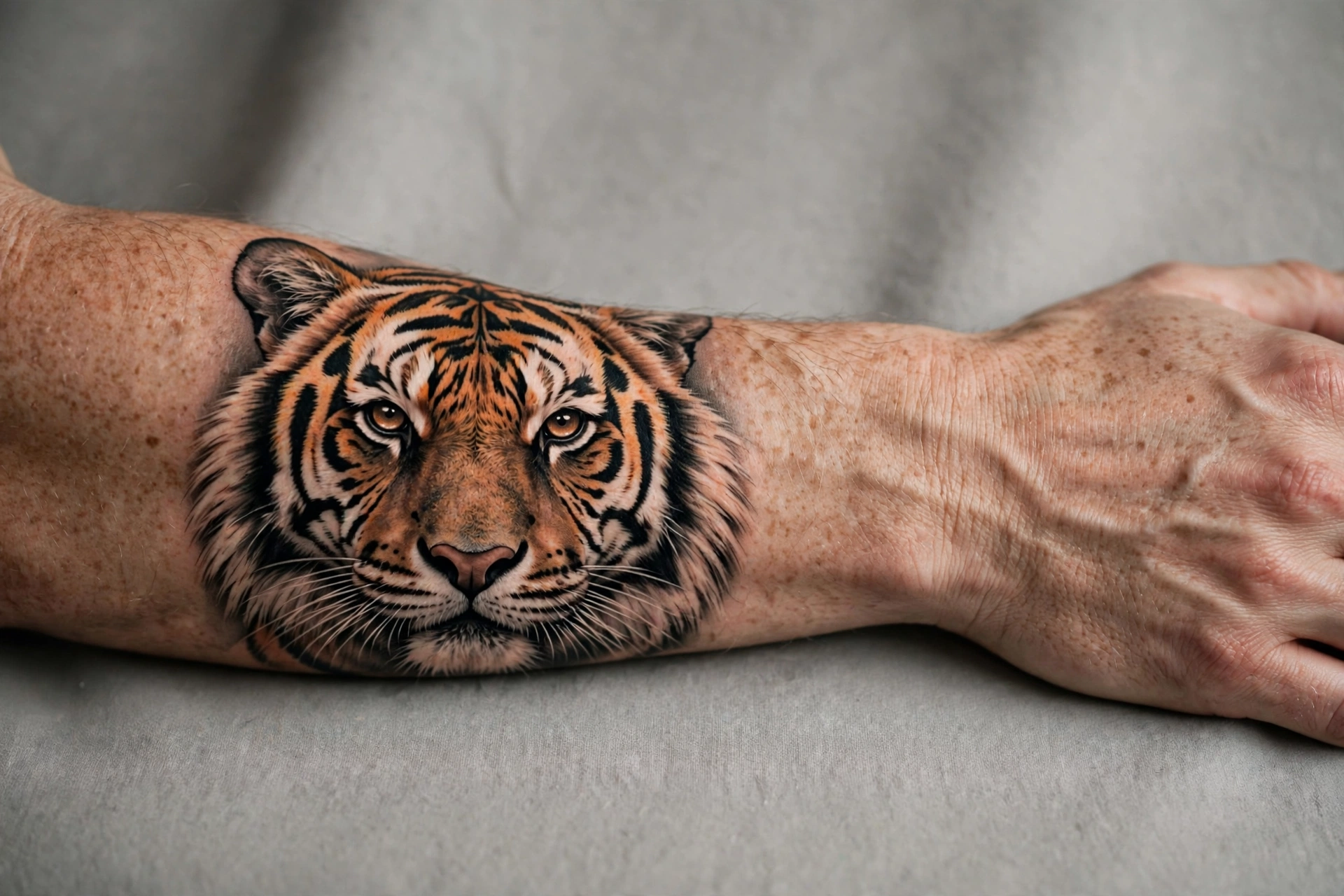
A realistic tiger face depends on the eyes and the stripes. The eyes give the design its expression, and the stripes give it its shape. If either one is weak, the whole portrait feels flat, no matter how much shading is around it.
This is a strong choice for the full forearm. The face can sit across the widest part of the arm, with the stripes running down toward the wrist and the fur shading filling the space on either side. Ask your artist to keep the darkest stripes along the forehead and cheeks, and to leave the area around the eyes a little lighter, so the gaze stays the first thing you notice.
Design note: Compare a calm, direct gaze with an open-mouthed roar. A calm face feels steady and suits a larger portrait; a roaring face needs more space around the mouth to read clearly.
2: Geometric Tiger
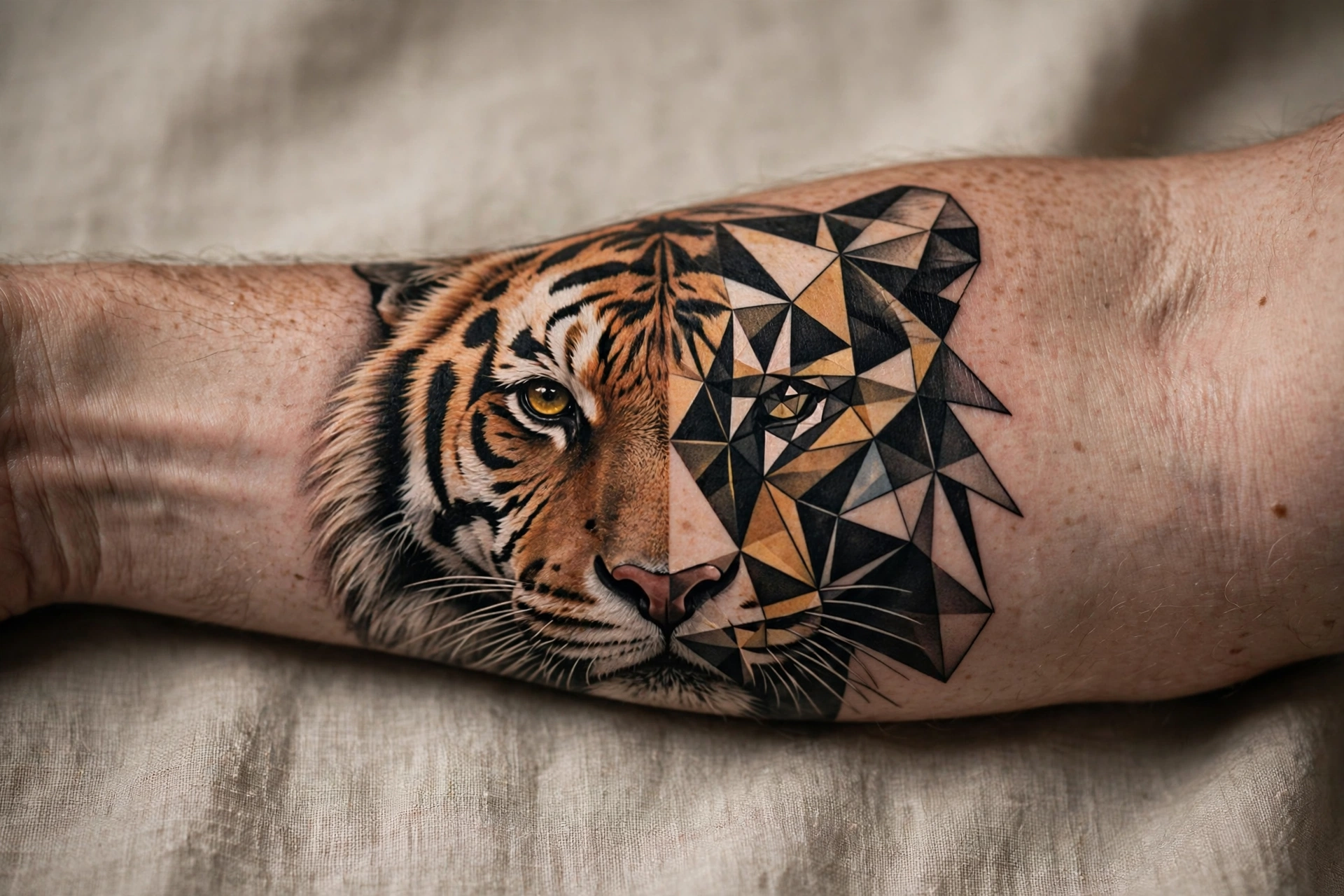
A geometric tiger breaks the animal into triangles, lines, and flat planes, while keeping the face easy to recognise. One half of the face can stay realistic while the other half turns into facets, or the whole portrait can be built from angular shapes.
It works well on a forearm because the straight edges sit neatly against the arm, and the design reads clearly even from a distance. The key is alignment: the eyes should line up across the centre, and the nose and mouth should connect both sides, so the portrait still reads as one face rather than two separate halves.
Design note: Ask which small facets your artist would simplify at actual size. Every triangle does not need its own texture, and a cleaner geometric face often ages better than a crowded one.
3: Tiger and Bamboo
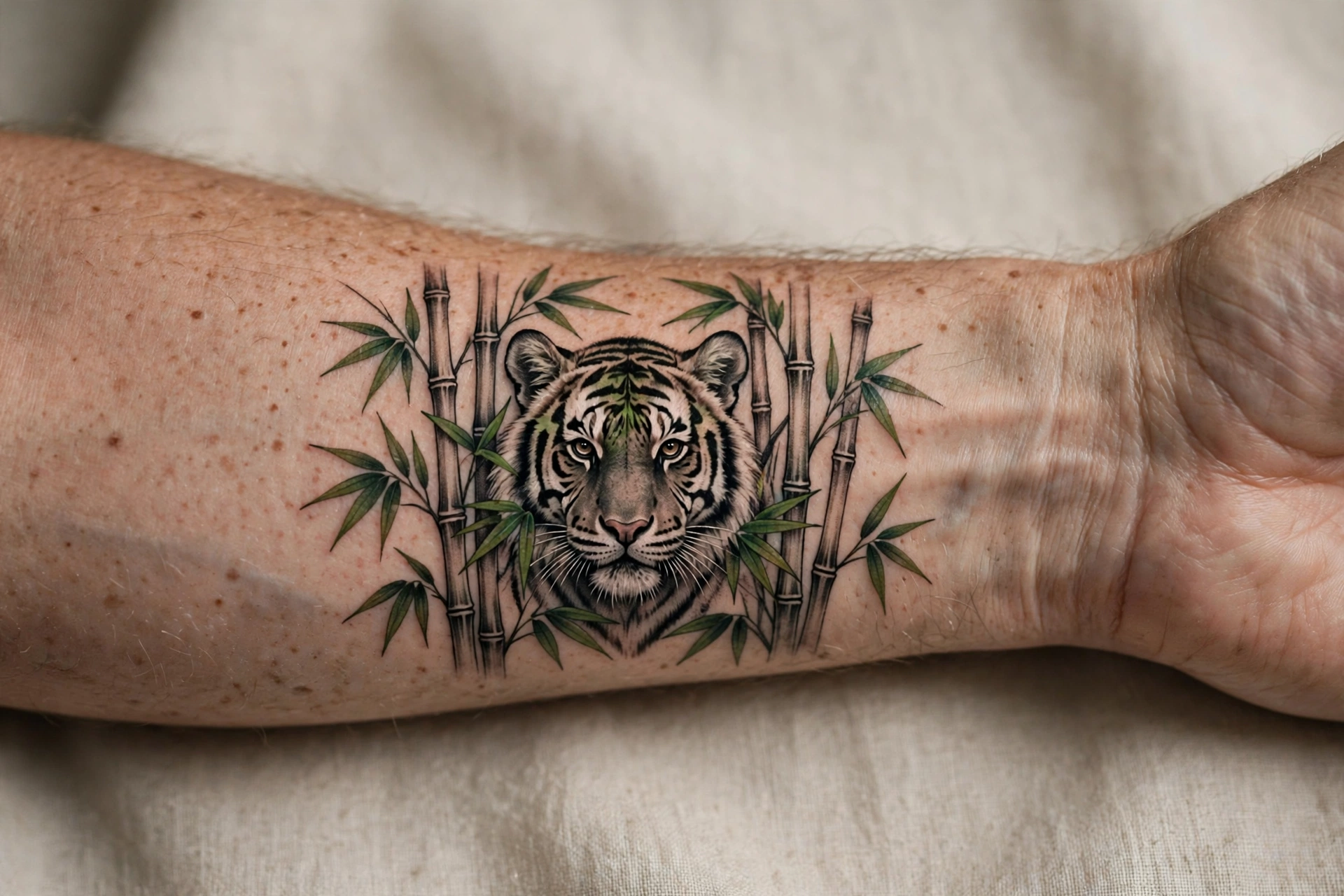
Pairing a tiger with bamboo gives the design a natural setting without adding a busy background. The tall, straight bamboo stalks run along the arm, while the tiger’s face or body sits between them, partly framed by the green leaves.
This suits a long forearm piece. The bamboo gives the design a clear vertical direction, with the tiger near the elbow and the stalks running down toward the wrist. Keep the bamboo to two or three stalks at most. More than that, and the tiger starts to disappear behind the plants.
Design note: Decide whether the tiger is looking out from the bamboo or walking past it. A face peeking between stalks feels quieter; a full body moving through them needs more room.
4: Blackwork Tiger
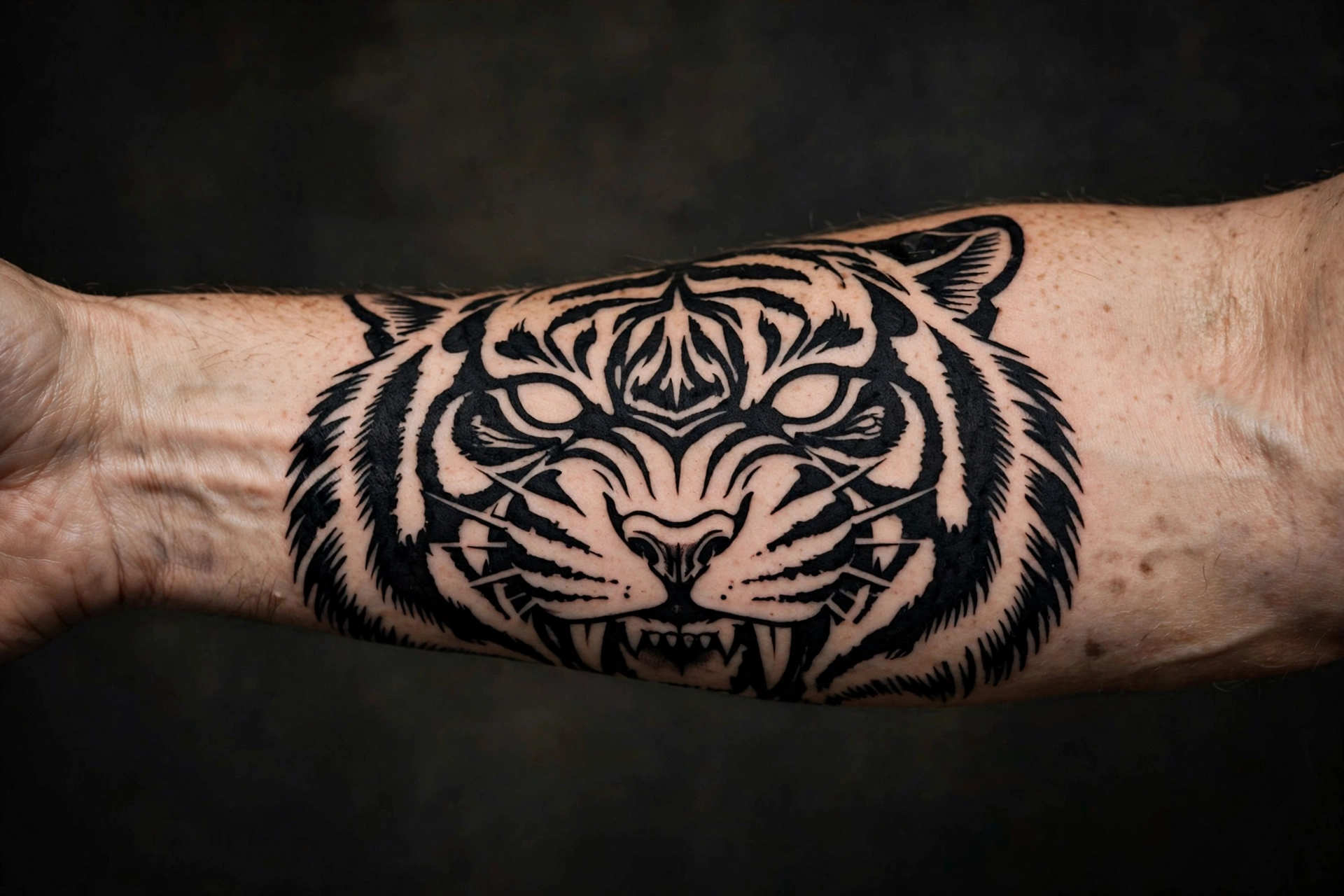
A blackwork tiger trades colour for contrast. Solid black stripes and dark shapes carry the design, with open, uninked gaps forming the face, the fur, and the space around the eyes.
This version suits a forearm or upper arm, where the dark areas have room to breathe. The open gaps matter as much as the ink. If every stripe is filled solid and the gaps are too narrow, the tiger can turn into one dark block. Ask your artist to leave clear channels of skin between the stripes, so the face keeps its form.
Design note: Blackwork ages well when the shapes are bold. Avoid very thin black lines inside a solid design, as they can close up over time.
5: Tiger Eye Close-Up

A tiger eye close-up uses one eye, a few stripes, and the fur around it, instead of the whole face. It is a smaller, more focused design, and it works because a tiger’s eye is so distinctive: amber, sharp, and framed by strong dark markings.
It suits the inner forearm or the wrist, where a full face would feel crowded. The eye should sit flat against the arm, with the stripes running in the direction of the forearm rather than across it. Keep the surrounding fur simple, so the eye stays the clear centre of the piece.
Design note: Check the size on your skin first. An eye that looks striking on a screen can feel small once it is on a forearm, and enlarging it slightly often helps it read better.
6: Tiger and Peony

A tiger with a peony softens the animal without weakening it. The large, open flower sits below or beside the tiger’s face, and its soft petals contrast with the sharp stripes and the steady gaze.
This works well as a full forearm composition. The tiger stays the main subject, with the peony as a second focal point lower down the arm. Leaves can connect the two, so the flower feels like part of the design rather than an extra piece added underneath. Keep the peony to one large bloom, so the tiger and the flower stay in balance.
Design note: Decide how much attention you want the flower to receive. A large open peony makes it a co-star; a smaller bloom keeps the tiger firmly in charge.
7: Small Minimal Tiger
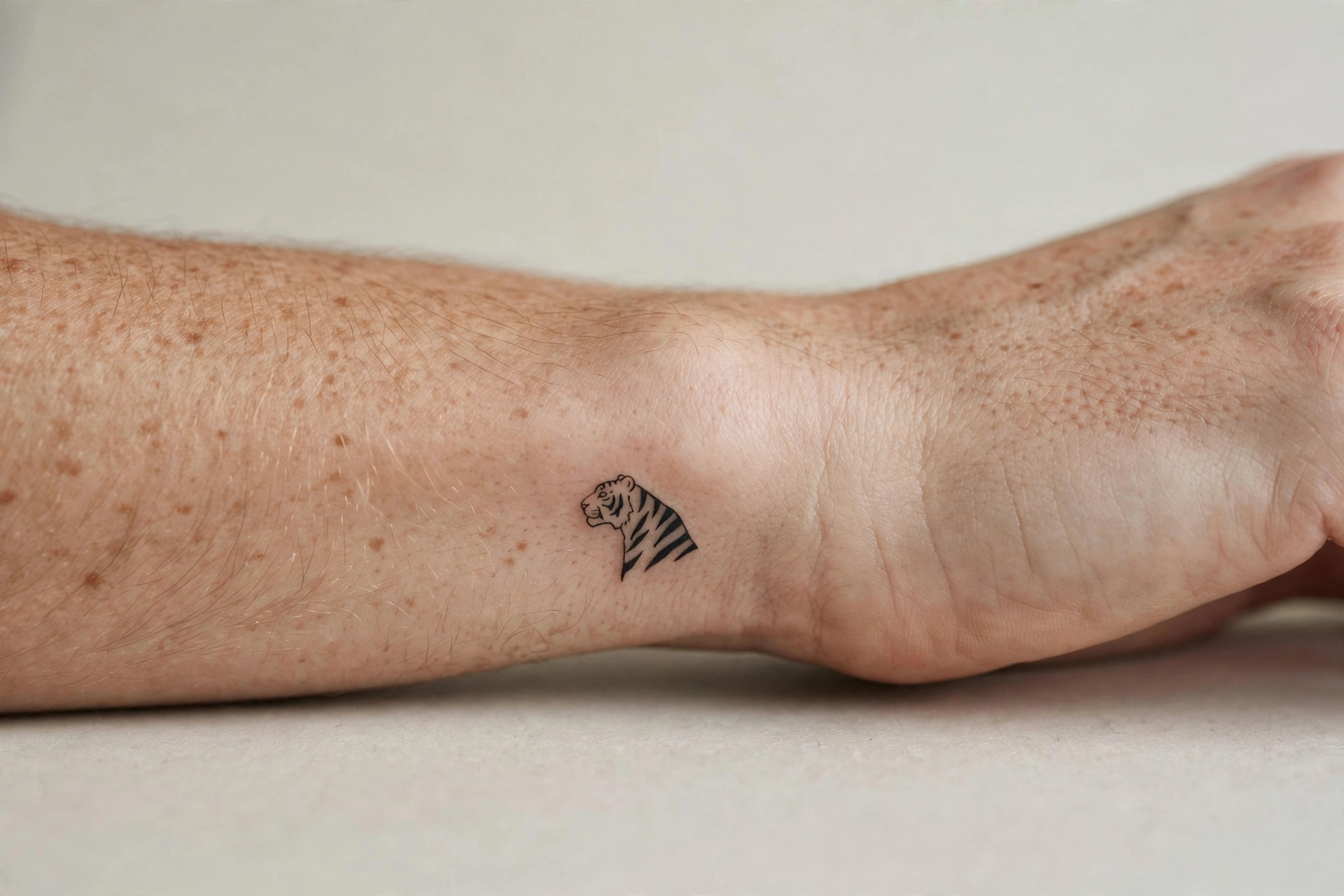
A small minimal tiger is a single head or a simple crouching shape, drawn with clean lines and very little shading, at about the size of a coin or a little larger. It is a good first tattoo because the commitment is low and the placement is easy to cover if you need to.
Good spots are the wrist, ankle, behind the ear, and the top of the shoulder. The design should be simple enough to read at that size: a clear face, a few stripes, and no more than a hint of fur texture. Fine detail that looks good enlarged will often disappear at this scale.
Design note: Keep the stripes to a few bold ones. Too many thin stripes on a small tiger can blur together as the tattoo ages, while a clean outline keeps the shape readable for longer.
Choosing Your Tiger Tattoo
If you keep coming back to bold designs, start with the realistic tiger face or the blackwork tiger. If you want something more graphic, compare the geometric tiger with the tiger eye close-up. The tiger and bamboo and the tiger and peony are the clearest choices if you want a fuller composition, while the small minimal tiger is the best option if you want the animal without the size.
Save two designs you like most and note what draws you to each: the stripes, the expression, the size, or the extra motif. Those specific preferences give your artist a useful starting point for a tiger tattoo that feels like your own.